


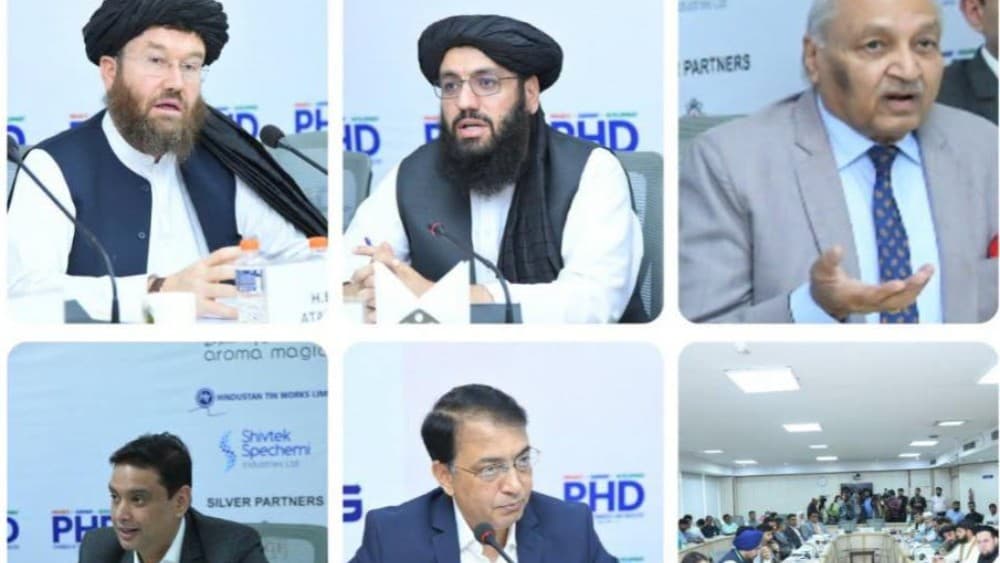
When Taliban Agriculture Minister Mawlawi Attaullah Omari visited India this week, he offered what appeared to be an enthusiastic endorsement of the relationship between the two countries.
Afghanistan and India, he said, share "one DNA."
He spoke warmly of the hospitality he received in New Delhi, describing the two nations as bound by history, culture and shared civilizational ties. The remarks came as the Taliban seek stronger economic engagement with India through trade and investment.
Diplomatically, the statement was intended to build goodwill.
Politically, however, it invites a deeper question: what exactly did Omari mean by "one DNA"?
Perhaps more than he intended.
Since returning to power in August 2021, the Taliban regime has imposed one of the world's most restrictive systems of governance for women. Girls have been barred from secondary schools and universities. Women have been excluded from most forms of employment, prohibited from visiting parks, gyms and beauty salons, and subjected to increasingly strict morality regulations.
The United Nations has repeatedly described Afghanistan as facing the world's most severe women's rights crisis, while UN experts have warned that the Taliban's policies amount to systematic discrimination and may constitute gender persecution under international law.
India presents a fundamentally different political system. It remains a constitutional democracy with regular elections, an active judiciary and an independent media landscape.
Yet under Prime Minister Narendra Modi's government, human rights organisations, civil society groups and UN experts have repeatedly raised concerns about rising religious polarisation, increasing pressure on minorities and shrinking space for dissent.
Critics frequently point to the 2002 Gujarat riots, in which more than 1,000 people, most of them Muslims, were killed, as well as more recent allegations of discrimination, hate speech and communal violence targeting India's Muslim minority.
These are not identical governments.
Nor are they driven by the same ideology.
The Taliban derive legitimacy from an uncompromising interpretation of Islamic law. The Bharatiya Janata Party (BJP) draws political support from Hindutva, a Hindu nationalist ideology that its supporters describe as a cultural identity and critics argue has increasingly marginalized religious minorities.
The differences matter.
But so do the similarities their critics identify.
The first concerns the treatment of women.
In Afghanistan, restrictions are explicit and codified through Taliban decrees. Women have been systematically excluded from education, employment and much of public life.
In India, women's rights advocates point to persistent gender-based violence and argue that communal politics have disproportionately affected women from minority communities, although the legal and constitutional framework protecting women's rights remains fundamentally different from Afghanistan's.
The second concerns dissent.
UN reports have documented Taliban repression of journalists, protesters, political opponents and religious minorities. Independent media in Afghanistan has shrunk dramatically under Taliban rule, with journalists facing arrests, intimidation and censorship.
In India, international rights organizations and press freedom advocates have raised concerns over the treatment of journalists, activists and opposition figures, citing the use of anti-terror and national security laws, restrictions on civil society organizations and increasing pressure on independent media. The Indian government has consistently rejected accusations that democratic freedoms are under threat.
These comparisons should not erase the profound differences between Afghanistan and India.
Afghanistan today is governed by an unelected Taliban regime that seized power through force and has not sought an electoral mandate. India remains an electoral democracy with functioning institutions and constitutional protections, even as critics debate whether those institutions are under growing strain.
Yet Omari's remark remains striking precisely because it unintentionally invites comparisons that neither Kabul nor New Delhi may have wished to encourage.
His words were intended to celebrate friendship.
Instead, they have drawn attention to a broader conversation about ideology, governance and the treatment of those who stand outside the dominant political narrative.
If there is indeed "one DNA" linking the two governments, it is unlikely to be the shared civilization Omari had in mind.
It is, rather, the increasingly familiar tendency of ideological states, whatever their religion or political identity, to centralize power, narrow the space for dissent and define national belonging in increasingly exclusionary terms.
That is a comparison worth examining, not because the two systems are identical, but because history shows that when governments begin measuring citizenship through ideology instead of rights, the people who suffer first are almost always those with the least power.