


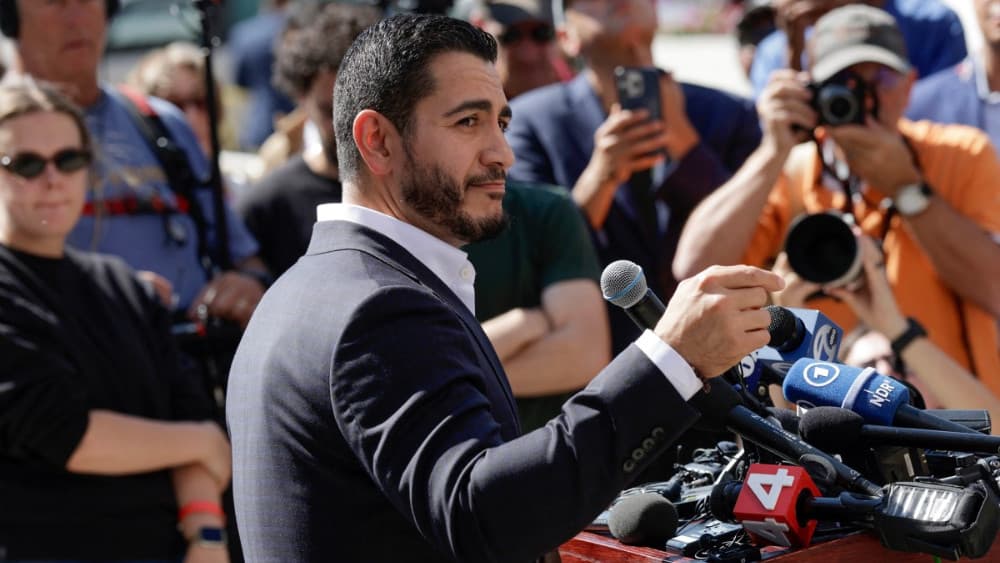
ISLAMABAD: For most of his adult life, Abdul El-Sayed has treated public health as a matter of systems and structures: infant mortality rates, lead in water pipes, and the economics of medical debt.
On Aug 4, voters in Michigan, a state in the northern United States bordering Canada, handed him a different kind of system to fix: the US Senate, the upper chamber of the US Congress, where each of the country's 50 states elects two members.
Career and achievements
According to a New Yorker interview, El-Sayed was born on October 31, 1984, in Rochester Hills, a Detroit suburb. His parents include an Egyptian-born engineer and a psychiatric nurse practitioner.
He went on to study biology and political science at the University of Michigan before winning a Rhodes Scholarship, a prestigious postgraduate award, to study at Oxford University in England, where he earned a doctorate in public health in 2011, according to his Columbia University alumni profile.
He later trained as a physician at Columbia University in New York, receiving his medical degree in 2014 and joining its faculty as a professor of epidemiology, according to the university's alumni magazine.
His path into government began in 2015, when Detroit's mayor appointed him the city's top public health official at age 30, according to City of Detroit municipal records.
Over roughly 18 months in the role, he secured a $10 million pollution-reduction commitment from an oil refinery and expanded lead testing in Detroit public schools, according to records from the Michigan Department of Environment, Great Lakes, and Energy (EGLE), the state environmental agency.
He resigned in February 2017 to run for governor of Michigan, finishing second in the 2018 Democratic primary, based on City of Detroit employment records and certified Michigan Department of State election results.
Between campaigns, El-Sayed built a national profile as a television commentator and podcast host, according to a New Yorker interview. He also taught public policy at the University of Michigan, according to the Ford School.
In December 2022, he returned to government to lead the health department of Wayne County, home to Detroit, a post he held until April 2025, according to records at the Wayne County government portal.
There, he directed public funds toward a program that erased $57.4 million in medical debt for about 83,000 residents, based on Wayne County government records. This was short of the $700 million figure he has publicly cited, which Bridge Michigan's fact-checkers say represents the program's target rather than debt already cleared.
US Senate race
El-Sayed narrowly won the Democratic Party's nomination for one of Michigan's two Senate seats on Aug 4, defeating sitting congresswoman Haley Stevens by about one percentage point: 740,950 votes (48.5%) to 726,057 (47.5%), according to CNN.
He now faces Republican candidate Mike Rogers in the general election in November, when American voters will decide which party controls the US Senate.
Campaign promises
His campaign centered on health care costs, corporate influence in politics and the cost of living rather than his religion, though commentators have compared his rise to that of Zohran Mamdani, the first Muslim mayor of New York City
.
He supports a government-run, single-payer health insurance system similar to those in some European countries, based on his campaign policy materials and published health care proposals.
He has called for conditioning US military aid, including to Israel, on human rights compliance.
A potential historic first
No Muslim has ever served in the US Senate, based on a review of the Congressional Research Service's "Membership of the 118th Congress: A Profile," which documents the religious affiliations of serving lawmakers.
If El-Sayed wins in November, he will become the first Muslim senator in US history.