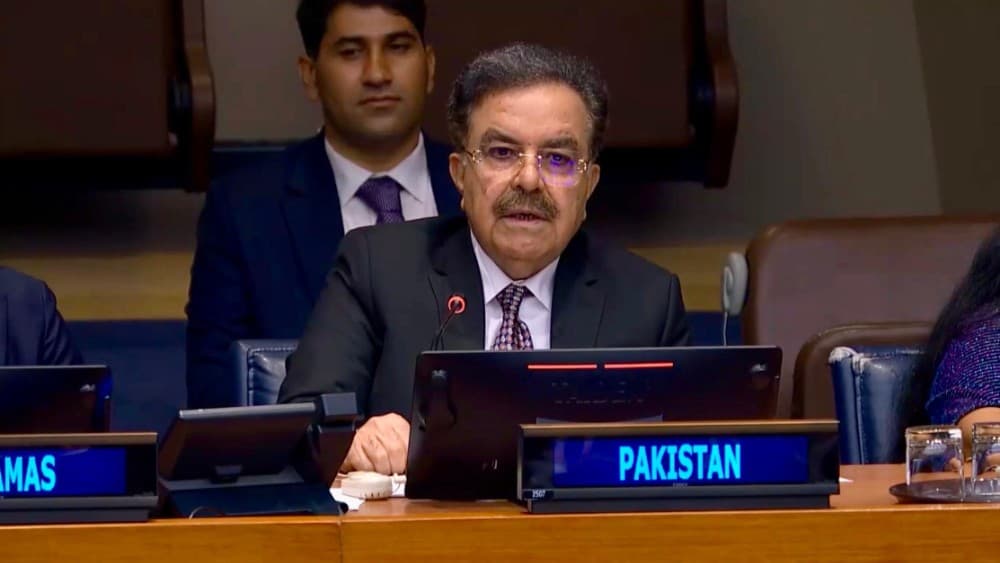
ISLAMABAD: Balochistan Governor Sheikh Jaffas Khan Mandokhail has called on young people to play a central role in shaping the future of artificial intelligence, stating that the AI revolution must be "inclusive, ethical, and human-centered."
Addressing the “Youth and AI Summit at the United Nations on International Youth Day”, the governor highlighted Pakistan’s young population, saying nearly 70% of the country’s population is under the age of 30.
He said, “Artificial intelligence presents Pakistan with an extraordinary opportunity to harness its demographic strength and accelerate the transition towards a knowledge-based economy.”
Referring to Pakistan’s National AI Policy, Sheikh Jaffar said the country aims to train “one million AI professionals by 2030”, while expanding AI education, research, innovation, and cooperation between the government, academia, and industry.
The governor also highlighted initiatives aimed at improving AI literacy and future skills among Pakistani youth, citing the recent **Indus AI Week in Islamabad** as an important platform for bringing together policymakers, startups, academia, industry, and international partners.
Speaking in his capacity as Governor of Balochistan, he said that technology could help overcome geographical and connectivity barriers faced by young people in the province.
He stressed that a young person in “Quetta, Gwadar, Turbat, or a remote district of Balochistan” should have the same opportunity to acquire skills, innovate and compete globally as young people elsewhere.
Sheikh Jaffar cautioned, however, that AI could become an equalizer only if access to technology is itself equitable.
He called for developing countries to gain better access to digital infrastructure, computing capacity, skills, financing, and knowledge, warning that unequal access could widen existing economic and technological disparities.
The governor said, "AI has the potential to improve education and healthcare, strengthen climate resilience, generate productive employment, enhance public services, and accelerate progress towards the Sustainable Development Goals."
He also emphasized the importance of giving developing countries and young people a meaningful voice in global AI governance.
Welcoming the establishment of the “UN Independent International Scientific Panel on AI” and the “Global Dialogue on AI Governance,” he said that international processes should help bridge the AI divide and ensure broader participation in decisions concerning the development and regulation of artificial intelligence.
Addressing young participants, Sheikh Jaffar said the future of AI should not simply happen to their generation, but should be shaped by them.
“Learn, question, innovate and lead,” he urged, calling on youth to use technology not only to develop smarter machines but also to build fairer societies, stronger communities and a more sustainable world.
He reaffirmed Pakistan’s readiness to work with the United Nations, member states, academia, industry and young people to ensure that the age of artificial intelligence delivers greater opportunity, inclusion and human progress for all.




.jpg&w=3840&q=75)