


ISLAMABAD: A growing number of Bollywood actors have publicly criticized the Indian government's handling of student protests and the police crackdown on demonstrators in New Delhi, marking one of the strongest collective responses from the Indian film industry in recent years.
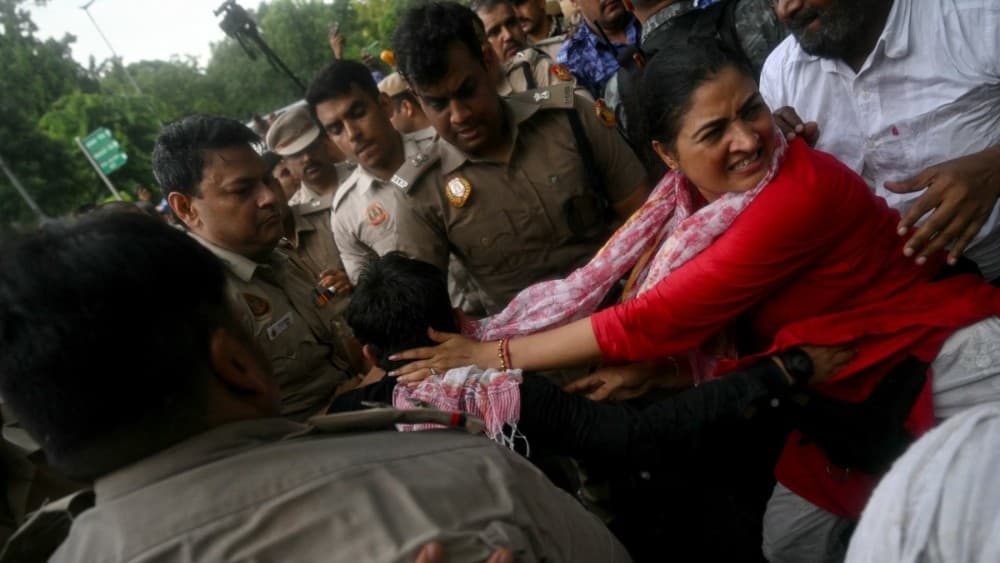
The demonstrations were organized by the Cockroach Janta Party (CJP) and student groups over alleged irregularities in the National Eligibility-cum-Entrance Test (NEET) and included demands for education reforms and the resignation of India's Union Education Minister Dharmendra Pradhan. The protests coincided with activist Sonam Wangchuk's indefinite hunger strike and were followed by clashes after police used tear gas and batons to disperse demonstrators marching towards Parliament. Indian Opposition Leader Rahul Gandhi also joined the protest and faced brief detention by police.
Veteran actor Naseeruddin Shah delivered one of the sharpest rebukes, expressing solidarity with protesting students and thrashing the authorities for treating them with brutality. In a video message, Shah said his “full sympathy” was with the students, praised their courage, and urged them not to lose hope.
Condemning the police action, he compared masked security personnel wielding batons to US immigration enforcement officers and told the government that “everything will be remembered.”
Veteran actress Shabana Azmi joined protesters at Delhi's Jantar Mantar, calling peaceful protest a constitutional right and urging authorities to listen to students' concerns instead of suppressing dissent.
Actor Prakash Raj, a frequent critic of Prime Minister Narendra Modi's government, marched alongside protesters carrying a copy of the Indian Constitution and called for accountability, saying he will continue to empower the youth who are fighting for their future.
Filmmaker Anurag Kashyap criticized the reported police action against demonstrators, accusing authorities of using excessive force and saying dissent should not be criminalized.
Actor Pooja Bhatt condemned the use of force against students, saying state violence was often justified under the guise of maintaining law and order.
Sonakshi Sinha shared an emotional message recalling the violence during the July 20 protest, while Aditi Rao Hydari appealed for dialogue, saying humanity must rise above politics and students deserve dignity and empathy.
Bollywood actress Preity Zinta also joined the growing list of celebrities backing the student movement. In a post on X, she urged activist Sonam Wangchuk to end his hunger strike while appealing to the Indian government to begin a meaningful dialogue with Wangchuk and student groups.
“You and the students are fighting for the future of India and for our youth,” she wrote, extending her “heartfelt and unwavering support” to the protesters and calling for reforms to strengthen India's education system.
Actor Sonu Sood urged authorities to embrace students “with arms, not batons,” while Dia Mirza condemned the reported use of force and called for transparency and reforms in the education system.
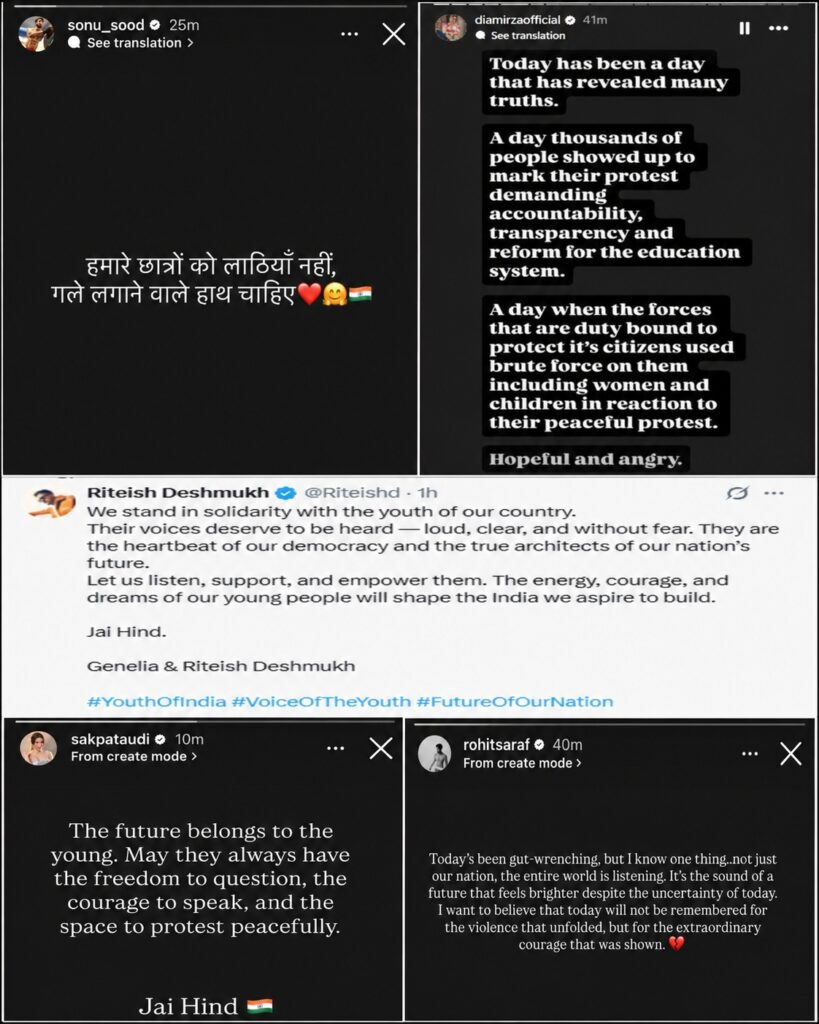
Actors Riteish Deshmukh and Genelia Deshmukh issued a joint statement saying the country's youth deserve to be heard “loud, clear and without fear,” describing them as the architects of India's future.
Singer-actor Diljit Dosanjh also criticized the police action, urging authorities to listen to students rather than silence them. He said he expected to be labelled “anti-national” again, recalling the backlash he faced after supporting the farmers' protests.
Among other prominent voices, Huma Qureshi, Soha Ali Khan, Richa Chadha, Bhumi Pednekar, Revathy Asha, Swara Bhasker, and television personality Ranjini Haridas also expressed support for the protesters and criticized the reported use of excessive force.
The wave of statements has prompted debate over whether Bollywood is becoming more willing to publicly challenge the Modi government after years of relative silence on politically sensitive issues.
Khans stay mum
While a growing number of Bollywood personalities have publicly backed the student movement, the continued silence of some of India's biggest stars has drawn criticism on social media and in sections of the Indian media.
Commentators argue that actors with the country's largest platforms have remained absent from major public debates, including the alleged NEET paper leak controversy, the farmers' protests, the #MeToo movement, the Hema Committee report on the Malayalam film industry, and the Citizenship Amendment Act (CAA) protests.
The criticism has been directed particularly at superstars Shah Rukh Khan, Salman Khan and Aamir Khan, whose silence has been contrasted with the outspoken positions taken by actors such as Naseeruddin Shah, Shabana Azmi, Prakash Raj and Anurag Kashyap.
Critics argue that while India's biggest stars command enormous influence through films, advertising and social media, they have largely avoided commenting on politically sensitive issues, prompting questions over whether silence has become their preferred strategy in an increasingly polarized environment.