


ISLAMABAD: Abhinandan Varthaman, the Indian fighter pilot who became a household name after being captured by Pakistan during the 2019 India-Pakistan aerial confrontation, has taken premature retirement from the Indian Air Force and begun a new career flying civilian aircraft.
The former Indian Air Force Group Captain and Vir Chakra awardee has joined Goa-based regional airline FLY91 as a commercial pilot, according to Indian media reports citing sources.
Varthaman, 43, retired from the IAF on March 31, 2026, after nearly 22 years of service and subsequently joined FLY91 in August. He is currently undergoing training required for commercial operations, with the airline confirming his association but declining to provide further details, citing employee privacy.
His transition marks a striking turn in the career of an officer whose name became inseparable from one of the most politically charged India-Pakistan military confrontations of the past decade.
In February 2019, Varthaman was flying a MiG-21 Bison during an aerial confrontation between Indian and Pakistani aircraft following India's Balakot strikes. His aircraft was hit and he ejected over Pakistan territory, where he was captured.
Pakistan has maintained that its Air Force shot down Indian aircraft during the February 27 confrontation, while India has presented a different account of the engagement and credited Varthaman with shooting down a Pakistani F-16 before his own aircraft was brought down. The competing claims surrounding the encounter have remained a point of dispute between the two countries.
Varthaman was held by Pakistan for roughly three days before being returned to India on March 1, 2019. His capture and subsequent release turned him into a highly recognizable figure in India, while footage from his detention also became one of the most widely circulated visual episodes of the crisis.
One particular moment acquired a life of its own.
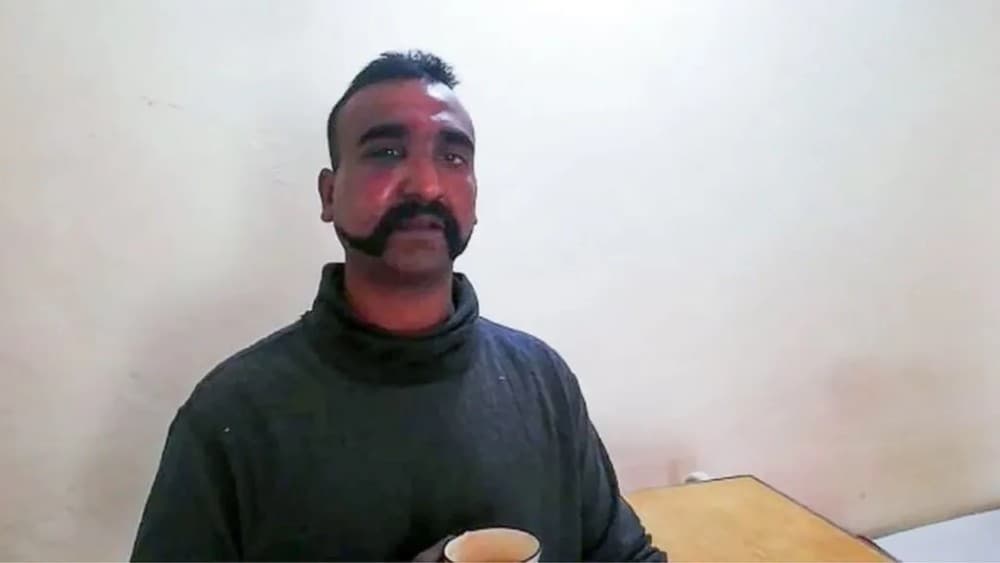
While in Pakistani custody, Varthaman was filmed answering questions about his treatment. Holding a cup of tea, he described the beverage as “fantastic” and praised the Pakistani military officers who had looked after him.
“I would like to put this on record, and I will not change my statement if I go back to my country also. The officers of the Pakistani Army have looked after me very well. They are thorough gentlemen, starting from the captain who rescued me,” he said.
The image was striking for another reason: amid one of the most dangerous military crises between the nuclear-armed neighbors, a captured fighter pilot appeared calm, composed and remarkably restrained.
For Pakistan, the episode became part of a broader narrative about military capability coupled with restraint. Islamabad repeatedly portrayed Varthaman's release as a gesture aimed at preventing further escalation, even as the two sides exchanged sharply conflicting accounts of the aerial confrontation.
For India, meanwhile, Varthaman was transformed into a symbol of military valor. He received the Vir Chakra, India's third-highest wartime gallantry award, in 2021.
Yet more than seven years after the episode that made him internationally known, Varthaman has now left the service he represented.
His move to FLY91 places him in a very different cockpit. Instead of flying a MiG-21 on combat missions, he is preparing to operate an ATR 72-600 turboprop on regional civilian routes.
The change is also revealing in the way the Indian media continues to frame his legacy. Much of the coverage announcing his departure from the IAF remains anchored to the February 2019 confrontation, underscoring how deeply a single episode has defined his public identity.
The irony is difficult to miss.
A pilot whose military career became globally recognizable because he was shot down, captured and later returned to India is now moving into an aviation career where the stakes are measured not by combat sorties and aerial engagements, but by passengers, schedules and safe landings.