


ISLAMABAD: India’s Declassified: Operation Sindoor presents itself as a definitive account of the military operation launched against Pakistan in May 2025. But a closer examination of the film’s own timeline, official statements and claims leaves several important questions unanswered.
Released on August 15, on India’s Independence Day, the documentary was produced by Prabhu Asgaonkar and Maneka Berry Asgaonkar in coordination with the Indian Army’s Additional Directorate General of Public Information (ADG PI).
It features interviews with nearly 20 serving and retired senior Indian military officers, including a former military chief, service chiefs, directors general of military operations, fighter pilots and India’s national security advisor.
Presented as an unprecedented first-hand account, the film attempts to establish a clear narrative of Operation Sindoor, portraying India’s military response as precise, overwhelming and strategically successful.
But the documentary’s account is challenged by its own chronology, statements from Indian officials and events that unfolded during the May conflict.
A timeline that raises questions
The documentary frames Operation Sindoor as a direct and immediate response to the April 22, 2025 Pahalgam attack.
Yet one central question remains: when did India formally identify those it held responsible for the attack?
New Delhi did not publicly name the three men it identified as responsible until July, roughly 82 days after the Pahalgam incident.
That means India launched its military operation against Pakistan on May 7, weeks before publicly identifying the men it later said were responsible for the attack.

.jpg)
Pakistan’s Information Minister Attaullah Tarar and the Inter-Services Public Relations (ISPR) have also separately raised questions about the chronology surrounding the Pahalgam incident, including the registration of the First Information Report.
Pakistan’s position has been that the FIR was registered within minutes of the attack, despite the location of the incident and the distance from the nearest police station.
Those discrepancies, Pakistan says, warrant closer scrutiny of the sequence of events and the evidence used to justify the subsequent military action.
Claims of a war without losses
At the heart of the documentary is its portrayal of Operation Sindoor as an overwhelming Indian success, with its officials asserting that targets were hit while Indian pilots and aircraft emerged without significant losses.
That account, however, sits uneasily alongside statements made by India’s own senior military leadership.
India’s then-Chief of Defense Staff General Anil Chauhan acknowledged in an interview with Bloomberg TV and Reuters at the Shangri-La Dialogue in Singapore on May 31, weeks after the conflict, that India had lost aircraft during the confrontation, attributing the losses to what he described as a “tactical mistake.”
Pakistan has consistently maintained that several Indian fighter aircraft were shot down during the confrontation, including Rafale jets. Pakistani officials publicly presented aircraft wreckage and cited tail numbers in support of their claims.
Several international media outlets have independently reported that India lost multiple Rafale fighter jets during the conflict, challenging the documentary’s portrayal of the operation as one without significant aircraft losses.
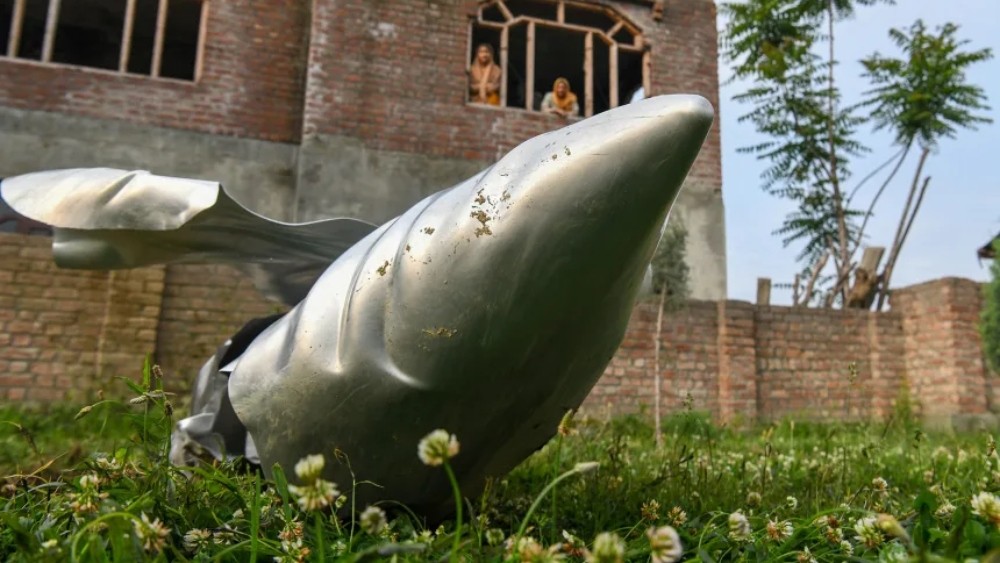 Wreckage of Indian Air Force fighter jet that crashed in Wuyan Pampore in Indian occupied Kashmir. (AFP/File)
The issue is further complicated by India’s subsequent disclosure of soldiers killed during the conflict, a development that also sits uneasily with an account that presents the operation almost entirely through the prism of so-called success.
The question is not simply what the documentary includes, but what it leaves out.
The documentary’s omissions also raise questions about whether its account fully reflects the events of the conflict. The issue is not simply whether the filmmakers were aware of evidence pointing to Indian aircraft losses, but why those claims and subsequent developments received little or no attention in the film.
The documentary’s portrayal also raises an operational question: if India suffered no significant aircraft losses, as the film suggests, why were Rafale operations reportedly curtailed during the conflict while drones and other platforms were increasingly used? That shift in operational posture warrants scrutiny, particularly against the documentary’s broader portrayal of an unambiguous Indian military success.
Against that backdrop, Pakistan TV Digital released “Four Nights: When Pakistan Roared” on the first anniversary of the May 2025 conflict, bringing together firsthand accounts from journalists, officials, analysts and witnesses to reconstruct the four days of fighting and examine how the confrontation unfolded.
The ceasefire account
The documentary also presents a version of events surrounding the eventual ceasefire that differs sharply from Pakistan’s publicly stated position.
According to the film, Pakistan’s military operation chief contacted his Indian counterpart to seek a ceasefire.
Pakistan’s military, however, had publicly stated during the conflict that it was exercising restraint at the request of the United States, provided India reciprocated.
The question of who initiated the ceasefire and how it was achieved became a major political issue after the fighting ended.
US President Donald Trump repeatedly said Washington had played a role in bringing the two sides to a ceasefire.
Pakistan publicly acknowledged the American role, while India rejected the characterization of the ceasefire as the result of third-party mediation and maintained that the understanding was reached through direct military communication.
The competing accounts remain central to how the May conflict is remembered.
Technology and selective silence
The documentary devotes considerable attention to Indian military technology, including the Integrated Air Command and Control System, airborne surveillance platforms, the Akashteer air-defense network and the BrahMos cruise missile.
But some of the systems most closely associated with the May confrontation receive little or no attention.
Among them are the French-made Rafale fighter aircraft and Russia’s S-400 air-defence system, both of which figured prominently in public discussion of the conflict.
That omission is significant because the performance and survivability of advanced military platforms became a central part of the competing narratives after the fighting.
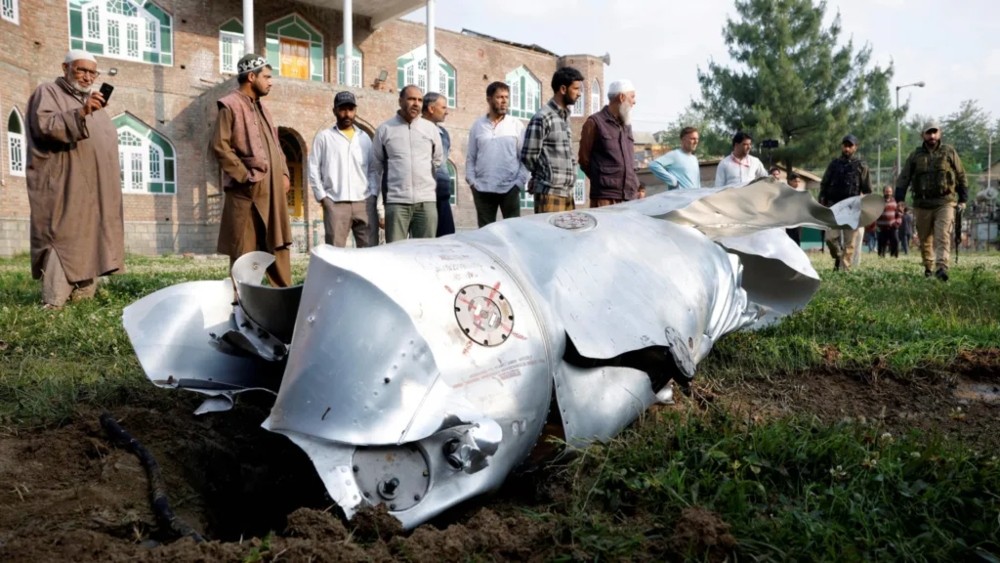 Metal debris lies on the ground in Wuyan in Indian-occupied Kashmir's Pulwama district. (Reuters/File)
The documentary also presents BrahMos as part of India’s military capability, although the cruise missile is developed by BrahMos Aerospace, a joint venture involving India and Russia.
The civilian cost
The documentary further presents Operation Sindoor as an operation directed exclusively at terrorist infrastructure, emphasizing precision technology and measures intended to avoid civilian casualties.
Pakistan’s account of the conflict is markedly different.
Pakistani authorities reported civilian deaths, including women and children, following Indian strikes. Pakistan also said several civilian sites, including mosques, were hit.
Funerals were held for those killed, while Pakistani authorities and media released images and footage from locations affected by the strikes.
For Pakistan, these casualties form an essential part of the record of May 2025 and cannot be separated from the military narrative surrounding the conflict.
What the documentary leaves behind
The May 2025 conflict, referred to in Pakistan as Marka-e-Haq, the Battle of Truth, was not simply another military exchange between India and Pakistan.
It involved direct strikes, aerial combat, missile launches, drone activity and exchanges along the Line of Control, bringing two nuclear-armed neighbors into their most serious direct military confrontation in years.
For Pakistan, the conflict culminated in Operation Bunyan Um Marsoos, which Islamabad says successfully responded to Indian aggression and established Pakistan’s military deterrence.
A documentary released a year later can offer one country’s interpretation of those events. But an interpretation is not the same as an uncontested historical record.
Declassified: Operation Sindoor puts forward India’s version of the May conflict. Pakistan TV Digital’s examination finds that several elements of that account require greater context, particularly the chronology leading to the operation, the aircraft losses, the circumstances of the ceasefire, the civilian toll and the selective treatment of military capabilities.
The significance of the film, therefore, lies not only in what it says, but also in what it does not say.
For Pakistan TV Digital, the responsibility of journalism is not to accept a government-produced narrative at face value, but to examine its claims against the available record.
A year after the guns fell silent, the competing narratives of May 2025 remain firmly entrenched. The task now is to ensure that the history of those four days is shaped by evidence and accountability, rather than by whichever version is repeated most effectively on screen.