


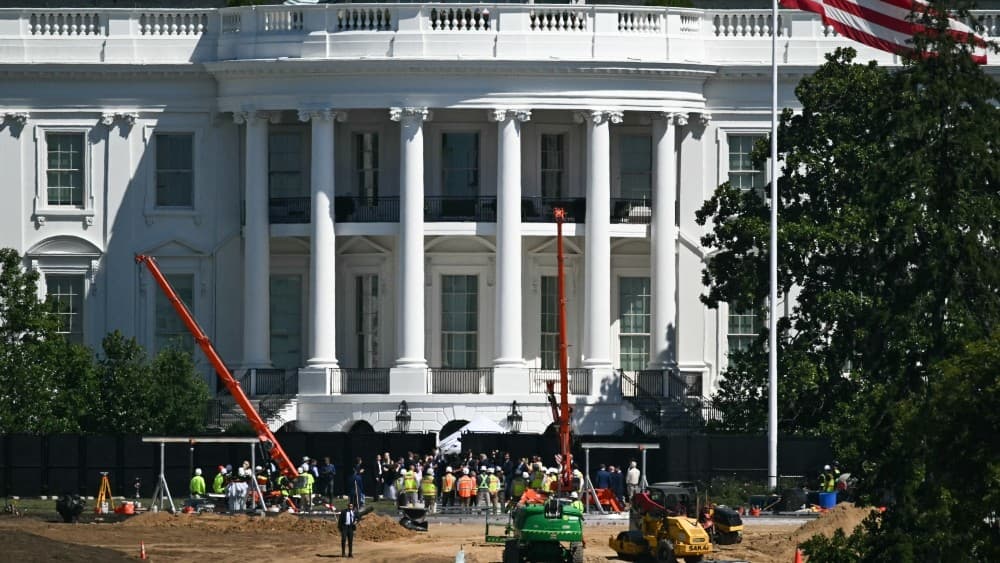
WASHINGTON: The US Supreme Court on Friday allowed construction of a massive White House ballroom to continue for now, temporarily lifting a lower court ruling that had demanded a halt to the building by midnight on Friday.
Chief Justice John Roberts’s one-sentence order means that work on the ballroom may proceed while litigation plays out in the lower courts.
Trump, in a post on Truth Social, said he was "grateful" for the Supreme Court decision.
"The Military/Ballroom Complex being built on the hallowed grounds of the White House, which is so vital for National Security, will be the greatest of its kind!" he said. "Construction is under budget and ahead of schedule."
The Trump administration asked the Supreme Court last week to allow it to finish building the ballroom and an underground bunker at the White House, saying the project was essential for national security.
Trump ordered the demolition of the entire historic East Wing of the White House last year — without input from Congress — to make way for his long-desired ballroom, but the project was quickly challenged in court.
A district court ordered a halt to work on the aboveground ballroom while allowing construction of the underground military bunker to proceed, but that order had been stayed while on appeal.
The appellate court recently upheld the lower court's order, agreeing that a White House overhaul required the consent of Congress, but gave the administration time to appeal to the Supreme Court.
Trump initially touted the construction of the ballroom as being necessary to host galas and state dinners, but has since repeatedly emphasized the addition of a sophisticated underground military bunker and other security features.
'Not a tenant'
Solicitor General John Sauer, in the appeal to the Supreme Court, also stressed the security aspects of the project and argued that the president has the authority to make changes to the White House.
"The President of the United States of America is not a tenant, but rather the sole, elected head of the Executive Branch, and Congress has authorized him to renovate, secure, and protect the White House and its grounds, as other Presidents have been allowed to do, without exception," Sauer said.
The project is already 65% complete, he said, and halting it "will stall this vital construction, making this president — the subject of recurrent assassination attempts — much less safe, and risking future presidents' safety."
Work on the ballroom began last year with the sudden demolition of the East Wing, which used to house the offices of the First Lady.
Trump has insisted that the ballroom will be privately financed, but according to media reports significant taxpayer funds are going to the project, which could cost as much as $600 million.
The ballroom is just one of Trump's moves to leave his mark on Washington by the time his second term ends in January 2029. They include renovation of the Lincoln Memorial Reflecting Pool, a White House helipad, work on public parks and plans to construct a gigantic downtown arch.
Several of the projects have similarly faced legal challenges, but the ballroom project is the first to reach the Supreme Court.