


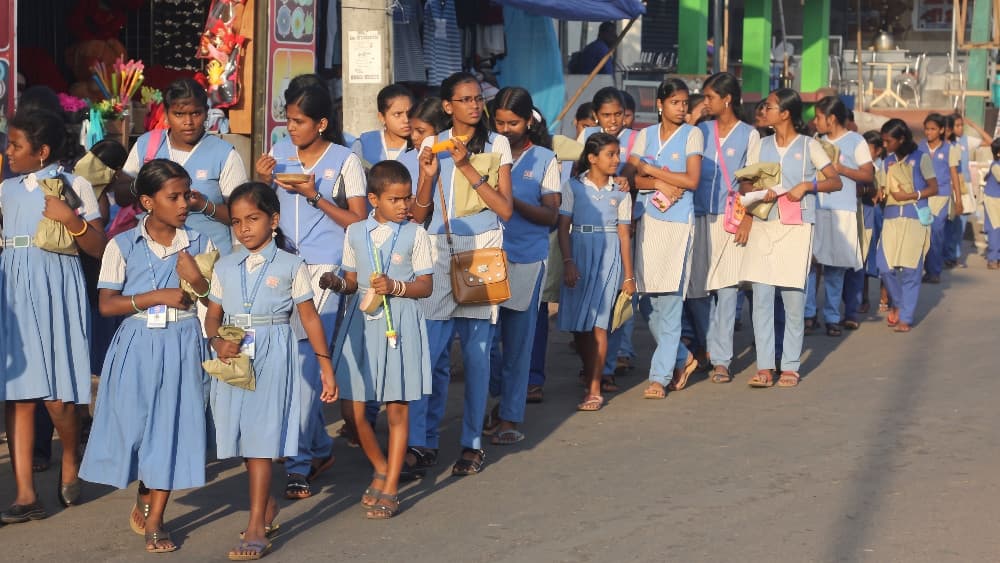
ISLAMABAD: India faces a cascading school sanitation deficit that exceeds global trends, with over 98,000 government schools lacking functional girls' toilets, according to the National Institution for Transforming India (NITI Aayog).
A Supreme Court of India ruling issued January 30, 2026, placed the crisis within a broader international education equity emergency, where deficient water and sanitation facilities prevent girls from completing schooling at rates far higher than boys.
The problem reflects a larger global challenge. Approximately 427 million children worldwide lacked basic sanitation services at school as of 2023, according to the WHO and UNICEF Joint Monitoring Programme.
Within that context, India's infrastructure failures are acute. The National Institution for Transforming India reported that 61,540 schools lack usable sanitation facilities entirely, while 119,000 schools have no electricity, 14,505 lack drinking water, and 59,829 lack handwashing stations.
School sanitation deficits disproportionately impact girls. In India, the National Institution for Transforming India reported that girls miss 1-4 school days per menstrual cycle. This translates to cumulative losses of up to 60 school days annually, nearly one-third of the academic year, affecting academic achievement and completion rates, according to NITI Aayog data.
.jpg)
.jpg)
The secondary education dropout rate for girls in India stands at 11.5%, compared to 0.3% in primary education, as per NITI Aayog. UNESCO's Global Education Monitoring Report found that when schools lack single-sex toilets and menstrual hygiene management facilities, girls remain "trapped in pockets of disadvantage," particularly in sub-Saharan Africa and South Asia.
India's infrastructure investment has been substantial but ineffective in maintenance. The Indian government spent $228.8 million on 140,000 toilets between 2014 and 2019 via the Swachh Vidyalaya Abhiyan initiative, as per the country’s education ministry.
However, maintenance budgets via Samagra Shiksha allocate only a few thousand rupees per school annually, according to Education Ministry data. This is insufficient to sustain functionality.
An audit by India's Comptroller and Auditor General examined 2,695 toilets across 2,048 schools in 15 states. The findings were stark: 11% remained incomplete, 30% sat unused, 72% lacked running water, 55% had no handwashing basins, and 75% were unhygienic.
According to UNICEF, basic sanitation means single-sex, usable facilities with water access, a definition nearly half of India's audited schools failed to meet.
The Supreme Court of India, in its January ruling, issued directives under articles 21 (right to life), 21A (right to free education), 14 (equality), and 15 (non-discrimination). The ruling addressed the constitutional violation inherent in denying menstruating girls access to safe, dignified sanitation during school hours.
This ruling aligns with Sustainable Development Goals 4 (quality education) and 6 (clean water and sanitation), according to UN documentation. UNESCO has stated that achieving universal WASH access by 2030 would require a two-fold increase in progress rates for sanitation and four-fold for hygiene.
India's trajectory suggests an institutional and budgetary recalibration is imminent.