


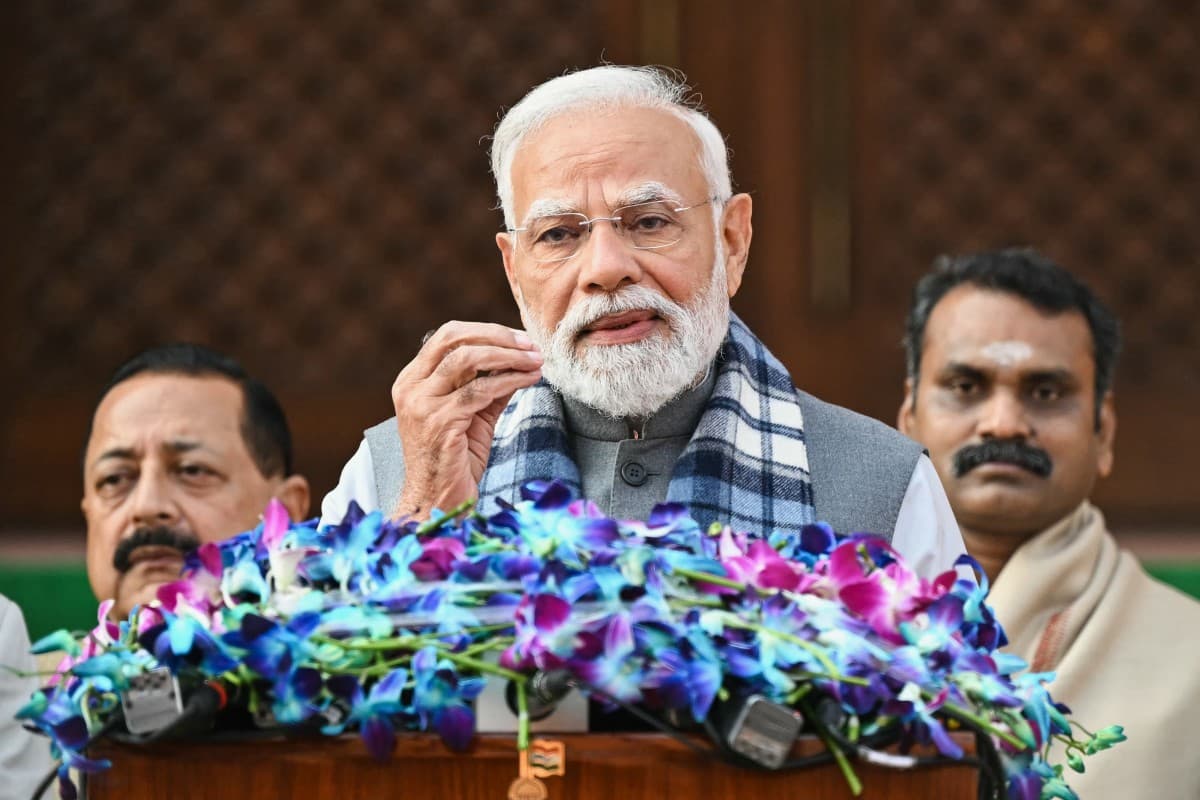
ISLAMABAD: Prime Minister Narendra Modi has reignited a decades-old debate over India’s national song, accusing the Congress leadership, particularly freedom fighter Jawaharlal Nehru, of “breaking” Vande Mataram in 1937 under pressure from the Muslim League, a decision he claimed later “paved the way” for Partition.
Speaking during a special 10-hour parliamentary sitting marking 150 years of the song, which translates as “I bow to you, Mother,” Modi claimed the Congress Working Committee’s 1937 decision to retain only the first two stanzas amounted to “appeasement politics.”
“The song was broken into pieces for political reasons,” Modi told lawmakers, alleging that the Congress “bowed to pressure” from Muhammad Ali Jinnah’s Muslim League.
The comments sparked an immediate pushback from the opposition.
Congress general secretary Priyanka Gandhi Vadra said Modi was rewriting history for political gain:
“By accusing the division of Vande Mataram, the BJP is accusing the entire Constituent Assembly, holding every one of its leaders guilty,” she said in Parliament.
What happened in 1937?
Vande Mataram, written in the 1870s by Bankim Chandra Chattopadhyay and published in the 1882 novel Anandamath, contains six stanzas. While the first two praise the motherland in broad, secular imagery, the remaining verses explicitly invoke Hindu goddesses such as Durga, according to Encyclopaedia Britannica.
By the mid-1930s, the All-India Muslim League objected to the latter verses, calling them incompatible with Islamic monotheism.
In a 1938 speech, Jinnah denounced the composition as:
“Not only idolatrous but, in its origin and substance, a hymn to spread hatred for the Muslims,” according to historical archives The Voice.
Responding to these concerns, the CWC met on October 26,1937 and resolved that only the first two stanzas would be used at Congress-led national events. The party emphasized the remaining stanzas were not banned, organizers were free to use them, but they would not represent the Congress in official settings.
A key voice behind this compromise was Rabindranath Tagore. Three days before the CWC meeting, Tagore wrote to Nehru arguing that the religious verses risked alienating Indian Muslims:
The first part expressed “tenderness and devotion” to the motherland, he wrote, but he had “no sympathy” for the later stanzas, having been “brought up in the monotheistic ideals” of his father, historian Sabyasachi Bhattacharya wrote in “Vande Mataram: The Biography of a Song.”
Harvard historian Sugata Bose later confirmed that both Subhas Chandra Bose and Nehru consulted Tagore before finalizing the decision:
“It was on Tagore’s advice that Congress decided to sing only the first part at national meetings,” he said in an interview to Indian Express.