


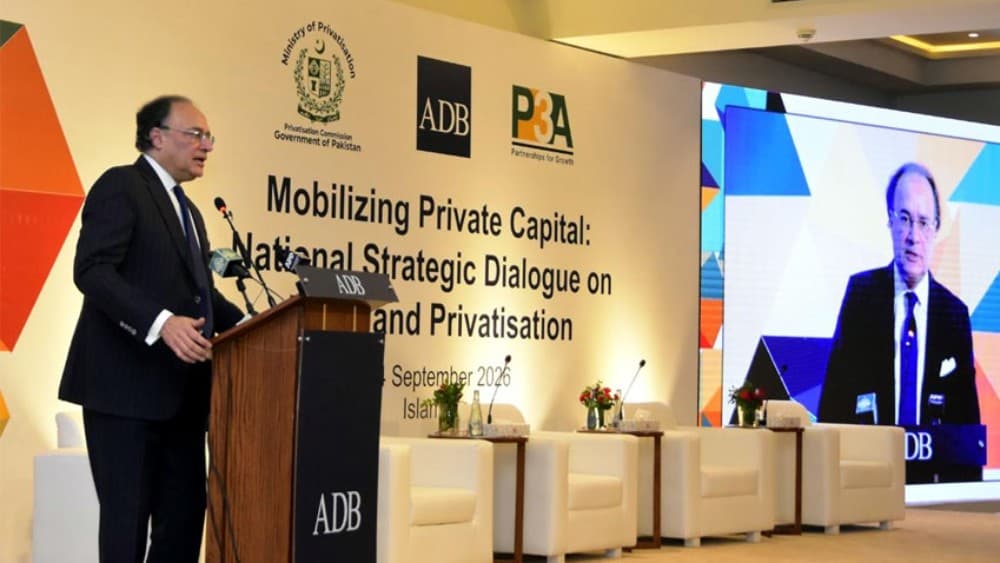
ISLAMABAD: Pakistan’s Finance Minister Muhammad Aurangzeb on Friday reaffirmed the government’s commitment to privatization and public-private partnerships as part of efforts to mobilize private capital and drive economic growth, according to Radio Pakistan.
Speaking at an event organized by the Asian Development Bank in Islamabad, Aurangzeb said the government’s priorities include enabling the private sector to lead economic growth, maintaining the pace of structural reforms and avoiding a return to the country’s recurring boom-and-bust economic cycles.
"We want to stay the course on structural reforms and ensure that we do not go back to boom-and-bust cycles," Aurangzeb said.
The minister highlighted improvements in Pakistan’s fiscal position, saying government revenues have increased by 40% over the past two years while efforts to control expenditures continue.
He said the country’s tax-to-GDP ratio currently stands at 10.3%, with a short-term target of increasing it to between 11% and 12%.
Aurangzeb also pointed to the technology sector as a source of growth, saying information technology exports reached $4.6 billion during the last fiscal year. Freelancers accounted for $1.6 billion of those exports, he said.
The finance minister said the government is targeting economic growth of more than 4% during the current fiscal year.
Pakistan’s foreign exchange reserves stood at $18.5 billion as of June 30, Aurangzeb said, adding that the government aims to increase reserves to $21 billion by the end of the current fiscal year.
Speaking at the same event, Adviser on Privatization Muhammad Ali said Pakistan’s future economic growth would be led by the private sector rather than the public sector in terms of business activity.
Ali said the federal Public-Private Partnership Authority, known as P3A, is being consolidated under the Privatization Division. The move is intended to simplify procedures, improve coordination and increase efficiency in public-private partnership projects, he said.
He added that 38 projects worth $6.5 billion are currently operating in PPP mode across sectors including roads, railways, hospitals, hospitality, aviation and industrial estates.
On privatization, Ali said the government is working on 27 transactions involving assets and entities including power distribution companies, airports, insurance companies and banks.
He pointed to the recent sale of Pakistan International Airlines as evidence that the country has the capacity and commitment to privatize state-owned assets.
The government has increasingly emphasized private-sector participation as a means of reducing the fiscal burden on the state, attracting investment and supporting longer-term economic growth.