


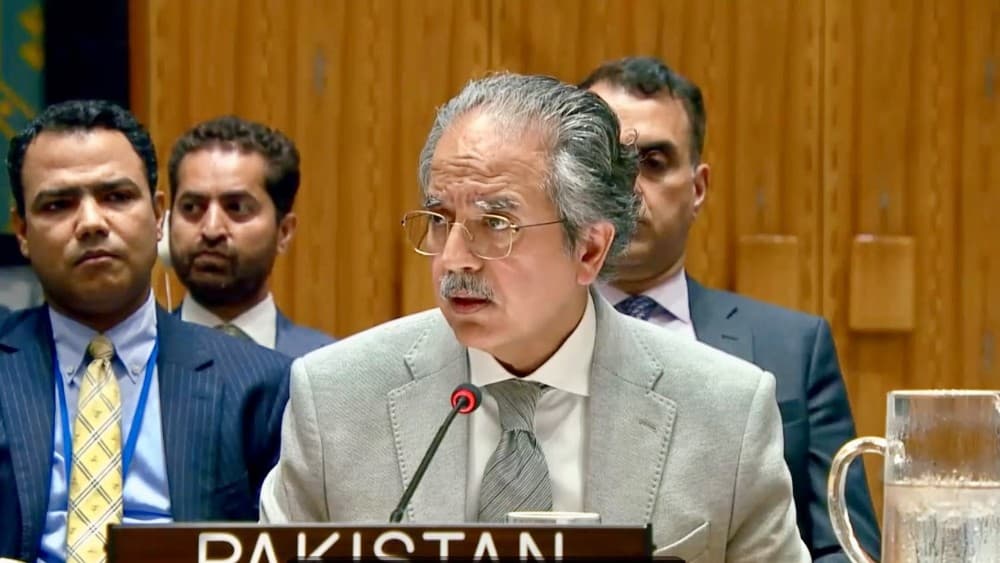
ISLAMABAD: Pakistan has called on the UN Security Council to ensure that natural resources become a source of peace and sustainable development rather than conflict, coercion, or exploitation, and has strongly condemned India's unilateral move to place the Indus Waters Treaty in abeyance.
Addressing a UN Security Council debate chaired by the Democratic Republic of the Congo, Pakistan's envoy to the UN, Asim Iftikhar, said that India is attempting to "weaponize water" by unilaterally and illegally placing the Indus Waters Treaty in abeyance.
Rejecting the move, he said it threatens the livelihoods of more than 240 million Pakistanis.
“Indus Waters Treaty remains valid, binding, and fully in force,” he maintained, adding that the August 2025 Award of the Court of Arbitration reaffirmed its legal status.
He stressed that no country should use shared water resources as a tool of coercion or political pressure in violation of treaty obligations.
Implications for regional peace
Pakistan also warned that the issue carries serious implications for regional peace and security due to its connection with the longstanding Jammu and Kashmir dispute.
Calling for greater UN Security Council vigilance, the envoy urged the Council to utilize preventive diplomacy, peaceful dispute resolution, sanctions regimes, and monitoring mechanisms where the exploitation or weaponization of natural resources threatens international peace and security.
He reaffirmed Pakistan's commitment to working with the international community to ensure that natural resources support sustainable development, shared prosperity, and lasting peace.
Illicit exploitation of natural resources must be curbed
Ambassador Iftikhar said that the growing global competition for critical minerals, driven by the transition to clean energy, artificial intelligence, and advanced manufacturing, must not come at the expense of international law or the rights of developing countries.
He said, “Weak governance, illicit extraction, external interference, and unequal distribution of resource benefits continue to fuel instability, particularly in Africa.”
Referring to the Democratic Republic of the Congo, he stressed that stronger traceability mechanisms, responsible supply chains, and regional cooperation were essential to curb the illicit exploitation of natural resources that finances armed groups.
The Pakistani envoy emphasized that resource-rich developing nations should become equal partners in global value chains through responsible investment, local processing, technology transfer, skills development, and equitable revenue sharing.
Highlighting the importance of international law, he reaffirmed the principle of permanent sovereignty over natural resources as enshrined in UN General Assembly Resolution 1803, urging respect for national ownership and policy space.
No provision for treaty abeyance
Later, exercising its right of reply, Pakistan rejected what it described as India's "misleading" remarks at the Security Council, reiterating that the Indus Waters Treaty contains no provision allowing it to be placed in abeyance.
Pakistan said the August 2025 Court of Arbitration award reaffirmed the treaty's validity and accused India of using shared water resources for political coercion.
Responding to India's allegations on terrorism, Pakistan claimed India was sponsoring militant proxies targeting Pakistan and alleged human rights violations in Indian Illegally Occupied Jammu and Kashmir.
It urged India to fulfill its obligations under international law, the UN Charter, and relevant UN Security Council resolutions.