


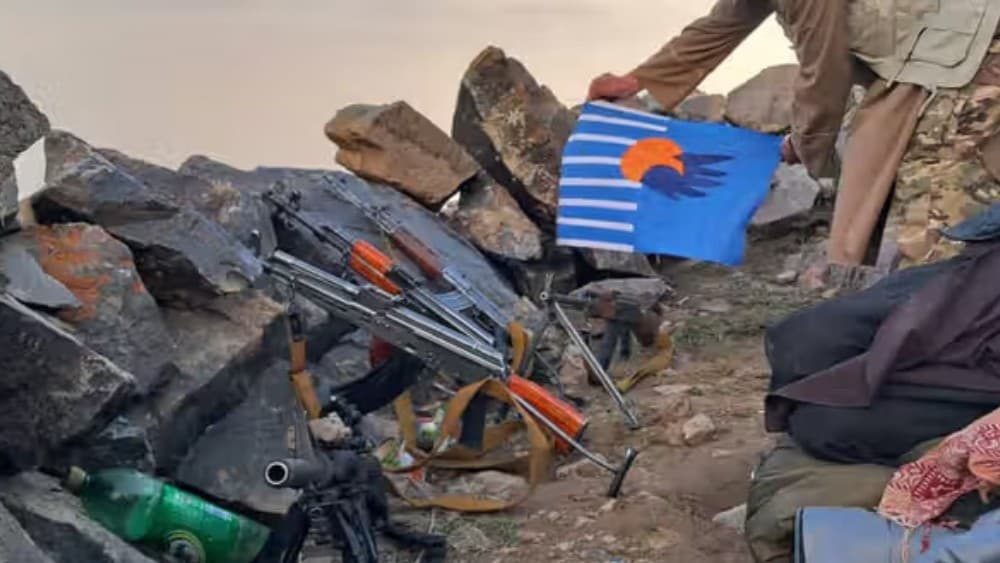
ISLAMABAD: A newly emerged armed opposition group calling itself Sepahiyan-e-Mihan (Patriotic Soldiers Front) has drawn national and regional attention after claiming responsibility for a surprise attack on the Yaftal-e-Sufla (Yaftal-e-Payeen) district center in Afghanistan's northeastern Badakhshan province.
According to Afghanistan International, little is publicly known about the organization; its reported operation has fueled debate over whether Afghanistan is entering a new phase of organized resistance against Taliban rule.
Badakhshan operation
The group first came into the spotlight in mid-July when it reportedly launched a coordinated early-morning attack on government installations in Yaftal-e-Sufla, a strategically located district only a few hours from the provincial capital, Faizabad.
According to Afghan media reports, the fighters briefly seized control of the district administration, intelligence, and police headquarters, disarmed Taliban personnel, and withdrew after holding the area for several hours.
The Taliban reportedly responded by deploying reinforcements and senior officials to the area while launching extensive search operations aimed at identifying suspected members and supporters.
Who are Sepahiyan-e-Mihan?
Despite the operation's high profile, much about Sepahiyan-e-Mihan remains unclear. No verified information has emerged regarding its leadership, organizational structure, or exact number of fighters.
Local sources told Afghanistan International that the group’s ranks include former members of the now-defunct Afghan National Defense and Security Forces, local political activists, and residents of Badakhshan who have grown increasingly dissatisfied with Taliban governance.
Residents of different areas in Badakhshan province suggested, “Tribal elders and community figures are also believed to have provided varying levels of support.”
Differs from other resistance groups
The group's emergence comes nearly five years after the Taliban returned to power in August 2021. Since then, armed resistance has largely been led by organizations such as the National Resistance Front (NRF) and the Afghanistan Freedom Front (AFF), both of which have concentrated much of their activity in remote mountainous regions, particularly in northeastern Afghanistan.
Most previous clashes have involved guerrilla attacks, ambushes, and sabotage operations rather than temporary seizures of district centers.
That distinction has made the Yaftal-e-Sufla operation particularly significant.
Security analysts say the group's ability to briefly overrun official compounds near Faizabad suggests that armed opposition may be expanding beyond isolated valleys into areas closer to provincial administrative centers, according to Afghanistan International.
Even though the group did not attempt to permanently hold the district, the attack demonstrated a level of coordination that has attracted attention from observers monitoring Afghanistan's evolving security landscape.
Badakhshan matters
Badakhshan has increasingly emerged as a sensitive province for the Taliban. While the province has long been viewed as one of the country's traditional anti-Taliban strongholds, it has also witnessed growing tensions over governance, economic hardship, and disputes between local Taliban commanders and fighters deployed from other provinces.
Reports of public dissatisfaction and localized unrest have periodically surfaced, creating conditions that some analysts believe could provide opportunities for new resistance movements to recruit supporters.
A changing resistance landscape
The appearance of Sepahiyan-e-Mihan also reflects the increasingly fragmented nature of Afghanistan's opposition landscape, reports Afghanistan International.
Rather than a single unified movement, multiple armed groups now operate with differing local bases, objectives, and command structures.
Whether the new organization develops into a sustained military force or remains a localized phenomenon will likely depend on its ability to recruit fighters, secure resources, and survive Taliban counterinsurgency operations.
For the Taliban, the incident serves as a reminder that despite maintaining nationwide control since 2021, security challenges persist in several parts of the country.
The swift deployment of reinforcements following the Badakhshan attack underscores the importance Taliban authorities attach to preventing localized insurgencies from gaining momentum.
Looking Ahead
At this stage, Sepahiyan-e-Mihan remains an organization with more questions than answers, reports Afghanistan International.
Its long-term capabilities, political agenda, and operational reach are still uncertain. However, its emergence and its reported ability to briefly seize a district center have already positioned the group as a notable new actor in Afghanistan's complex and evolving security environment.
Whether it marks the beginning of a broader resistance movement or represents an isolated local uprising will become clearer in the months ahead.