


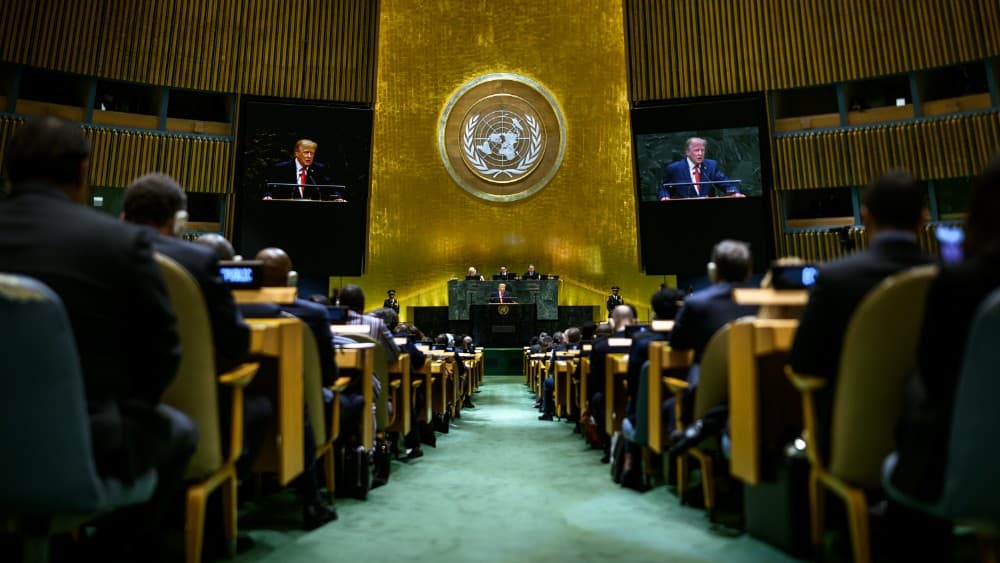
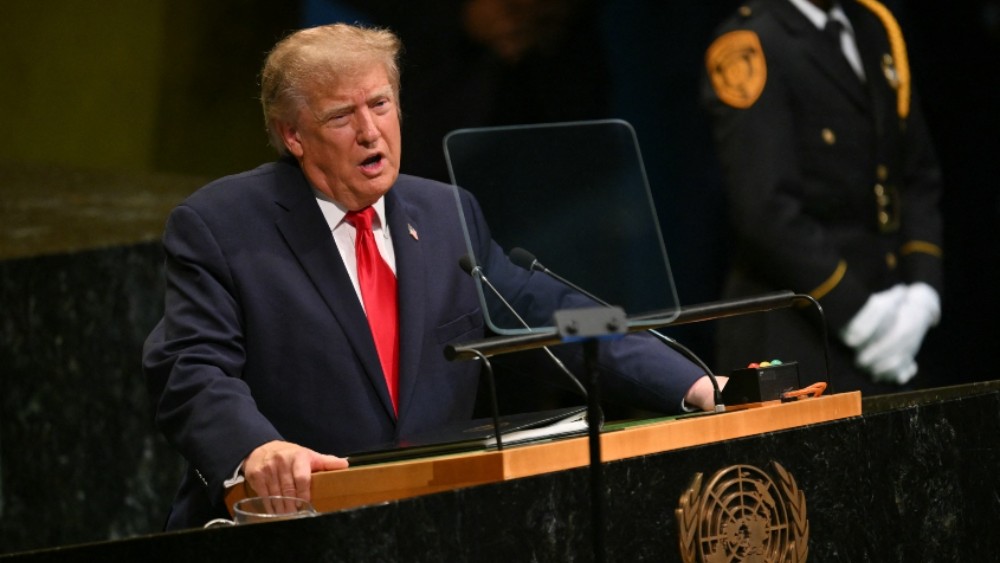
ISLAMABAD: US President Donald Trump mentioned his controversial Board of Peace in his address to the UNGA on Tuesday, while he has been repeatedly criticizing the United Nations.
Trump has been portraying the UN as a bureaucratic and ineffective world body, but at the same time has used the UNSC to fetch legitimacy and political backing for his Gaza peace plan.
In January, President Donald Trump signed an executive order to withdraw the United States from 66 international organizations, many of them related to the UN, stating they “no longer serve American interests.” The U.S. pledged to contribute a total of $3.8 billion in UN humanitarian aid this year, down from a high of $17 billion in recent years.
The Security Council’s Resolution 2803, adopted in November 2025, “welcomed the establishment of the Board of Peace as a transitional administration for Gaza” and authorized it to coordinate reconstruction, humanitarian assistance, and a temporary international stabilization force.
Under the resolution, the board is required to report to the Security Council every six months.
This clearly means that Trump’s Board of Peace is to operate with a UN mandate and not as a replacement for the UN.
Ambassador Abdul Basit believes that President Trump is still not a great fan of the UN and wants a better international space for his Board.
"But fulfilling the annual ritual at the UNGA to enumerate his achievements was meant primarily for his domestic audience," said the former Pakistani ambassador, who has served in many Asian and Western capitals during his diplomatic career.
A British news agency reported that Trump proposed expanding the Board beyond Gaza to address other conflicts around the world.
Ghaith Al-Omari of the Washington Institute wrote in June 2026 that the Board of Peace was originally created for Gaza, but Trump subsequently wanted it to address conflicts globally.
Major world powers like China and Russia did not join the board, while several Western and Global South countries also stayed away.
Signs of difficulty
There are also clear indications that the Board has not achieved all of its stated objectives.
According to a report by a Turkish news agency, in September, the Board’s envoy Nickolay Mladenov admitted having remained “far from what is needed” for a political solution.
He told the agency that Israel was needed to implement its commitments for the roadmap to move forward.
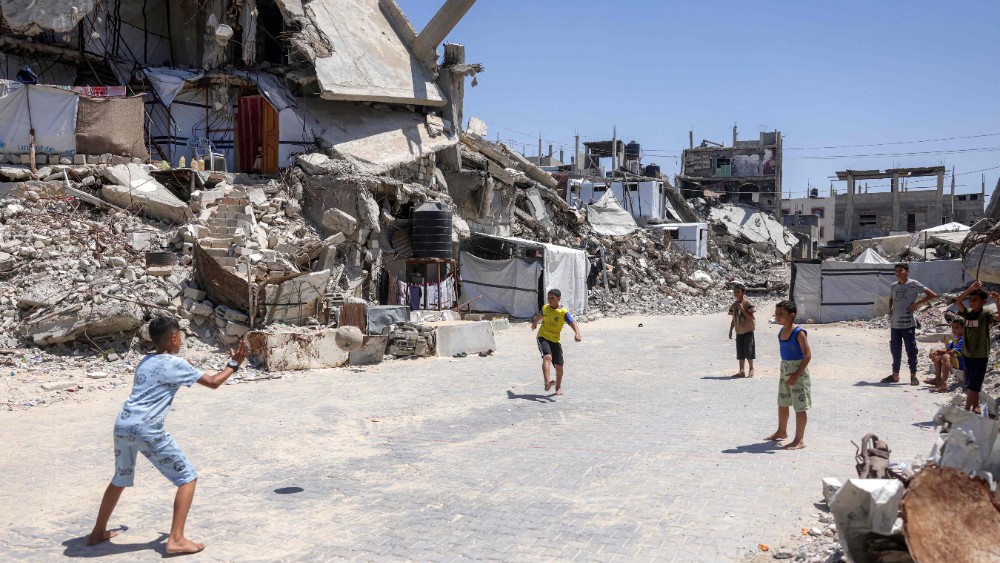
The Board's own May report on the UN website acknowledges that reconstruction remained incomplete, while humanitarian needs were still extensive.
The Guardian also reported in July that the Board had scaled back a broader Gaza recovery plan to a smaller pilot scheme.
"Its chances of success are minimal without demonstrating its ability to make progress regarding the conflict for which it was originally created, namely, Gaza," argues Ghaith Al-Omari in his article.
Experts see two different interpretations
Some analysts view the Board as an attempt to create an alternative mechanism to traditional multilateral diplomacy.
The European Policy Centre's Chris Kremidas-Courtney argued that Trump's initiative signals ambitions that go beyond Gaza and could challenge the existing international order.
But international-law experts quoted by Euronews have stressed that the Board's legal authority remains limited by state consent and the UN mandate. Professor Aurel Sari of Exeter University told Euronews that the Board would have to respect existing international law and legal commitments.
A replacement
Commentators believed Trump's appearance at the UN therefore does not by itself demonstrate the failure of the Board of Peace.
Instead, it reveals that Trump is attempting to use a US-led mechanism but simultaneously using the UN's authority for international legitimacy.
Trump's appearance at the UNGA session suggests that the world body is not going to disappear. But the entire situation may be described as a struggle to shape the international system for resolving conflicts.