


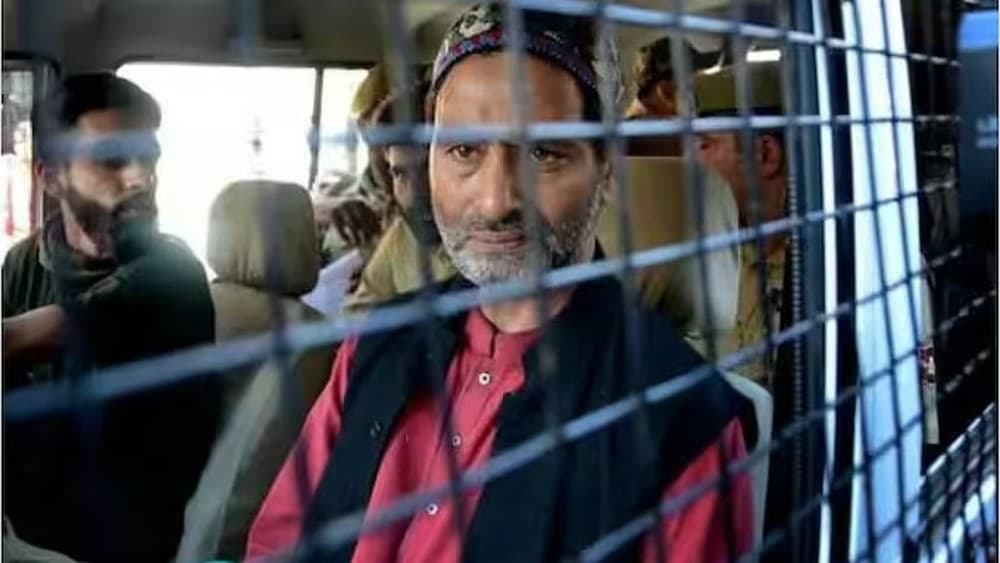
ISLAMABAD: Jailed Kashmiri leader Yasin Malik has told an Indian court that he will no longer contest proceedings in the murder case of a nurse and has requested capital punishment, Indian and Kashmiri media reported.
Malik, who is the chairman of the Jammu Kashmir Liberation Front (JKLF), was named by India’s State Investigation Agency (SIA) as one of five men charge-sheeted for the 1990 killing of Kashmiri Pandit nurse Sarla Bhat.
According to the Times of India, Malik submitted a 25-page affidavit before a special court judge in Srinagar on Aug 27 from Delhi's Tihar Jail.
In the affidavit, Malik said that he had decided not to contest the proceedings further. He said that his decision should not be treated as an admission of guilt or acceptance of the prosecution's allegations and asked the court to award him the death penalty.
Tells wife to begin new chapter
Malik said he had been unable to speak to his wife and daughter for eight years because he was not permitted to make telephone calls to them.
He noted that his wife is 20 years younger than him and said he does not want her to spend the rest of her life burdened by his imprisonment or as a widow.
“I therefore request you to find the courage to begin a new chapter of your life with dignity and hope,” Malik wrote in his affidavit, as reported by Kashmir Times.
“I shall always love, respect and remember both of you in this world and in the next life. Wherever my destiny takes me, my prayers, affection and blessings will always remain with you.”
Denies murder charges
According to Malik's affidavit, SIA officials questioned him in Tihar Jail on June 2 and 3 regarding an alleged handwritten JKLF note recovered from the scene and the prosecution's allegation that he had ordered Bhat's killing.
Malik rejected the prosecution's account and disputed the alleged JKLF note, as well as the claim that Bhat was targeted for allegedly providing information to security forces.
He also questioned why he and other accused persons were not prosecuted when they were arrested or investigated during the 1990s.
The affidavit also contains Malik's account of his alleged contacts with senior Indian officials following his release from jail in 2000. He claimed that the then BJP-led government under Prime Minister Atal Bihari Vajpayee had initiated a dialogue process with him, according to the report.
Malik claimed that senior Indian officials, including Intelligence Bureau officer Ajit Doval, Shyamal Dutta and National Security Adviser Brajesh Mishra, met with him during the period.
He further claimed that while he was receiving medical treatment at Johns Hopkins Hospital in the United States, the Indian Embassy informed one of his friends that Vajpayee had sanctioned $50,000 for his treatment. Malik said he declined the money.
Malik also cited injuries he allegedly suffered after falling from a fifth-floor building on April 8, 1990, saying he remained unconscious and underwent extensive medical treatment. He used the account to challenge the prosecution's allegation that he directed Bhat's killing on April 19.
Bhat, a 27-year-old staff nurse at the Sher-i-Kashmir Institute of Medical Sciences (SKIMS), was abducted and killed during a period of intense militancy in Jammu and Kashmir that also saw the mass displacement of Kashmiri Pandits from the valley.
Malik's request for capital punishment does not, by itself, determine his sentence. The court will decide the case on the basis of the prosecution's evidence, the defense position and applicable law.