


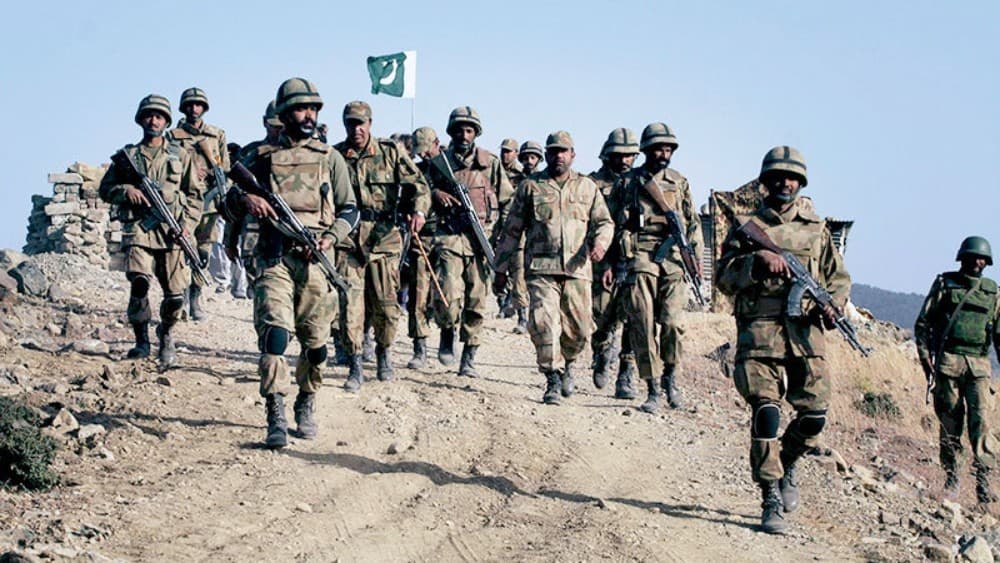
ISLAMABAD: Pakistan has stepped up counterterrorism operations across Khyber Pakhtunkhwa and Balochistan in the days following the deadly Kohat Police Lines mosque attack, with security forces reporting the deaths of dozens of terrorists in separate ground operations and strikes.
The latest operation was in southwestern Balochistan province, where the military said Wednesday that 19 terrorists were killed in separate engagements in the Shaban area of Quetta, as well as Kech and Quetta West. One army soldier, Subedar Muhammad Jamil, was also martyred, according to the Inter-Services Public Relations (ISPR).
The operations come after the Sept 18 attack on a mosque inside Kohat Police Lines in northwestern Khyber Pakhtunkhwa, where 22 people, including 16 police personnel, were martyred and more than 100 injured, according to hospital and police officials. Security forces subsequently carried out a clearance operation at the Police Lines complex and reported killing the attackers.
19 terrorists killed in Balochistan
According to ISPR, intelligence agencies reported multiple hideouts of “Indian-sponsored Fitna al-Khawarij” and “Fitna al-Hindustan” in the Shaban area of Quetta district.
Security forces have been conducting a clearance operation in the area since Sept 21, the military said.
“Following an intense exchange of fire, 13 Indian-sponsored terrorists have been killed so far,” ISPR said, adding that weapons, ammunition and explosives were recovered from the cleared hideouts.
Fitna al-Khawarij and Fitna al-Hindustan are terms used by Pakistani authorities for different terrorist threats. Islamabad uses Fitna al-Khawarij for the TTP and related factions, and Fitna al-Hindustan for BLA and other Balochistan-based groups it says are India-backed. In Islamic usage, fitna broadly means trial, tribulation or turmoil, while Khawarij refers to a historical Islamic movement associated with rebellion against Muslim authority.
In separate engagements on Sept 22 and 23, troops conducted pre-emptive intelligence-based operations in Kech and Quetta West districts.
Six more terrorists were killed following exchanges of fire, while weapons and ammunition were recovered, according to the military.
During one of the engagements, Subedar Muhammad Jamil, 39, a resident of Taunsa Sharif in Dera Ghazi Khan, was martyred, ISPR said.
The military said the Shaban clearance operation would continue until the threat in the area was completely neutralized.
“Security Forces and Law Enforcement Agencies remain committed to eliminating the menace of foreign-sponsored and supported terrorism from the country,” ISPR said.
Operations intensify after Kohat attack
The Balochistan operations are the latest in a series of counterterrorism actions reported by Pakistani authorities following the Kohat attack.
On Sept 19, police and security forces completed a clearance operation at the Kohat Police Lines complex following the mosque attack. Provincial police officials reported that eight terrorists were killed during the operation.
The following day, an exchange of fire between a security forces convoy and terrorists in neighboring Hangu district left eight terrorists dead and six security personnel, including two officers, martyred, according to ISPR.
The military identified the officers as Captain Abuzar Farooq and Lieutenant Sheraz Babar.
37 terrorists reported killed in KP, Afghan border region
On Sept 21, Pakistan's Ministry of Information and Broadcasting said security forces had killed 37 terrorists in intelligence-based operations in Khyber Pakhtunkhwa and the border region with Afghanistan.
The ministry said a ground operation around Kohat, Hangu and Thal killed nine terrorists, followed by calibrated airstrikes against terrorist camps and hideouts in the Afghan border region.
It said three targets, including a suicide bomber training center, were destroyed and 28 terrorists and multiple suicide bombers were killed. The ministry said precautions were taken to prevent civilian casualties.
The Information Ministry described the operations as part of Pakistan's wider counterterrorism campaign under Ghazab lil-Haq, conducted under the broader Azm-e-Istehkam framework.
Islamabad presses Taliban over Afghan sanctuaries
The military operations have also intensified pressure on Afghanistan's Taliban authorities as Pakistan moves to counter terrorist networks operating from Afghan territory and prevent cross-border attacks.
Following the Kohat attack, Pakistan's Information Ministry said it had repeatedly raised concerns over the use of Afghan territory by Fitna al-Khawarij and other terrorist groups.
The ministry said the presence of terrorist sanctuaries and their recruitment and support infrastructure in Afghanistan posed a direct threat to Pakistan's security.
It called on the Afghan Taliban to “dismantle these networks rather than deflect responsibility” and demanded “credible, verifiable and sustained measures” to dismantle terrorist sanctuaries, disrupt radical recruitment and training networks, and prevent attacks against Pakistan.
Pakistan also criticized Kabul's response to the Kohat bombing, saying the Afghan Foreign Ministry had condemned the attack and expressed sympathy for victims' families but had not mentioned terrorism in its statement.
“Notwithstanding, condemnation must be matched by concrete action,” Pakistan's Information Ministry said.
The ministry said Pakistan had pursued dialogue and constructive engagement with the Afghan Taliban but would not allow what it called the “pretence of dialogue” to shield those threatening the country.
Government vows continued operations
The latest Balochistan operations have drawn praise from Pakistan's political leadership.
Prime Minister Shehbaz Sharif and President Asif Ali Zardari separately praised security forces for the operations and paid tribute to Subedar Muhammad Jamil. PM Sharif said security and law enforcement operations would continue until terrorism was eliminated.
The military said the counterterrorism campaign under Azm-e-Istehkam, approved by the Federal Apex Committee on the National Action Plan, would continue “at full pace.”