


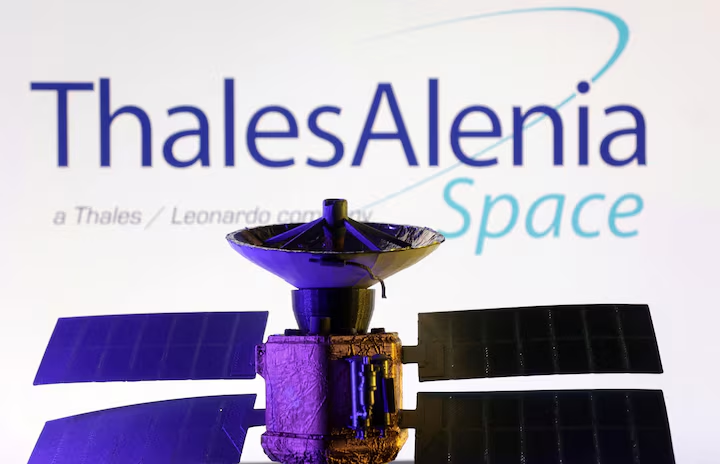
French companies are refining plans for stratospheric surveillance balloons and airships as rivalry intensifies in the area between the atmosphere and outer space, seen as a potential future zone of conflict among global powers.
Stratobus, owned by Thales Alenia Space, and Hemeria, a small company formed in 2019 to protect sensitive French technology amid a merger, are focusing on the region called Very High Altitude.
Interest in near-space peaked in 2023 when the US shot down a suspected Chinese spy balloon, with Beijing claiming it was for scientific research and accidentally entered US airspace. Yannick Combet, head of Stratobus, said, "It's an unoccupied space. We must be there, or others will take the lead."
French companies testing high-altitude vehicles
The Stratobus airship is intended to restore communications after disasters or monitor areas of urgent interest, such as hostage situations. Combet stated the balloon, which is 142 meters long, could fit Notre-Dame Cathedral inside it. Thales is developing test models aiming for operational readiness by 2031.
Hemeria’s smaller Balman balloon is designed for rapid deployment and can maneuver by adjusting altitude to use wind currents. A second test flight is planned soon, with limited operations starting by 2027. Project manager Alexandre Hulin said they aim to be reactive and able to launch within hours, compared to the current two-month preparation time.
In June, France announced a new strategy to operate at Very High Altitudes between 20 km and 100 km and intercept adversaries. Shortly after, French fighters shot down two balloons flying above 20 km as a demonstration.
Regulatory grey area
Officials note these vehicles can cover large distances and remain stationary for months, complementing constantly moving satellites. However, they exist in a regulatory grey zone dating back to early air power, now receiving attention.
After World War One introduced aerial bombing, peace talks in Paris established each nation's sovereignty over its airspace, abandoning efforts to treat skies like international waters. This sovereignty was reaffirmed near the end of World War Two.
Outer space laws developed differently. The 1967 treaty declared outer space open for exploration and use but did not define a clear boundary for the thinning atmosphere. This vague boundary between Earth and space is now a new area of competition.
Brigadier-General Alexis Rougier, France’s top Very High Altitude official, said last week technology improvements will lead to flying higher and faster, while satellites will orbit lower. He added, "A zone little used in the past will be increasingly used," during a National Assembly defense committee session.