


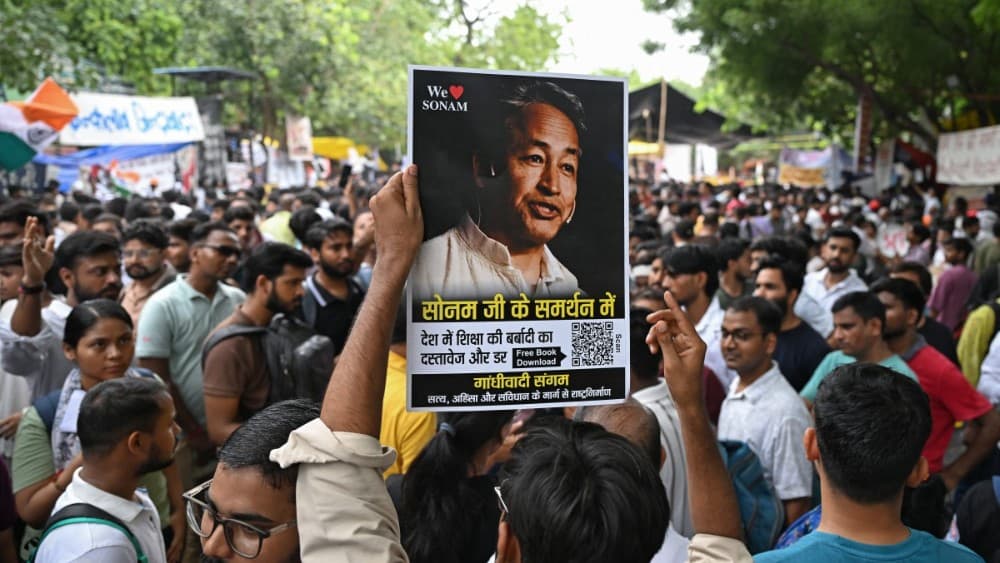
ISLAMABAD: Indian engineer and climate activist Sonam Wangchuk, 59, has emerged as the most recognizable face of youth-led protests demanding education minister Dharmendra Pradhan's resignation. According to The Hindu, his decision to join students on an indefinite hunger strike transformed what began as a student campaign into a nationwide movement.
On Monday, Wangchuk said he would resume his hunger strike in hospital after witnessing the "brutality with which peacefully protesting students are being dealt with", following police action against thousands of demonstrators marching toward India's parliament on July 20 to demand examination reforms and Pradhan’s resignation.
Education reformer
An engineer by training, Wangchuk is best known for pioneering water conservation projects in the Himalayas.
In 1988, he launched the Students' Educational and Cultural Movement of Ladakh (SECMOL) to promote education in the Himalayas after finding flaws in the traditional school system.
His work later expanded into environmental innovation, including the development of artificial "ice stupas," cone-shaped ice reservoirs that store winter water for use during spring planting. The Ramon Magsaysay Award Foundation said it honored Wangchuk with the 2018 Ramon Magsaysay Award for reforming local schooling and sustainable development in Ladakh.
His life and work are said to have inspired a character played by Bollywood star Aamir Khan in the hugely popular movie "Three Idiots."
Not the first time
Sonam Wangchuk was jailed for six months after he was held over protests in the Himalayan region last year.
He became a key figure in Ladakh's movement for greater autonomy, was held in September and later charged under India's National Security Act following protests that left four people dead and dozens wounded.
Al Jazeera called it the deadliest unrest the region had seen in years.
New Delhi blamed the violence on "provocative speeches" by Wangchuk, who had been on a hunger strike demanding constitutional safeguards for Ladakh, including inclusion under the Sixth Schedule of India's Constitution to protect tribal rights and the Himalayan ecosystem.
Under the stringent National Security Act, a suspect can be detained for up to 12 months without being formally charged.
The home ministry later said it had decided to end Wangchuk's detention "with immediate effect" after "due consideration."
Mustafa Haji, a lawyer for the Leh Apex Body, which spearheaded last year's protests, said Wangchuk was released from jail in the western city of Jodhpur soon after.
The home ministry said it remained "committed to fostering an environment of peace, stability, and mutual trust in" Ladakh and had "meaningful dialogue with all stakeholders."
Cockroach Janta Party
Months after his release, Wangchuk joined the Cockroach Janta Party (CJP), a satirical youth-led movement launched in May after India's chief justice called India’s unemployed youth “parasites” and “cockroaches” during a Supreme Court hearing.
He began an indefinite hunger strike at the CJP's Jantar Mantar sit-in on June 28, surviving on salt water. Just recently, doctors warned of possible organ damage as opposition leaders and Bollywood figures began rallying behind him.
He had pledged to keep fasting "at any cost" through a planned July 20 march to Parliament when police forcibly moved him to hospital last week.