


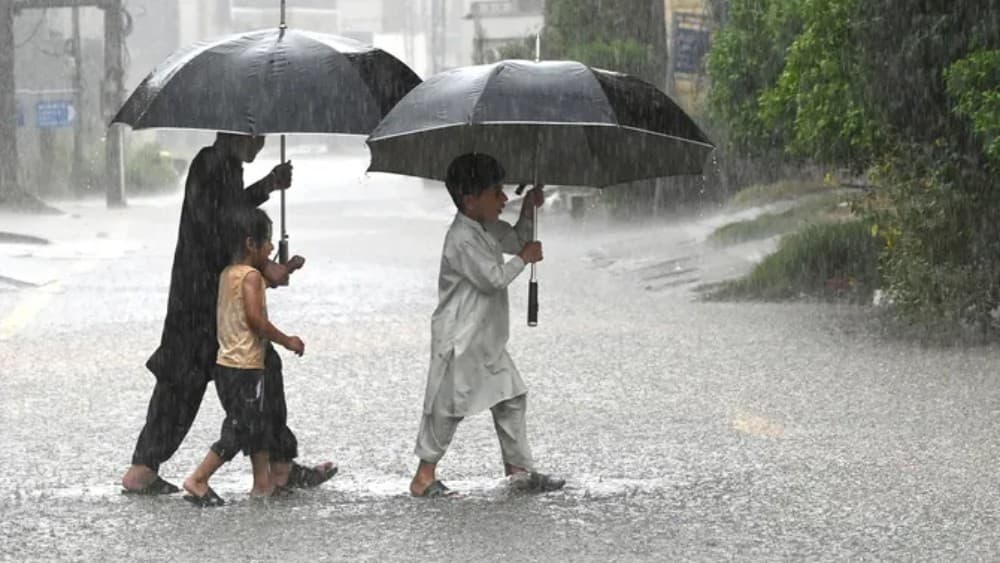
PESHAWAR: Across most parts of Pakistan, weather conditions currently remain hot and dry, though overcast skies have begun covering northern districts of Khyber Pakhtunkhwa.
Abdul Shakoor, a meteorologist from the Regional Meteorological Department (RMD) Peshawar, speaking to Pakistan TV Digital, stated that a shift in weather dynamics is expected starting from Sept. 13th.
“A westerly wave originating from the Mediterranean, interacting with incoming moist monsoon currents, will bring a fresh spell of rain to the region, especially the rain-starved southern districts,” he said.
This wet weather is forecast to persist until September 18th in the northern districts of Khyber Pakhtunkhwa, while lasting through September 15th across the rest of the province.
This anticipated mid-September rain spell comes as welcome news for the agricultural sector in KP. The rainfall will moisten the soil at a critical time, preparing fields for the upcoming October wheat sowing season and the cultivation of other winter crops.
Because a major portion of southern KP relies entirely on rainfall for agriculture, this spell is set to provide vital soil moisture for rain-fed (barani) farming operations.
Retrospective on the 2026 Monsoon Season
The incoming rain spell follows a predominantly dry summer monsoon across much of the country. According to performance data from the Pakistan Meteorological Department (PMD) shared with Pakistan TV Digital, Pakistan experienced an overall monsoon rainfall deficit of 11.4 percent below normal during the June-July-August (JJA) 2026 period.
The month of August was particularly dry, recording a nationwide rainfall deficit of 9.4 percent alongside a mean temperature of 0.9°C above normal.
Punjab was the only province to receive above-normal rainfall, finishing 5.4 percent above average for the JJA season and 17.9 percent above average in August.
Sindh suffered severe rainfall deficits, ending the JJA season 57.1 percent below normal and August 45.2 percent below normal.
Khyber Pakhtunkhwa recorded rainfall deficits of 21.7 percent during the JJA period and 29.2 percent in August.
Gilgit-Baltistan, AJK, and Balochistan similarly experienced sustained rainfall deficits throughout the summer months.
Forecast for Autumn (September–October–November 2026)
Looking at the September–October–November (SON) 2026 period, seasonal climate drivers, specifically a positive El Niño-Southern Oscillation (ENSO)—resulting in a suppressed monsoon season and a hotter summer for Pakistan—and a positive Indian Ocean Dipole (IOD), which indicates a stronger monsoon and chances of flash flooding in Pakistan—are shaping regional climate dynamics.
Positive ENSO and Positive IOD have compensating effects on rainfall and precipitation in Pakistan.
Forecast models indicate a north-south contrast in rainfall distribution, as normal to above-normal precipitation is projected over Gilgit-Baltistan, Kashmir, Khyber Pakhtunkhwa, and upper Punjab, while below-normal rainfall and warmer-than-average temperatures are expected across central to southern Pakistan, particularly in southern Sindh, southern Punjab, and eastern Balochistan.
Implications
While dry conditions in southern and central regions are beneficial to the ongoing harvesting of Kharif crops like cotton and peanuts, the lack of rain increases reliance on supplemental irrigation and increases the risk of moisture deficits or drought development in rain-fed southern areas.
Furthermore, late-season windstorms and isolated hailstorms could pose temporary risks to standing crops during harvest activities.
However, according to Abdul Shakoor from RMD Peshawar, for farmers in KP and northern regions preparing their fields for the upcoming Rabi sowing season, the mid-September rain provides an essential boost.