


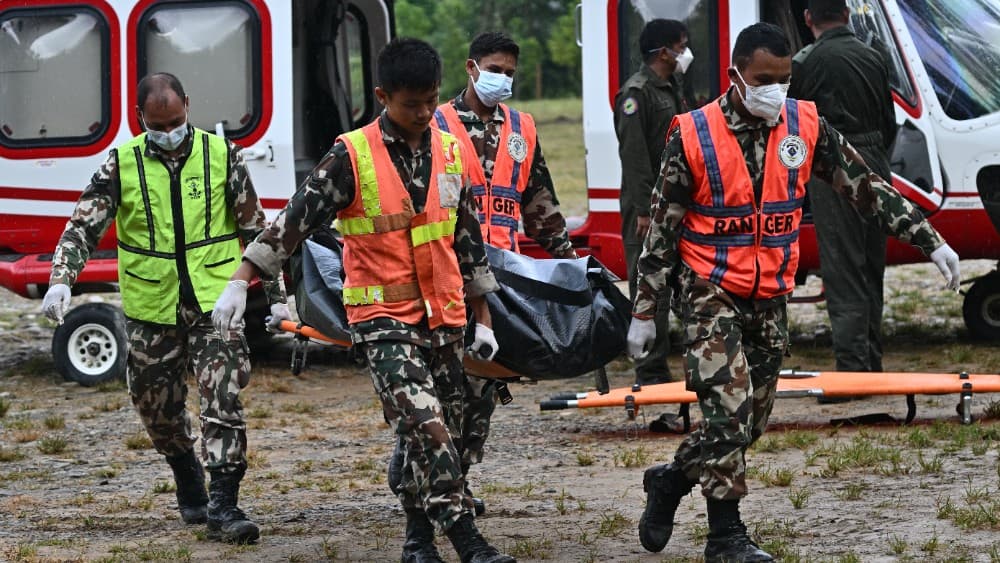
KATHMANDU: The death toll from devastating flash floods and mudslides along the Nepal-China border has risen to 1,308, while 5,624 people remain missing, as rescue teams continue searching devastated Himalayan communities nine days after the disaster.
Nepal’s National Disaster Risk Reduction and Management Authority said that 1,287 people had been killed and 5,083 remained missing, including 583 foreigners.
On the Chinese side, authorities reported 21 deaths and 541 missing people in Tibet, bringing the combined toll to 1,308 dead and 5,624 missing.
The disaster struck on Aug. 26 after a glacier on Nepal’s Mount Langtang Lirung fractured at an altitude of about 5,200 meters, triggering an ice-and-rock avalanche that developed into a massive debris flow.
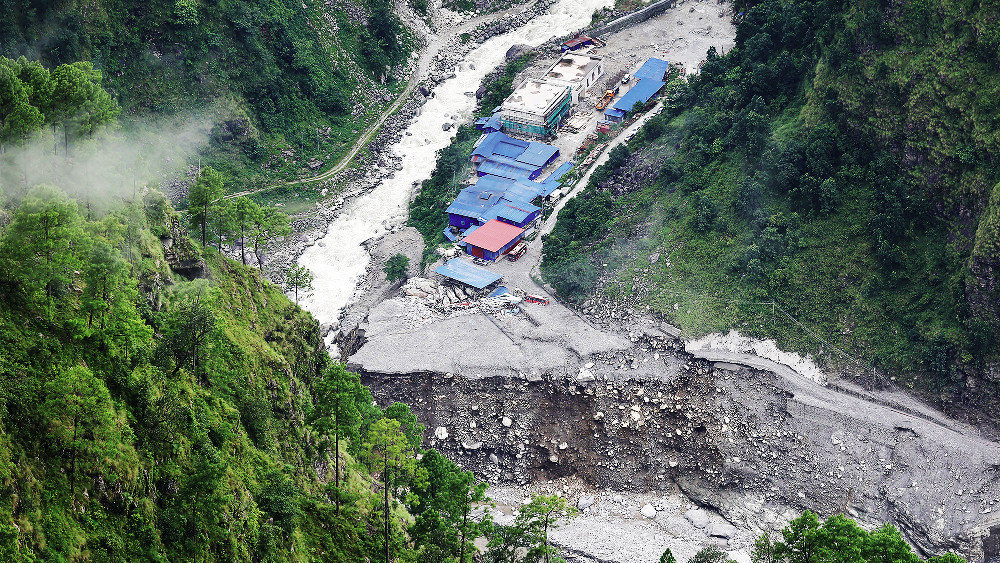
The torrents swept through valleys along the border, destroying homes, roads, bridges and hydropower facilities in Nepal’s Rasuwa, Nuwakot, Dhading and Kavre districts and parts of the Kathmandu Valley.
The Gyirong border crossing in China’s southwestern Xizang Autonomous Region was also buried.
Among the missing are hundreds of foreign nationals, including trekkers, pilgrims and workers. Nepal’s authorities said 844 foreigners are unaccounted for on both sides of the border.
Two workers rescued
A rare breakthrough in the search came Friday when rescuers pulled two hydropower workers alive from a debris-filled tunnel at the Trishuli 3A Hydropower Project.
The men, identified as mechanical foreman Sanjay Shah and mechanical supervisor Kabir Maharjan, had been trapped for days after the disaster buried the tunnel. Rescuers reportedly heard a faint response from inside before digging through roughly 50 to 60 meters of debris to reach them.
The rescue was described as a “miracle” by those involved. Amir Maharjan, the brother of rescued worker Kabir, told AFP, "I am so happy, my heart is lighter."
Australian tunnelling expert Arnold Dix, who has been assisting the operation remotely, said rescuers had entered "miracle country" after what he described as a "week of 24/7 heartache."
Nepal’s Army said search-and-rescue operations were continuing, while experts from India, China and South Korea were assisting local teams. At least six hydropower projects were hit, with about 900 personnel deployed at the facilities still unaccounted for.
Vast destruction hampers relief
The scale of destruction has made access to some of the worst-hit communities extremely difficult. Roads and bridges have been washed away, while communications and electricity remain disrupted in several areas.
UN coordinator in Nepal Lila Pieters Yahia described the scale of destruction as “simply incredible” and said, “The access has been very, very, very difficult.”
Aid agencies have been using helicopters, cargo drones and considering porters to reach isolated communities.
AFP reported that entire settlements in Rasuwa district had disappeared beneath mud, rocks and debris. Survivor Yangee Tamang described the devastation bluntly, “It is all gone, nothing is left. No one is left."
With thousands still missing and many communities cut off, rescuers are racing against time to locate survivors while authorities begin recovering and temporarily burying unidentified bodies to facilitate later identification and return to families.