


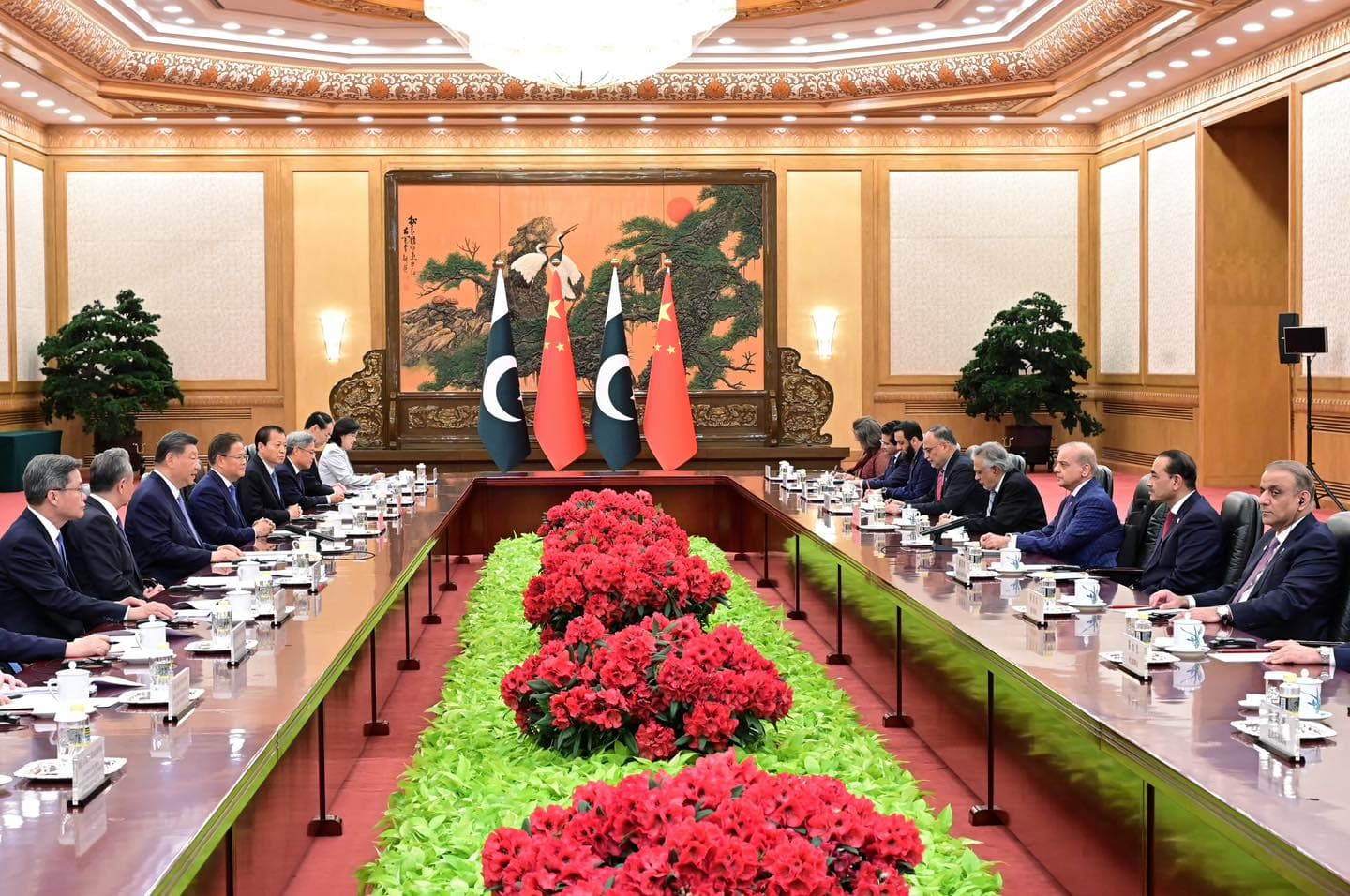
ISLAMABAD: Pakistan and China agreed to accelerate work on major infrastructure, industrial and connectivity projects under the second phase of the China-Pakistan Economic Corridor (CPEC), as Prime Minister Shehbaz Sharif concluded a four-day visit to China focused on expanding strategic, economic and security cooperation.
In a joint statement issued Tuesday after meetings between PM Sharif, Chinese President Xi Jinping and Premier Li Qiang, the two sides pledged to “promote the high-quality development of the upgraded version of CPEC 2.0” and strengthen coordination on regional and international issues.
The agreement reflects Islamabad’s broader push to reposition CPEC beyond traditional infrastructure financing toward industrial cooperation, manufacturing, agriculture, technology and regional trade connectivity as Pakistan seeks long-term economic modernization and export-led growth.
Both countries agreed to “move faster to build an even closer China-Pakistan Community with a Shared Future in the New Era,” describing the relationship as carrying “even more strategic importance and relevance” amid shifting regional and global dynamics.
The statement said the two sides would advance the Karakoram Highway realignment project “in a phased and orderly manner,” expand the role of Gwadar Port as a regional connectivity hub and strengthen land connectivity through the Khunjerab Pass.
China and Pakistan also welcomed third-party participation in CPEC projects “under the model agreed upon by China and Pakistan.”
The two countries agreed to deepen cooperation in industrial parks, mining, oil and gas exploration, digital economy, artificial intelligence, finance, information technology and energy.
Both sides also committed to strengthening industrial supply chains and expanding cooperation in scientific and technological innovation.
China agreed to support Pakistan’s agricultural modernization efforts and facilitate market access for “more high-quality Pakistani agricultural products” following the completion of a Chinese training program for 1,000 Pakistani agricultural technicians.
The joint statement highlighted expanding educational, cultural and scientific exchanges, including plans for two Pakistani astronauts to train in China.
“China welcomes two Pakistani astronauts to come to China for training and looks forward to a Pakistani astronaut becoming the first foreign astronaut for the early entrance into the China Space Station,” the statement said.
On security cooperation, the two sides agreed to establish a “China-Pakistan Security Partnership,” expand military and counter-terrorism cooperation and strengthen security measures for Chinese personnel and projects operating in Pakistan.
The statement said both countries opposed “double standards on counter-terrorism” and agreed that militant groups, including the Tehreek-e-Taliban Pakistan (TTP) and Eastern Turkistan Islamic Movement (ETIM), should not be allowed to use any territory to threaten regional security.
Pakistan reaffirmed support for China’s positions on Taiwan, Xinjiang, Hong Kong and the South China Sea, while Beijing reiterated support for Pakistan’s sovereignty, territorial integrity and development priorities.
The two countries also reiterated support for resolving the Jammu and Kashmir dispute peacefully in accordance with United Nations resolutions and bilateral agreements.
During the visit, the two sides signed multiple cooperation agreements across various sectors, according to the statement.