


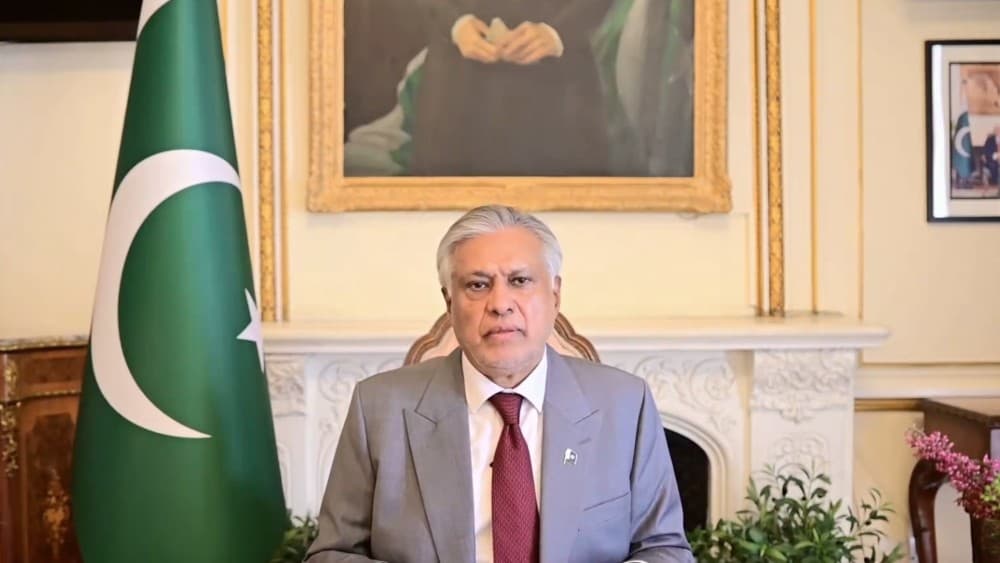
ISLAMABAD: Pakistan’s Deputy Prime Minister and Foreign Minister Ishaq Dar on Friday said that India's assertion of “abeyance” of the Indus Waters Treaty concerned the sanctity of treaties and confidence in international law for the entire world.
In April 2025, India announced it was placing the Indus Waters Treaty (IWT) in abeyance following the Pahalgam attack, raising fresh concerns over the future of one of the world's longest-standing transboundary water-sharing agreements.
While delivering a keynote address via a recorded video message at the seminar on “The Indus Waters Treaty: South Asian Security at the Crossroads” in Washington, the foreign minister said that Pakistan's position was clear and consistent: “the Indus Waters Treaty remains valid, binding and fully operative.”
The foreign minister also said that the Indus Waters treaty had endured because both countries understood that waters upon which hundreds of millions of lives depend were “too fundamental to be subjected to the fluctuations of political relations.”
He said that treaty-based proceedings have continued despite India's assertion of "abeyance," reinforcing the fundamental principle that unilateral action cannot displace an agreed legal framework.
“What is at stake, therefore, extends well beyond India and Pakistan,” FM Dar said.
“It concerns the sanctity of treaties. It concerns confidence in international law,” he said.
The foreign minister said that the treaty today faced its gravest challenge.
“For Pakistan, this is not an abstract legal debate,” FM Dar said.
He stated that Indus Basin was the lifeline for Pakistan’s 250 million people, agriculture, food security, energy production, livelihoods and economic development, adding that these functions were deeply dependent upon the waters of the Indus River system.
“The implications of unilateral interference with such an arrangement are consequently profound. They affect not only the stability of South Asia but create a dangerous precedent for treaty relations everywhere,” he said.
The foreign minister stated that international agreements derived their value from certainty and predictability.
“If solemn treaty obligations can simply be set aside whenever political relations deteriorate, the very purpose of concluding the treaties is undermined,” he said.
“Governments may change. Political relations may deteriorate. States may disagree profoundly with one another. But geography remains,” the foreign minister said, adding that states could not alter the direction in which rivers flow.
“That is precisely why rules matter.”
Signed in September 1960 and brokered by the World Bank, the treaty has survived three wars and decades of political hostility between the two nuclear-armed neighbors, making it one of the most enduring international agreements governing shared water resources.