


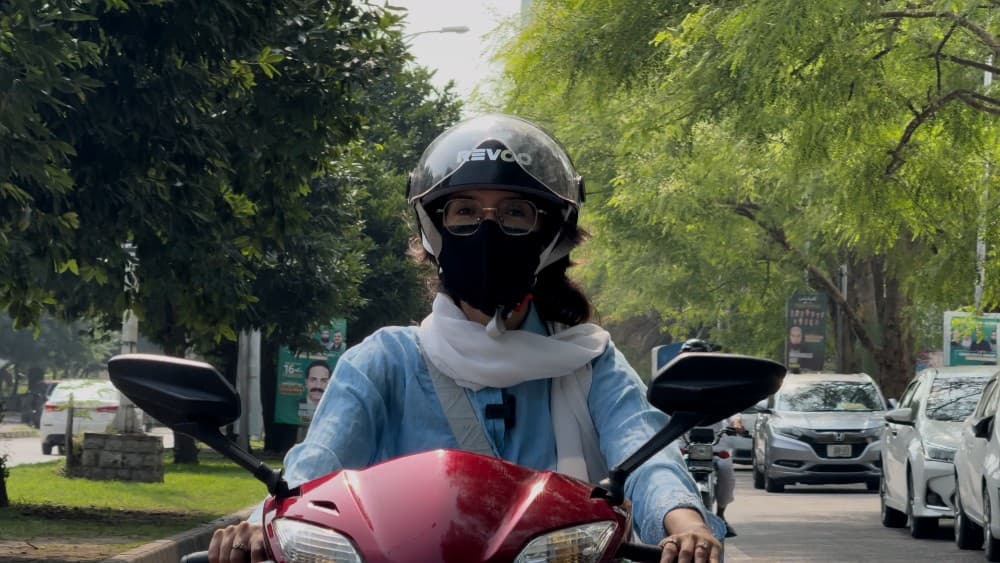
ISLAMABAD: Ever since she bought her scooter, Urwah no longer needs to wait for anyone to take her to university, her office, or even the grocery store. Her father, who was initially reluctant to let her drive alone, now asks her to pick him up and drop him off at his office as well.
“Before I bought a scooty, I would have to catch the 6 a.m. bus to get to university by 8 a.m., and then wait for it again after classes until 4 p.m., even though I got off at 2 p.m. By the time I got home, I had wasted so much time. Now I go to university, then my office, and even have time to run errands before I come home. I am finally in control of my time,” she says.
Her brother, who taught her to ride the scooter, says the family is much more content knowing she has her own vehicle to get around. She rides the electric Revoo A12, which she bought six months ago — a timely investment as petrol prices shot up due to the war on Iran.
She prefers the scooter over a petrol motorcycle for its comfort and storage space, including a front pocket for her phone and handbag. And because it’s electric, she just hits a button and zooms off. No kickstarting or clutch handling.
The rapidly increasing number of electric scooters on urban roads makes it evident that Pakistan's e-scooter market is booming.
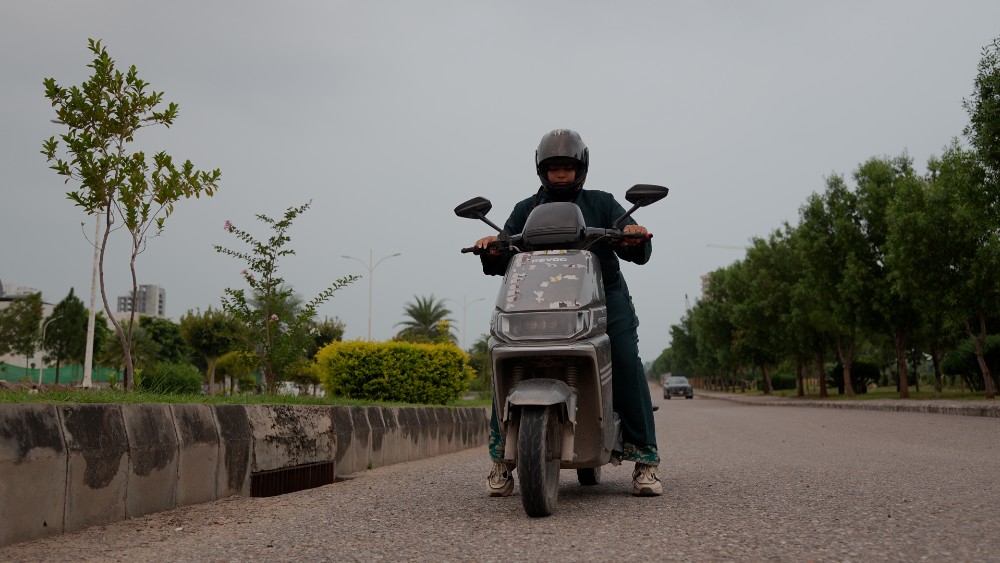 Urwah prefers the scooter over a petrol motorcycle for its comfort and storage space. (Photo: Video screengrab)
EVs to the rescue
According to MotorCycles Data, sales of electric two-wheelers in Pakistan shot up 173% in the first quarter of the year, mainly due to oil prices but also the government subsidy program.
The Pakistan Accelerated Vehicle Electrification Program is a federal initiative under the New Energy Vehicle Policy 2025-30. Under this policy, approved electric motorcycles qualify for a subsidy of about Rs80,000 per unit, with a 25% quota for women. The remaining balance is covered through easy, interest-free monthly installment plans.
According to Motorcycle Data, the scheme drew more than 270,000 applications within days, narrowing the gap between a typical electric model at around Rs250,000 and the petrol Honda CD70 at roughly Rs160,000. This is in addition to the separate schemes run by the Punjab, Khyber Pakhtunkhwa and Sindh provinces.
Pakistan's electric two-wheeler market, almost non-existent three years ago, now includes some 84 companies, ranging from homegrown start-ups such as Evee, Vlektra, Jolta, and OKLA, competing against established petrol-bike makers -- who have also started making EV scooters -- such as Metro, Crown, Road Prince, and United Auto, alongside Chinese brands such as Yadea.
The data reveals that more than 134,000 electric two-wheelers were registered in the first half of 2026, up 174% over the previous year and already approaching the total for all of 2025. The firm reports that Evee's sales are up 410%, and OKLA's are up 276%.
Most bikes still petrol
However, electric bikes remain a small slice of a market that sold a record 1.93 million motorcycles in FY26 — nearly nine in ten of them petrol Hondas — with many EV models assembled from Chinese kits imported at a minimal 1% duty
Syed Ibrahim Ali Shah, who opened an Evee dealership in June, compares the popularity of EVs to the 2022 solar boom.
“I just knew I had to get into this business … the timing and momentum of rising petrol prices were such that, of the 25 working days, I was completely sold out in six. Stock constraints were there already because the company was growing so quickly. When I started off, people were willing to pay up to Rs70,000 as a premium on certain models, which would account for 30-40% of the bike’s price itself … that’s how high the demand was.”
He describes Pakistani buyers as very price-sensitive, noting that his most successful month for sales was August, driven by Azadi (Pakistan’s Independence Day) sales. The only issue for now is the supply constraint. He points to the rise in female buyers, particularly noting women from even conservative backgrounds taking charge of their mobility.
According to Shah, Evee is Pakistan's largest electric scooter manufacturer, with annual capacity to build up to 300,000 scooters: 250,000 in Lahore and 50,000 in Karachi. Although the suppliers are Chinese, Evee will be the first Pakistani brand to ship to Sri Lanka.
Despite the success, Shah is worried about the battery track record, given this is the first year of exponential sales. There are two types of batteries: graphene and lithium.
“Graphene in budget-oriented bikes tends to last 18-20 months at peak performance,” he says.
Graphene-based models have a battery lifespan of 2-3 years; the warranty is for 20 months. As for lithium, you can expect 4-5 years of solid service, sometimes with a 3-4 year warranty.
Fuel still rules
But not everyone has given in to the electric hype.
Naushaba first bought her United petrol scooter four years ago, when her daily 40km commute was becoming too expensive.
Despite the hike in oil prices, she now spends Rs2,000-3,000 per week on ride-hailing services, compared to Rs3,000-4,000 per day. She did consider switching to electric, but she argues her “Dinky” -- the nickname she has given her pink scooter -- lets her go as fast as 80-100km/h which is not possible with current electric models.
She is still a strong advocate for the scooter, which has changed her life despite the challenges of riding on roads crowded with men.
“My father bought this for me and told me whenever there’s a problem, just call me and I’ll be there”.
Tayyaba, who rides a 100cc petrol scooter, says she’s reluctant to go electric because of battery issues.
“Often our mechanics are unable to fix these issues. And what if you run out of battery in the middle of the road?” she asked.
Her new Asia Ramza 100cc not only gives her a good average, but also the satisfaction of a “vroom broom sound,” she says. “At least you know you’re sitting on a scooter!”
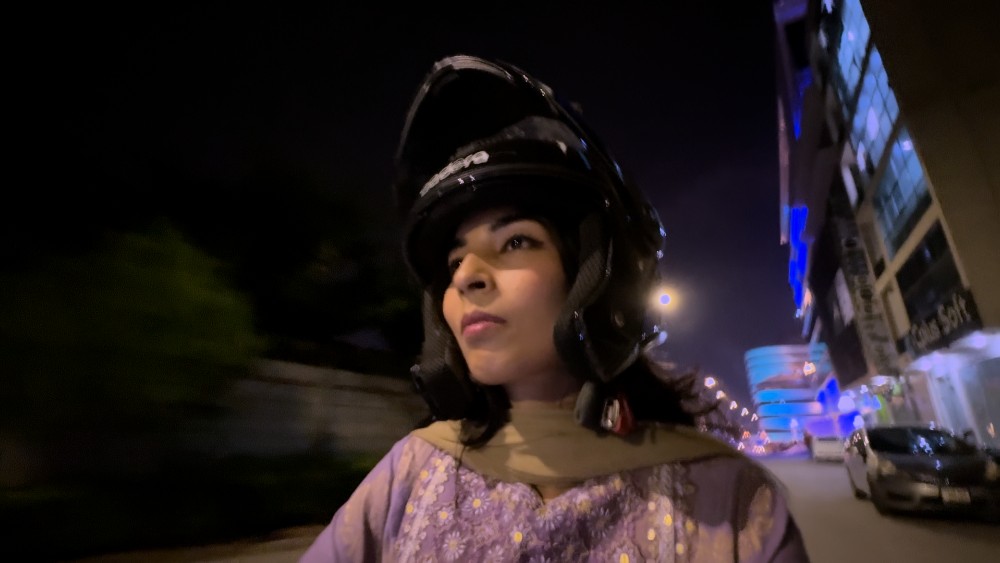 Nadia works in EV sales for a living. (Photo: Video screengrab)
Not an act of defiance
For Nadia, the switch from a traditional scooter to an EV was so good that she now works in EV sales for a living.
“I decided to buy a scooter four years ago because I was a student then and my pocket money was not enough to cover transport costs. And when the electric scooter came around, it seemed even more economical.”
For her and many others, choosing to ride a scooter, whether EV or not, is not an act of defiance, even if the men who try to overtake and speed past them on the roads think so. It is simply a way to live more conveniently: getting to university and work on time, dropping the kids to school, and not waiting for a male family member to run errands.
The EV boom certainly offers more choice, no petrol costs, an added government subsidy, and an incredibly smooth ride at the click of a button.