


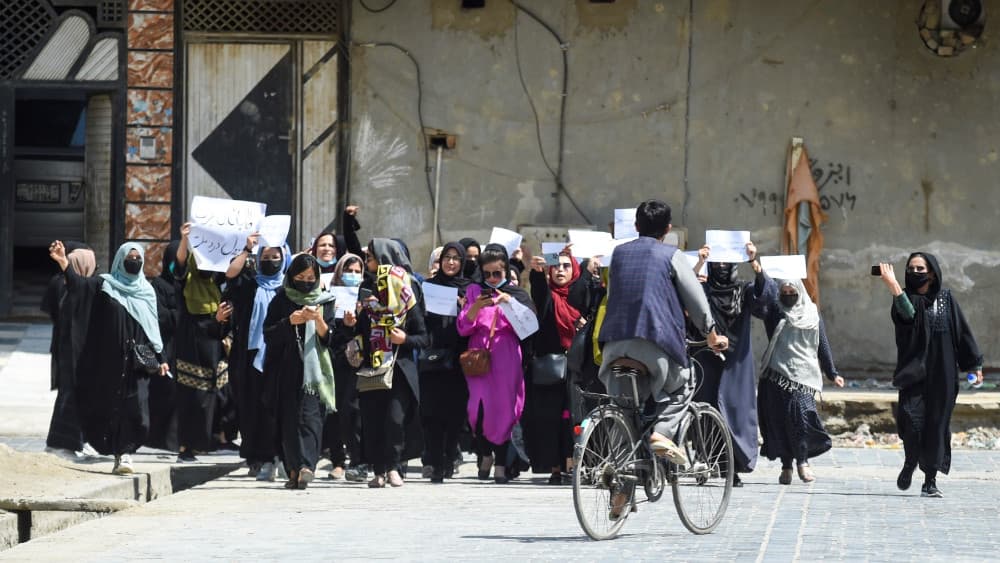
ISLAMABAD: Afghanistan's Taliban authorities moved to formalize the suppression of dissent by officially endorsing a new "Police Law" that imposes an absolute prohibition on all public gatherings nationwide.
The interim Taliban's Ministry of Justice published a 53-article "Police Law" on Saturday that explicitly forbids all demonstrations nationwide. The law was endorsed by Taliban supreme leader Hibatullah Akhundzada and renames the national police force "Shurta," adopting Arabic terminology favored by the group.
Article 50 of the statute states plainly: "Any demonstration within the territory of Afghanistan is prohibited."
The law formally codifies what has been Taliban practice since the group's takeover in 2021. As reported by the United Nations Assistance Mission in Afghanistan, security forces have responded to protests over the years with lethal force.
An 11-year-old boy was killed by police gunfire during a protest where residents were demonstrating against arbitrary arrests by the Taliban in Herat's Jebrai neighborhood in August, according to the UN Assistance Mission in Afghanistan. In Badakhshan province, at least 10 people were shot dead and more than 40 wounded when police opened fire on residents, Amnesty International documented in a statement on the group's 2025 annual report.
The law represents a shift from Taliban's reliance on informal bans to statutory repression. In September 2021, two months after seizing Kabul, Taliban authorities ordered a prohibition on all demonstrations "until a policy of demonstration is codified," according to Amnesty International's briefing "Afghanistan's Fall Into the Hands of the Taliban" published September 2021.
Saturday's law fulfills that order.
The legislation eliminates protections previously guaranteed under Afghanistan's 2004 Constitution, which protected citizens' right to gather peacefully. UN Special Rapporteur on Human Rights in Afghanistan Richard Bennett has stated the absolute prohibition violates Article 21 of the International Covenant on Civil and Political Rights, which guarantees the right to peaceful assembly. Bennett has written 11 reports to the UN Human Rights Council documenting a "downward trajectory" in human rights since the Taliban's return to power.
The law expands police authority beyond protest sites, allowing detention without judicial oversight. Article 27 extends pre-trial detention to 10 days without court authorization. Article 41 permits police to threaten suspects with death during interrogation, codifying tactics documented in detentions across the country.
Women protestors detained
Women have mounted the most organized resistance to Taliban restrictions. In November 2022, Taliban forces detained women's rights activist Zarifa Yaqobi at a press conference where she was launching the Afghan Women's Movement for Equality, the UN High Commissioner for Human Rights spokesman Jeremy Laurence said in a statement.
Yaqobi was held for 41 days. She disclosed in a statement at Canada's Parliament in March 2024 that she underwent electrocution, severe beatings and described hearing women in nearby cells pleading not to be sexually assaulted.
Widespread human rights violations
The UN Assistance Mission documented over 1,600 human rights violations in Taliban detention facilities between January 2022 and July 2023, with more than half involving torture, according to UNAMA's public statements.
In June this year, UNAMA reported that journalists and media workers faced 336 violations from August 2021 through September 2024, including 256 arbitrary arrests.
The Committee to Protect Journalists reported on Aug 14 that Khalid Qaderi, a Radio Nawruz reporter in Herat, became the first journalist convicted and sentenced by the Taliban for his reporting following the group's takeover.
Waliullah Rahmani, the Committee to Protect Journalists' Afghanistan-Pakistan Representative, said in a statement that women journalists face "additional discrimination" including bans on their voices in some provinces.
The new law contradicts Afghanistan's commitments under international treaties to which the nation remains bound, according to statements by UN human rights officials. In July 2025, the International Criminal Court issued arrest warrants against Taliban leader Akhundzada and Taliban Chief Justice Obaidullah on charges of crimes against humanity based on gender persecution, according to the International Criminal Court's public record.
Fereshta Abbasi, an Afghanistan researcher at Human Rights Watch, wrote in a published commentary in August that Afghan nationals deported from Germany have been subjected to torture and arbitrary detention upon return, violating international non-refoulement principles that prohibit returning people to countries where they face persecution.
According to human rights organizations including Human Rights Watch and Amnesty International, the systematic criminalization of assembly removes a primary avenue through which women and marginalized populations have resisted government restrictions on movement, employment, and education. These restrictions have been characterized by international bodies as “systematic gender persecution.”