


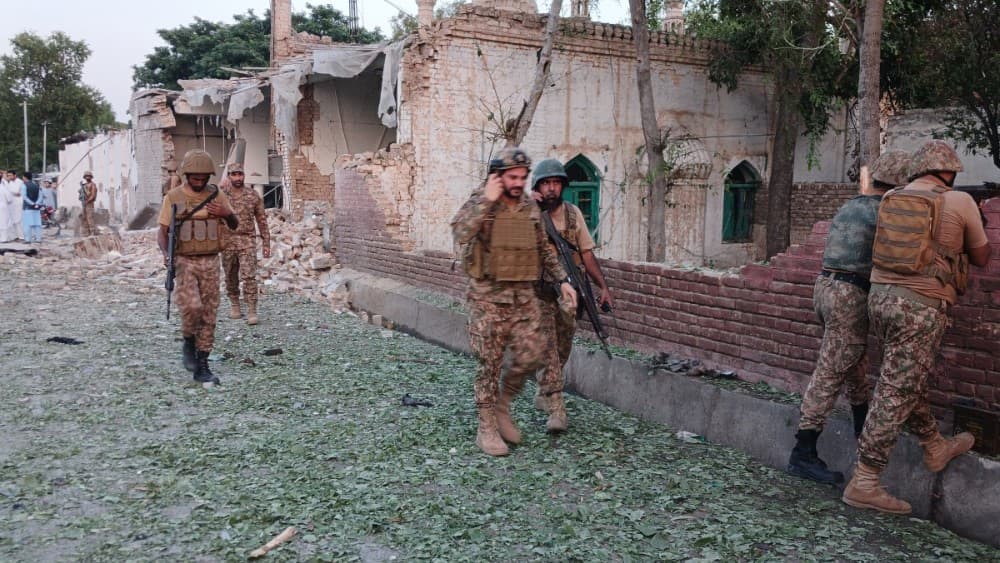
ISLAMABAD: Pakistan has called on the Afghan Taliban to dismantle terrorist sanctuaries and support networks in Afghanistan following the deadly attack on a mosque inside Kohat’s Old Police Lines, warning that Islamabad will take “all necessary measures” under international law to protect its citizens, territory and sovereignty.
The Information Ministry said the Friday attack was carried out by “the vilest of Khawarij with roots in Afghanistan,” and slammed the Taliban regime of allowing terrorist networks to operate from Afghan soil.
“Pakistan has both the will and the capability to eliminate terrorist threats wherever they are and will take all necessary measures, in accordance with international law, to protect its citizens, territory and sovereignty,” the ministry said.
Islamabad said it had repeatedly conveyed concerns to the Afghan Taliban over the presence of terrorist sanctuaries, recruitment and support infrastructure in Afghanistan.
The ministry said the Taliban must “dismantle these networks rather than deflect responsibility,” adding that any condemnation of attacks must be accompanied by “credible, verifiable and sustained measures” to prevent terrorist groups from planning and launching attacks.
The statement came after the Afghan Foreign Ministry condemned the Kohat attack but did not describe it as terrorism.
Attack leaves police and civilians dead, injured
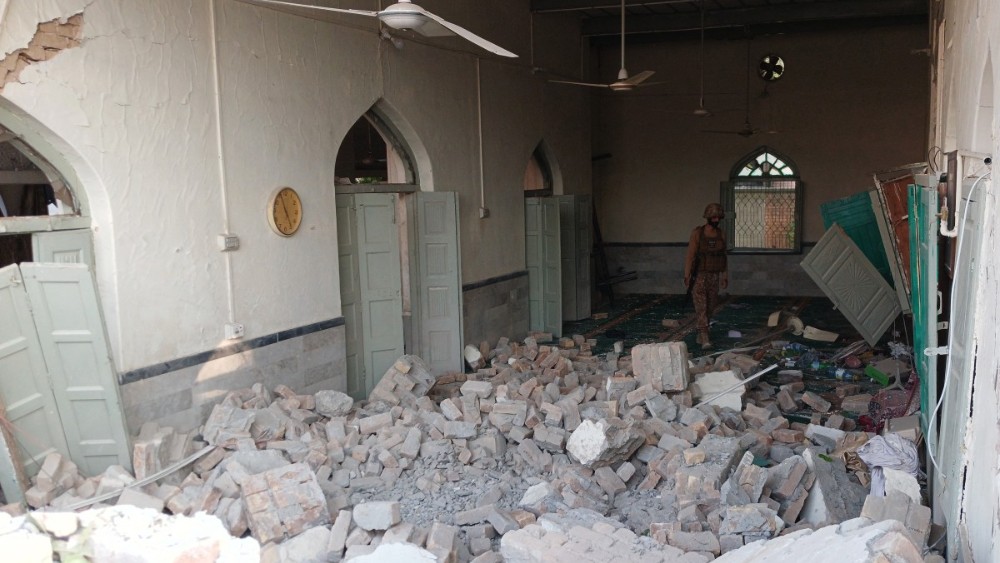
The Kohat attack struck during Friday prayers at a mosque inside the Old Police Lines in Khyber Pakhtunkhwa, a province that has remained at the center of Pakistan’s fight against terrorism.
At least 22 people were martyred and 103 injured, according to Kohat hospital officials, although casualty figures have varied as authorities continue to account for victims.
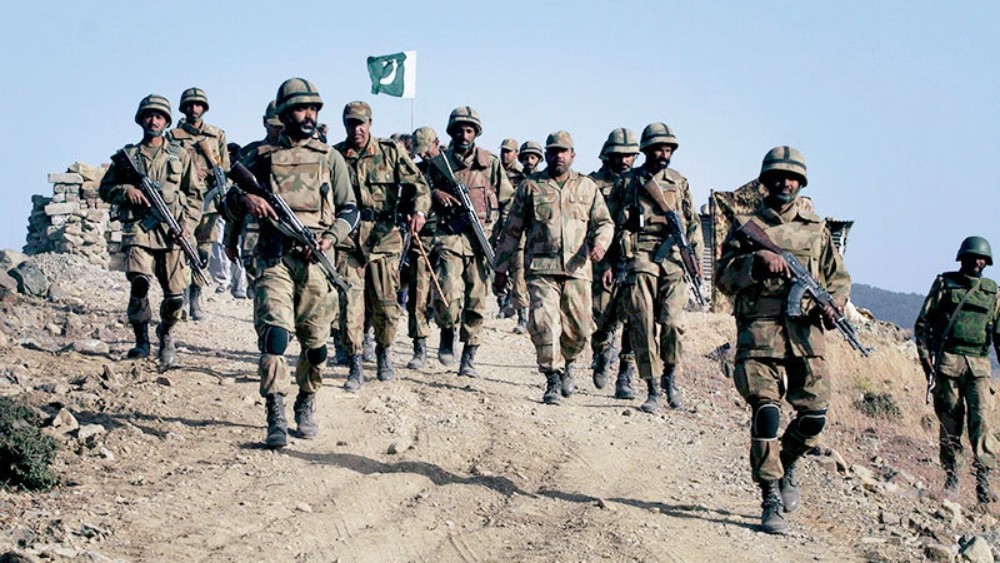
Authorities also launched a security operation after the blast as terrorists attempted to enter the Police Lines. KP Police later said eight terrorists were killed during the retaliatory operation, while federal security officials gave a figure of seven.
President Asif Ali Zardari and Prime Minister Shehbaz Sharif condemned the attack, called for immediate medical treatment for the injured and ordered authorities to investigate the nature and causes of the blast.
The president said the complete elimination of Fitna Al-Khawarij and terrorists operating with foreign backing was imperative for national security.
Interior Minister Mohsin Naqvi said the actions of the Khawarij would not weaken the country’s resolve to confront terrorism.
Inside Kohat hospital
At the district hospital, injured police personnel lie on beds as doctors and medical staff tend to wounds to their legs and other parts of their bodies. Relatives sit beside the injured, keeping vigil as they receive treatment in the aftermath of the attack.
Among those injured was police officer Umer Hayat, who told AFP that he had gone to the mosque after changing out of his uniform at police headquarters.
“When we stood up for the second rak’ah, the blast occurred. After that, a wall collapsed on me,” Hayat said.
He said he called for help but remained trapped for several minutes before losing consciousness.
“Later, someone came, lifted me up, and took me to the hospital,” he said.
Hayat’s account offers a direct glimpse into how the blast unfolded inside the mosque, where police personnel had gathered for Friday prayers.
‘The last 20-hour engagement’
Khyber Pakhtunkhwa Chief Minister Sohail Afridi visited the attack site and Kohat’s district hospital, where he met officials and injured personnel and reviewed the emergency response.
Afridi praised the Kohat district administration, police, Counter Terrorism Department, Special Branch, rescue services, doctors and residents for confronting the terrorists during what he described as a 20-hour engagement.
“First of all, I pay tribute to our police department, CTD, Special Branch, rescue services, doctors, District Administration, and the people of Kohat,” Afridi said.
He also paid tribute to police officers and civilians martyred in the attack, placing the incident within the broader history of terrorism in the province.
“Khyber Pakhtunkhwa has given immense sacrifices in this war against terrorism over the last 22 years since 2004,” he said. “80,000 precious lives of ours were lost.”
The chief minister also announced measures aimed at expanding health care capacity in KP, including a fully funded 1,000-bed steel-structure hospital in Kohat, which he said would be built within six months.
“In this context, I announced a 1,000-bed hospital for Kohat, and God willing, we will build it in a record six months,” he said.
Afridi also announced plans to upgrade District Headquarters hospitals across the province with modern diagnostic equipment, including CT scans and MRI machines, as well as health care projects in Malakand and Peshawar, a police hospital and a new mosque.
Terrorism central to Afghanistan ties
The Kohat attack has further sharpened Pakistan’s longstanding dispute with the Afghan Taliban over cross-border terrorism.
Pakistan has repeatedly said terrorist groups operating from Afghanistan pose a security threat to the country and has called on Kabul to prevent its territory from being used for attacks. Foreign Office spokesperson Ambassador Sajjad Haider Khan said earlier this month that Pakistan considers support and abetment by elements in Afghanistan, including the Taliban regime, to be an external dimension of the terrorism challenge facing KP and Balochistan.
The Foreign Office has also said Pakistan’s efforts to engage Afghanistan through direct talks and mediation by countries including Qatar, Türkiye and China have not produced the desired results, with Islamabad maintaining that terrorism emanating from Afghan territory must stop.
Pakistan has described TTP and affiliated networks as Fitna Al-Khawarij, a state designation intended to distinguish the group from Islam and emphasize its anti-state character. Islamabad also uses Fitna Al-Hindustan for BLA-associated separatist terrorism in Balochistan.
‘Taliban, TTP share ideological links’
Afghan affairs expert Hassan Khan, speaking to Pakistan TV Digital earlier this month, said Pakistan’s dispute was not with Afghanistan as a country but with the Afghan Taliban over their alleged links with terrorist networks.
“As you may have heard, the Foreign Office spokesman just a few days back said that Afghanistan is not our enemy,” Khan said. “I think Pakistan’s policy is that we have nothing against Afghanistan, but our only issue is with the Afghan Taliban.”
Khan said the Afghan Taliban and TTP had fought alongside each other against the former Afghan government and international forces and described them as “ideological brothers.”
“The Afghan Taliban and the Pakistani Taliban were together fighting against the Afghan government and the international forces for almost two decades,” he said. “They shared everything. They are ideological brothers. Their view of religion is the same.”
Khan also said the Pakistani state’s designation of TTP as Fitna Al-Khawarij and the group’s reported allegiance to Taliban leader Mullah Hibatullah Akhundzada were evidence, in his view, of an ideological relationship.
“So I don’t think this is a matter of Afghan national interest or Afghan political interest,” he said. “It is a matter of their ideology, especially that of the Afghan Taliban.”
Khan’s comments represent his assessment of the relationship and were made in the context of Pakistan’s dispute with the Afghan Taliban.
‘Taliban outside international recognition’
Former Pakistan ambassador Mansoor Khan said the Afghan Taliban’s lack of international recognition was linked to several concerns, including the absence of a broader political settlement, restrictions on women and girls, human rights concerns, media freedoms and the presence of terrorist groups.
He said there had been an expectation among Afghans, neighboring countries and the wider international community that the Taliban would pursue a political settlement following commitments associated with the Doha process.
“Afghanistan is a multiethnic, multipolitical country, so there should be some kind of political settlement involving other groups, other ethnicities and other political parties as well,” he said.
Khan said the Taliban had also not developed what he described as a constitutional framework during its five years in power and had faced international criticism over restrictions on girls’ education, women’s access to work and media freedoms.
He also pointed to security concerns among neighboring countries.
“There are so many concerns from the region and neighboring countries, including Pakistan, about the presence of terrorist groups,” he said.
The ex-envoy said the Taliban government had not, in his assessment, established sufficient arrangements with neighboring countries or the international community to become part of a broader counterterrorism framework.
“So all these factors that I have narrated are the reasons, or the factors, behind the Afghan Taliban government not being internationally recognized,” he said.