


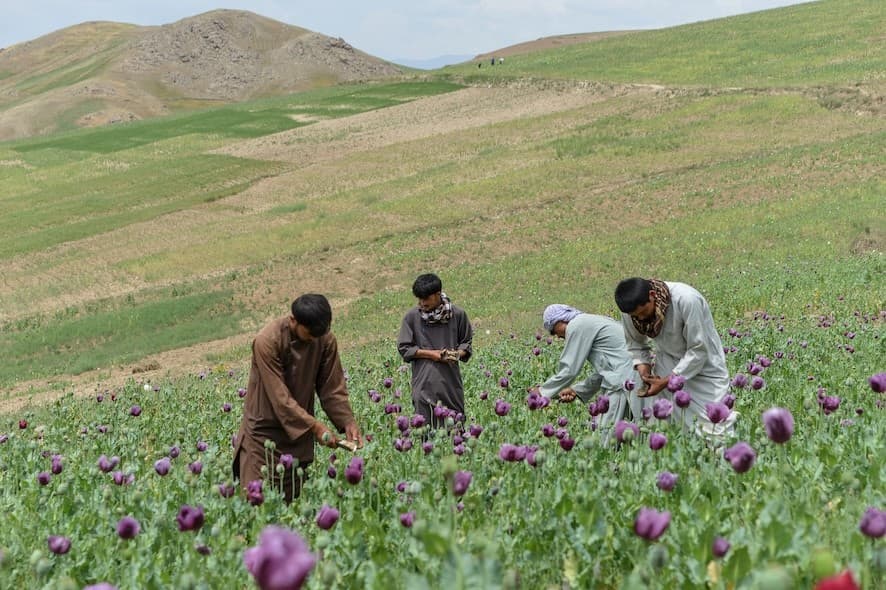
ISLAMABAD: Large stockpiles of illicit opium accumulated in Afghanistan before the Taliban's nationwide poppy ban continue to sustain the global heroin trade, delaying any immediate disruption to international drug markets despite a collapse in cultivation, according to the World Drug Report 2026 released by the United Nations Office on Drugs and Crime (UNODC).
The report said Afghanistan's unprecedented crackdown on poppy cultivation has reduced opium production by around 95% since the Taliban imposed the ban.
However, it adds, the large quantities of opium accumulated before the ban continue to feed international drug markets, delaying any immediate disruption to global heroin supplies.
Afghanistan's long legacy as the world's drug hub
For more than two decades, Afghanistan remained the world's largest producer of illicit opium, supplying nearly 80 percent of the world's illicit opium and serving as the backbone of the global heroin trade.
The narcotics economy became one of the country's largest underground industries, enriching criminal networks, smugglers and transnational trafficking syndicates while fueling corruption, organized crime and regional insecurity.
According to the UN report, no other country, including Myanmar, Mexico or Laos, has been able to replace Afghanistan's dominant role in global opium production despite the sharp decline in Afghan cultivation.
Heroin supply tightens, synthetic drugs rise
The report warns that while heroin trafficking will continue for now because of existing stockpiles, shrinking supplies are already reshaping global drug markets.
In 12 major destination markets, the price of one gram of pure heroin nearly doubled during 2023 and 2024, from around $250 to nearly $500, while purity declined because of reduced availability.
The UN also warns that traffickers are increasingly turning to synthetic opioids, including fentanyl and nitazenes, which are cheaper to manufacture, easier to smuggle and significantly more potent than heroin.
Experts fear this shift could trigger a new global public health crisis due to rising overdose deaths.
Trafficking networks remain active
Despite the cultivation ban, heroin trafficking has not stopped.
The report says seizures of heroin and opium in Afghanistan and neighboring countries indicate that criminal networks continue to move narcotics using stockpiles accumulated before the Taliban ban.
Although the volume of seizures has declined, trafficking routes remain active and are expected to continue operating until the remaining reserves are exhausted.
Economic crisis deepens for Afghan farmers
The report says that while the poppy ban has significantly reduced cultivation, it has also dealt a severe blow to Afghanistan's fragile rural economy.
Thousands of farming families who depended on opium cultivation have lost their primary source of income.
With widespread poverty, unemployment and limited alternative livelihoods, the UN warns that economic hardship continues to grow, increasing the risk that farmers may return to illicit cultivation unless sustainable sources of income are created.
Signs of regional spillover
The report notes early indications that traffickers may be looking beyond Afghanistan for new production areas.
According to UN data, the area of destroyed poppy fields in India and some other countries increased from 5,868 hectares in 2022 to 13,200 hectares in 2023.
While this does not suggest these countries can replace Afghanistan's former production levels, it indicates criminal networks are exploring alternative cultivation zones.
Warning: Afghanistan's drug legacy is far from over
The UNODC concludes that Afghanistan's poppy ban has dramatically altered the global heroin market, but decades of accumulated opium stockpiles mean the country's influence on international drug trafficking will continue through at least the end of 2026.
The report says Afghanistan's role in the global narcotics trade is entering a new phase rather than disappearing altogether.
As heroin supplies gradually decline, the growing shift toward synthetic opioids presents a new and potentially more dangerous challenge for governments, law enforcement agencies and public health authorities around the world.