


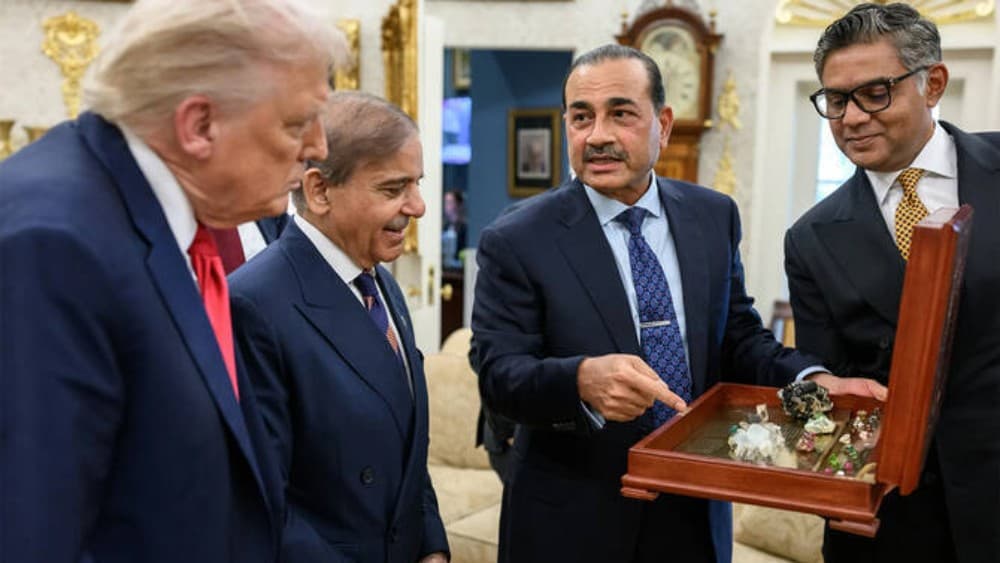
ISLAMABAD: The US expects to announce new partnerships with Pakistan in the critical minerals sector later this year, as Washington steps up efforts to secure global supply chains for strategic metals while encouraging American companies to expand investments in the country’s largely untapped mining industry.
Speaking during a background briefing with journalists, a US Embassy official said Washington is working with American companies exploring opportunities ranging from acquiring small mines and securing mineral offtake agreements to pursuing large-scale investments in copper and other strategic deposits.
The official said the US also hopes to unveil government-to-government initiatives this fall covering mining cooperation, including workforce training and support for developing new projects.
The remarks underscore growing US interest in Pakistan's mineral wealth as the Trump administration prioritizes access to critical minerals needed for semiconductors, artificial intelligence, defense technologies and energy infrastructure.
“The Trump administration has very much put a focus on forging these deals in the mining sector,” the official said, adding that critical minerals have become central to US “economic security, prosperity, [and] national defense.”
“Investments in Pakistan's mining sector can be transformative for its economy,” the official said, noting that the sector currently contributes about 3% to Pakistan's gross domestic product but has the potential to become a much larger driver of growth.
Washington's interest comes as Pakistan has intensified efforts to attract foreign capital. "Part of that is due to Pakistan more directly seeking that foreign investment in the sector,” the official said, pointing to the Pakistan Minerals Investment Forum and the country's participation in major mining conferences in Australia, Saudi Arabia and Canada.
"The government is doing everything they can to facilitate projects, to facilitate investment and to channel opportunities to US companies and foreign companies in general," he stated.
The US official added that American companies have shown particular interest in copper, antimony and tungsten deposits, although discussions remain at an early stage. Geographically, interest is no longer confined to Balochistan, with investors also examining opportunities in Khyber Pakhtunkhwa, and the Gilgit-Baltistan region.
Multiple investment models
The official described several types of commercial partnerships under discussion rather than a single investment model.
Rather than focusing solely on flagship projects, the embassy described growing US interest across the mining sector.
Some American companies are negotiating offtake agreements to purchase minerals from existing Pakistani mines for processing in the United States or allied markets, including Europe and South Korea. Others are evaluating acquisitions of smaller mines that can be expanded relatively quickly, while larger firms are studying potential investments in major copper projects that could require billions of dollars in financing.
“We encourage US companies to partner with experienced Pakistani partners who are working here already to navigate the local operating conditions and also understand the unique security risks of operating mines, especially in areas like Balochistan and KPK, where a lot of these mineral deposits are located,” the official added.
Reko Diq financing still moving
The official reaffirmed US support for the Reko Diq copper-and-gold project in Balochistan, where the US Export-Import Bank is considering approximately $1.25 billion in financing as part of a broader funding package that remains under negotiation.
Responding to questions about reports that the project's development timeline and financing requirements are being reassessed, the official said Reko Diq is “still moving forward,” though perhaps at a slower pace than originally envisioned.
The official said large mining developments routinely undergo revisions as engineering studies advance and financing structures evolve.
Long-term economic impact
The embassy official projected that Reko Diq alone could eventually contribute roughly half a percentage point to Pakistan's GDP while generating substantial export earnings and foreign exchange inflows.
Once fully operational, the project is expected to generate around $2 billion annually in free cash flow, according to current projections cited during the briefing.
“If it is that $2 billion cash flow per year, it's about half a billion dollars that is going back to these SOEs that can either lead to more exploration or be used in whatever way the government wants,” he said. “And then also about half a billion dollars going to Balochistan that can lead to development.”
He said the project would also support local employment, transportation providers and equipment suppliers, generating broader economic activity beyond revenues accruing to shareholders.
Strategic supply chains
Washington framed its growing engagement as part of a broader effort to diversify global supply chains for critical minerals rather than as a geopolitical contest.
Asked whether US investments were intended to counter China's presence in Pakistan's mining sector, the official avoided direct comparisons, saying Pakistan is seeking investment from multiple countries and there is room for American, Chinese and other international companies to participate.
The official argued that greater investment from all sources would help expand Pakistan's mining ecosystem by improving technical expertise, geological surveying and workforce development.
Security and investment climate
The embassy acknowledged that many prospective mining areas, particularly in Balochistan and Khyber Pakhtunkhwa, present security challenges.
The official said American companies are fully aware of those risks before investing and typically work with experienced Pakistani partners while developing their own security plans. Washington also continues to encourage Pakistan to provide a transparent investment framework and robust security for mining operations.
To improve investor confidence, the embassy urged Pakistani license holders to undertake internationally recognized geological surveys and feasibility studies before seeking foreign partners, allowing investors to better assess commercial opportunities.
The briefing marked the first in a year-long series of economic outreach sessions by the US Embassy aimed at expanding engagement with Pakistani media on trade, investment, innovation and broader economic cooperation.