


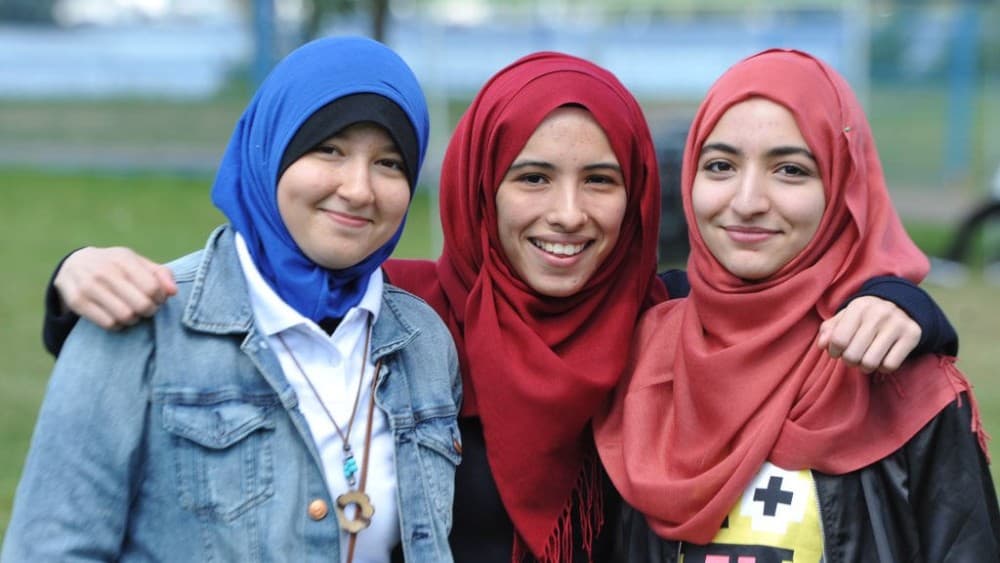
ISLAMABAD: A new school year in Austria has begun amid a controversial law banning Muslim headscarves for girls under 14, according to BBC News.
The decision has reignited a wider European debate over religious freedom, secularism, integration and the extent to which governments can regulate the religious expression of Muslim minorities.
The law, which took effect on Sept. 1 with the 2026-27 school year, prohibits pupils up to 14 from wearing a headscarf that covers the head “according to Islamic traditions” in public and private schools. Parliament approved the measure in December 2025.
The government says the ban is intended to protect girls from coercion, promote equality and safeguard their personal freedom. Integration Minister Claudia Bauer has described the headscarf as a potential “sign of oppression,” arguing that girls should be able to grow up freely and independently.
A first violation triggers a discussion involving the school, pupil and guardians. Repeated violations can lead to intervention by authorities and child and youth welfare services, while guardians may ultimately face fines of up to €800 ($930).
Ban opposed
Critics, however, say the measure restricts freedom of religion and disproportionately targets Muslims.
Austria’s official Islamic Religious Community (IGGÖ) has opposed the ban and plans to challenge it before the Constitutional Court. A legal assessment commissioned by the organization found serious concerns over religious neutrality and equality.
The issue is especially contentious because Austria’s Constitutional Court struck down an earlier headscarf ban in primary schools in 2020, ruling that it violated religious neutrality by disproportionately targeting Muslim students, according to BBC News.
Chancellor Christian Stocker has also called for a constitutional ban on what he terms “political Islam,” arguing that the political use of religion is incompatible with democracy and Austria’s constitutional order. Such a constitutional amendment would require a two-thirds parliamentary majority.
A wider European debate
Austria is not the only country regulating Islamic dress.
France banned “conspicuous” religious symbols, including Islamic headscarves, in public schools in 2004. The restriction applies to religious symbols generally, including Jewish skullcaps and large Christian crosses. France also introduced a nationwide ban on face-covering garments in public places in 2010.
Belgium imposed a nationwide ban on face-covering clothing in public places in 2011, largely affecting the wearing of niqabs and burqas.
Restrictions on visible religious symbols have also affected Muslim students. In 2024, the European Court of Human Rights declared inadmissible a case brought by three Muslim women challenging a ban on visible religious symbols in Flemish public education.
Denmark introduced a public-space ban on face-covering garments in 2018, with the niqab and burqa at the center of the debate.
Switzerland has also adopted legislation restricting face coverings in public places following a referendum.
European courts
The European Court of Human Rights has repeatedly considered cases involving Muslim dress and religious freedom.
In 2008, it ruled on two cases involving French Muslim schoolgirls excluded after refusing to remove their headscarves during physical education classes. The court found no violation of their freedom of religion under Article 9 of the European Convention on Human Rights.
Its case law has also recognized that states may, under certain circumstances, impose religious-neutrality requirements on public-sector employees.
Critics argue that even where laws are framed in religiously neutral terms, Muslim women and girls are disproportionately affected because the hijab, niqab and burqa have become central to political debates over religious dress.
The distinction between the garments is significant: a hijab covers the hair while leaving the face visible; a niqab covers the face except for the eyes; and a burqa provides more extensive face and body coverage.
Austria’s measure is therefore notable for directly restricting the ordinary hijab worn by girls in schools, rather than focusing on face covering.
Allowing freedom of choice or restricting it?
At the center of the controversy is the question of choice: whether removing a religious garment from a child in the name of protecting her freedom safeguards that freedom or restricts it.
Muslim organizations argue that governments should not assume that every girl wearing a hijab is being coerced, noting that it can also represent religious identity and personal choice.
Austria’s law has renewed unresolved questions across Europe over the balance between religious freedom, state neutrality, women’s rights and the rights of Muslim minorities.