


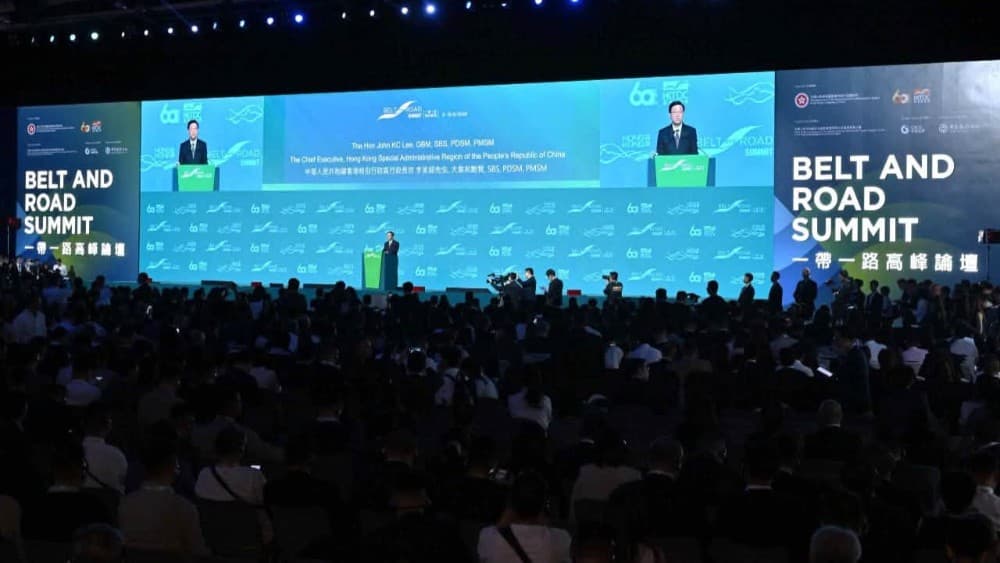
- Pakistan pitches CPEC Phase II at BRI summit
- Pakistan seeks Cathay Pacific flights to boost trade
- Jam Kamal seeks stronger Pakistan-Hong Kong economic ties
- Pakistan pursues new regional trade routes and markets
- Pakistan seeks stronger BRI links with Southeast Asia
ISLAMABAD: Pakistan used the 11th Belt and Road Summit in Hong Kong to advance a broad economic diplomacy agenda centered on trade, investment and regional connectivity, with Federal Minister for Commerce Jam Kamal Khan presenting CPEC Phase II as part of a wider effort to integrate Pakistan into regional and global value chains.
Khan arrived in Hong Kong on Sept 9 to represent Pakistan at the summit, where he participated in key sessions, engaged senior political and business leaders and promoted trade and investment opportunities.
Pakistan also maintained a dedicated stall at the summit showcasing its commercial and investment potential.
At the opening ceremony, attended by government leaders, ministers, diplomats and business figures from BRI partner countries, Khan held initial discussions with counterparts on trade, investment, connectivity and economic cooperation.
He delivered Pakistan’s main address at the summit on Sept 10, outlining Islamabad’s vision of using connectivity to translate the country’s geographic position into greater trade, investment and industrial opportunities.
“Pakistan is emerging as a vital bridge between West, Central and East Asia,” he said.
Khan said CPEC had helped position Pakistani ports as regional connectivity hubs linking landlocked Central Asia and western China with warm-water seas, while cooperation in energy, infrastructure and industrialization was reshaping Pakistan’s economic landscape.
He presented the next phase of this development as extending beyond physical infrastructure, with regional cooperation increasingly shifting from transport routes toward integrated value chains.
“Regional cooperation is undergoing a profound structural evolution, transitioning from transport routes toward integrated value chains,” he said.
The minister highlighted special economic zones, modern agriculture, expanded energy capacity, digital innovation and skilled employment as components of this evolving regional economic architecture.
He pointed to expanded rail and road links with China, transit-trade arrangements with neighboring and Central Asian states and the Trans-Afghan Railway Initiative as elements of Pakistan’s connectivity strategy.
Port reforms, digitized customs and modernized logistics, he said, were helping reduce transit times and costs and strengthening Pakistan’s potential as a transshipment and trade hub.
CPEC Phase II investment pitch
A central part of Jam Kamal’s address was Pakistan’s invitation to BRI partners to explore opportunities under CPEC 2.0, particularly in industrialization, agriculture, mining, energy, technology and export-oriented production.
He said Pakistan’s economic strategy was based on export-led growth, industrial modernization, investment facilitation and regulatory reform, with greater emphasis on value addition and integration into global value chains.
“We are focused on developing traditional sectors such as textiles and agro-processing alongside knowledge-based manufacturing and services,” he said.
The minister highlighted Pakistan’s agricultural potential, including climate-smart practices, modern seed technology and improved supply chains, as well as opportunities in copper, gold, industrial minerals and critical minerals under transparent and investor-friendly frameworks.
He also cited Pakistan’s young population and overseas workforce, noting that annual remittances of around $40 billion reflected the skills and global reach of Pakistani workers.
Beyond trade and industry, Khan invited BRI partners to explore Pakistan’s tourism potential, including adventure, religious, cultural and nature-based tourism.
He said improvements in security, hospitality infrastructure and travel processes were opening the sector to international visitors and investors.
Stronger Hong Kong economic ties
The summit was also used to strengthen Pakistan’s direct economic engagement with Hong Kong.
On Sept 11, Khan held a high-level meeting with Hong Kong Chief Executive John Lee Ka-chiu, with Hong Kong Secretary for Commerce and Economic Development Algernon Yau and Pakistan’s Consul General Riaz Ahmed Sheikh also present.
The two sides agreed to strengthen Pakistan-Hong Kong trade and economic relations and reaffirmed their commitment to expanding bilateral trade, investment and people-to-people ties.
Lee praised Khan’s address at the Belt and Road Summit and appreciated Pakistan’s role in promoting regional peace and stability.
Khan called for greater cooperation in services, finance, aviation and business-to-business connectivity, while proposing the resumption of Cathay Pacific flights to Pakistan.
He said improved air connectivity could help boost trade, tourism and business activity between Pakistan and Hong Kong.
Khan also invited Lee to visit Pakistan.
In a separate meeting with Algernon Yau, the commerce minister discussed stronger institutional and business engagement, including business delegations, financial services, trade in services and aviation connectivity.
The discussions added a practical Hong Kong dimension to Pakistan’s wider connectivity agenda, extending beyond physical transport links to finance, services, investment and business networks.
Regional economic diplomacy
On the sidelines of the summit, Khan also held separate meetings with counterparts from Sri Lanka, Bangladesh and Qatar, as well as with the Secretary General of the International Organization for Mediation.
With Sri Lankan Minister for Trade, Commerce, Food Security and Development Wasantha Samarasinghe, he discussed expanding bilateral trade and making greater use of Pakistan’s first-ever Free Trade Agreement with Sri Lanka.
The two sides emphasized business-to-business and people-to-people exchanges and explored cooperation in connectivity and infrastructure.
They also discussed artificial intelligence, cybersecurity, food security and the impact of tensions in the Middle East on the global economy and international trade.
Khan thanked Sri Lanka for supporting the reclassification of Pakistani kinnow for improved market access, while the Sri Lankan side welcomed Pakistan’s cooperation concerning pineapples, avocados and king coconut.
With Bangladeshi counterpart, Khandakar Abdul Muktadir, Khan discussed stronger economic cooperation and bilateral relations.
He highlighted Pakistan’s rice exports to Bangladesh as an encouraging example of growing trade and identified textiles and other sectors as areas with further potential.
The two sides also discussed industrial cooperation and the exchange of expertise, along with climate change, food security, cybersecurity and artificial intelligence.
Both ministers agreed that the Belt and Road Initiative and stronger regional connectivity could contribute to the region’s economic future and create new opportunities for trade and development.
With Qatar’s Minister of State for Foreign Trade Affairs Ahmad bin Mohammad Al Sayed, Khan discussed developments in the Middle East and their broader regional and economic implications.
The two sides explored new avenues for transit and trade through the Middle East and Central Asia, including potential routes connecting Pakistan and Qatar through the Middle East toward Türkiye and onward to Europe.
They also discussed expanding bilateral trade and identifying new areas of economic cooperation.
Khan said stronger regional connectivity could create new markets and broader opportunities for trade.
Mediation, institutional cooperation
The commerce minister also met Teresa Chan, Secretary General of the International Organization for Mediation (IoMed).
Chan briefed him on the organization, established in 2025, and highlighted Pakistan’s role as a contracting and founding member.
The two sides discussed the growing importance of mediation in resolving disputes involving governments and private organizations and the role of institutional mechanisms in facilitating peaceful dispute resolution.
Broader connectivity proposition
Khan’s four-day Hong Kong visit thus combined Pakistan’s BRI policy message with targeted economic diplomacy.
At the summit, Islamabad presented CPEC Phase II as an investment and industrialization platform, while the minister’s meetings with Hong Kong and regional counterparts sought to develop the trade, financial, aviation and business links needed to turn connectivity into wider economic opportunities.
The outreach also extended Pakistan’s regional economic proposition beyond its traditional China focus, encompassing Central Asia, South Asia, the Gulf, Türkiye and European markets.