


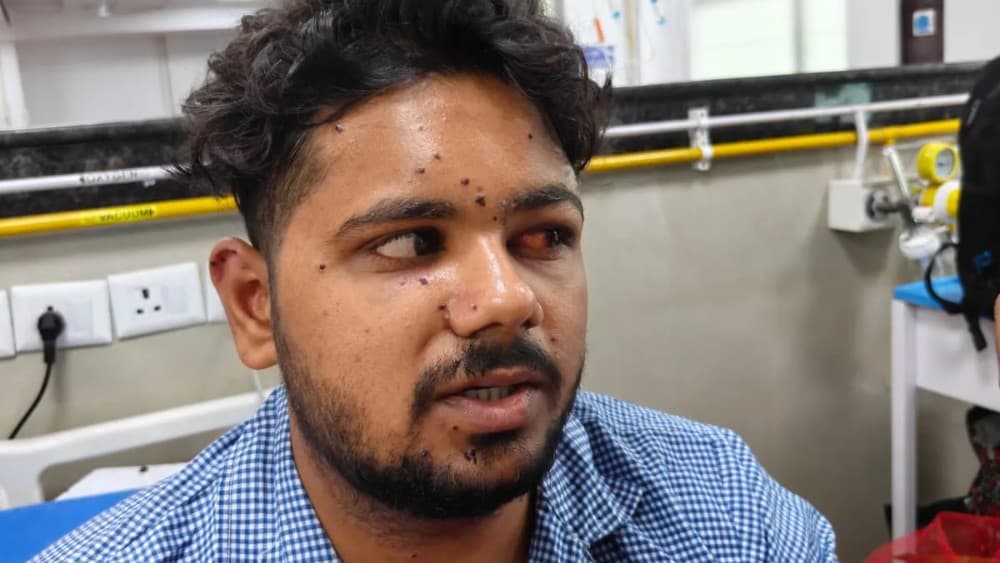
ISLAMABAD: Enough evidence has emerged to indicate that Delhi’s anti-riot forces used pellet guns against protesters during the July 20 march toward the Indian Parliament, reviving memories of the controversial use of these potentially lethal weapons in Indian Illegally Occupied Jammu and Kashmir during the mass protests of 2010 and 2016.
According to Indian media reports, at least three people were treated at hospitals in Delhi for pellet gun injuries sustained during the Cockroach Janta Party protest.
The injured were identified as Sheikh Irshad Mansoori, a 25-year-old Delhi University student; 19-year-old Sahil Lochab; and a 28-year-old journalist with Outlook magazine.
Vijaita Singh, deputy editor of The Hindu, wrote on X that this was the first reported incident of pellet gun use in the Indian capital, Delhi.
The Indian Express, citing government sources, reported that an internal inquiry by the Central Reserve Police Force (CRPF) found that a member of its Rapid Action Force (RAF) had fired at least seven rounds from a pellet gun at the protesters demanding the resignation of then Education Minister Dharmendra Pradhan.
According to the report, government sources said the preliminary inquiry concluded that five of the seven rounds struck protesters, while the remaining two hit the ground.
The Rapid Action Force is a specialized unit of the CRPF, established in 1992 to deal with riots and other public disturbances.
The findings have renewed scrutiny of the use of pellet guns for crowd control. The practice has long drawn criticism from human rights organizations because of the risk of causing permanent injuries, including blindness, and, in some cases, death.
Human rights organizations have called for investigations into the alleged use of excessive force against the protesters.
Human Rights Watch said that Delhi Police and the RAF attacked protesters with "electric shock batons, tear gas and stones," and implemented internet blackouts to restrict communication.
Pellet guns use in Indian-Occupied Jammu and Kashmir
While the deployment of pellet guns during the Delhi protests has been widely condemned, the practice is not new in India.
Since 2010, Indian law enforcement agencies have repeatedly used pellet guns in Indian-occupied Jammu and Kashmir, drawing sustained criticism over their widespread deployment and the severe injuries they have inflicted.
Eph, a Kashmiri writer and researcher who spoke to Middle East Eye under a pseudonym for safety reasons, said that Indian-occupied Kashmir was a "testing lab" for tools of suppression.
She explained, "Once everything was tested and they experimented with 'efficient' ways to suppress a protest, they began exporting the tactics to other places."
More than 100 Kashmiris, mostly young people, were killed in 2010 when Indian police opened fire on peaceful protesters in several parts of the valley.
Pellet guns were first used in Indian-occupied Jammu and Kashmir on August 14, 2010, to control stone-pelting Kashmiri youth, many of whom were minors. In addition to pellet guns, security forces used tear gas and chili grenades.
The use of pellet cartridges inflicted grievous and, in some cases, fatal injuries on hundreds of Kashmiri protesters, leading to widespread criticism from civil society and human rights organizations.
Later, despite assurances from the Indian government that it would refrain from using pellet guns, the then minister of home affairs said, "If these (other) measures prove to be ineffective in dispersing rioters, use of pellet guns may be resorted to."
Before the introduction of pellet guns, Indian police forces had been using plastic bullets as part of a graded response to protests in Indian-occupied Jammu and Kashmir.
The CRPF said that from July 8 to August 11, 2016, it had used 14 types of "less lethal and non-lethal" equipment for crowd control. These included oleoresin grenades, electric shells, 8,650 tear-smoke shells, and around 2,671 plastic pellets.
The CRPF also acknowledged firing around 3,000 pellet cartridges at protesters over a period of 32 days in 2016.
One report also stated that slingshots were used, with stones or glass marbles serving as projectiles.
More than 1,000 protests were reported across different parts of Indian-occupied Kashmir during July and August 2016, during which approximately 5,000 Kashmiri protesters were injured, most of them by pellet gun fire.
Reuters quoted a senior Indian police officer as saying that police were often forced to deploy less-lethal pellet guns at close range in self-defense.
Thousands injured
Various media outlets reported that thousands of people suffered pellet injuries, with hundreds sustaining eye injuries since July 2016.
SMHS Hospital in Srinagar admitted more than 570 people with mutilated retinas or severed optic nerves after their eyes were hit by pellets.
Another 27 protesters sustained pellet injuries to both eyes.
One of the youngest pellet gun victims was 19-month-old Heeba Jan, who suffered injuries in 2018 when she and her mother were caught in a pellet gun attack on Kashmiri protesters.
Indian media also reported injuries to another young victim, 15-year-old Insha Malik from the Shopian area, whose eyes were severely injured by pellet gun fire.
Apart from injuries, Indian media and human rights organizations reported at least 14 deaths resulting from pellet injuries.
The president of the Doctors Association Kashmir described pellet guns as a horrific nightmare, telling the Indian media, "Calling the pellet gun non-lethal is a dangerous fallacy. Even after the surgeries, we cannot remove all the pellets from the bodies. They are like ticking time bombs inside a person."
In July 2016, Amnesty International called on the Indian government to ban the use of pellet guns, while the United Nations High Commissioner for Human Rights described pellet guns as "one of the most dangerous weapons used against protesters."
In August 2016, Kashmiri doctors and medical workers wore white gauze patches over one eye to protest the use of pellet guns and the recent killing of a civilian in Srinagar.
Pellet guns are pump-action riot shotguns that fire metal pellets, also known as birdshot. The pellets are small metal projectiles, either round or irregular in shape. A single pellet cartridge contains around 500 pellets.