


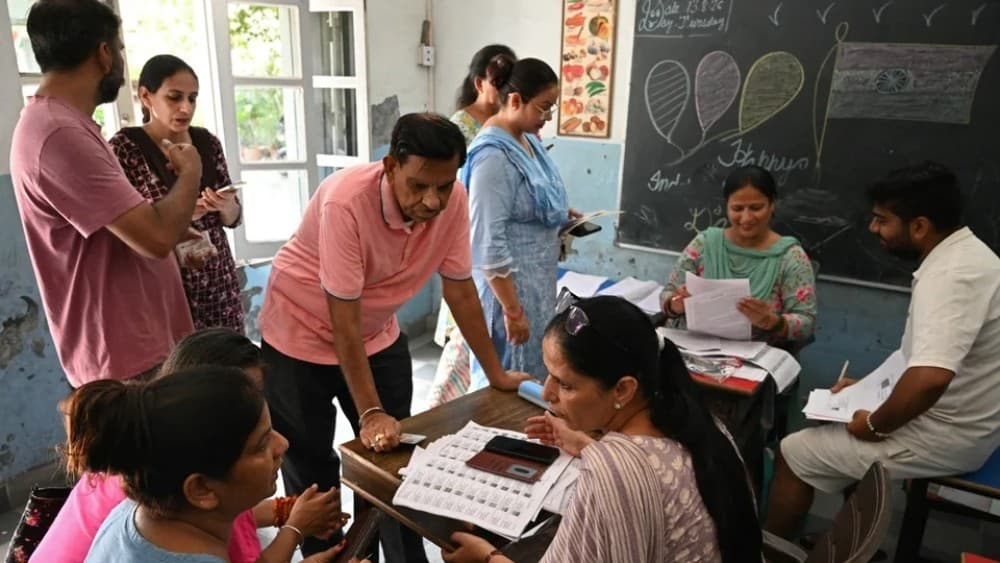
ISLAMABAD: India’s Special Intensive Revision (SIR) of electoral rolls has triggered a widening political and legal controversy, with millions of voter names removed or placed under scrutiny and critics questioning the transparency and impact of the exercise, particularly on marginalized and minority communities.
The Election Commission of India (ECI) launched the SIR in Bihar on June 24, 2025, and subsequently expanded the exercise to other states and Union territories.
The commission says the process is aimed at identifying and removing deceased, permanently shifted, duplicate and otherwise ineligible voters while ensuring eligible electors remain on the rolls. In Bihar, 6.5 million names were excluded from the draft roll, while the final roll contained about 4.7 million fewer electors than before the revision.
The scale of the wider exercise has become a major point of contention. An investigation by The Indian Express reported that more than 130 million names had been struck off draft rolls across 30 states and Union territories, although the figures cover different stages of the revision process and should not automatically be treated as permanent disenfranchisement.
A separate communication by three UN special rapporteurs in May 2026 raised concerns over reports that about 52 million voters had been excluded from electoral rolls across 12 states and Union territories, including about 9.1 million in West Bengal.
The experts sought explanations from the Indian government over allegations that the exercise disproportionately affected Muslims and other vulnerable groups.
The Election Commission has not published religion-wise deletion figures, making it difficult to independently establish the overall religious composition of those excluded.
Critics, however, have pointed to cases involving Muslim-majority areas and argued that documentation and verification requirements could disproportionately affect communities with weaker access to historical records.
West Bengal has emerged as a particularly contentious case. The ECI recently told the Supreme Court that 2.7 million voters were removed during the state’s SIR, with more than 2.2 million subsequently filing appeals for reinstatement.
The commission attributed deletions to categories including absentee, shifted, deceased and duplicate electors.
The Supreme Court has upheld the ECI’s authority to conduct the SIR. In its May 27, 2026 ruling, the court held that the commission can undertake a limited inquiry into citizenship when determining electoral eligibility.
However, it stressed that such an inquiry does not constitute a final determination of citizenship and that citizenship questions must ultimately be dealt with by the competent authority under the Citizenship Act.
The court specifically ruled that deletion from an electoral roll does not itself strip a person of Indian citizenship. Where citizenship is questioned, the ECI is required to refer the matter to the competent authority for adjudication, with the electoral consequences remaining subject to that process.
Delhi has now become another major flashpoint. Petitioners told the Supreme Court that more than 4.7 million names had been excluded from the draft electoral roll and that another 3.3 million voters had received notices over alleged “logical discrepancies” or because they could not be mapped to previous rolls.
On September 22, a bench headed by Chief Justice Surya Kant questioned whether the notices were being issued almost mechanically and asked the ECI to examine whether additional filters were necessary.
The controversy has also reached inside the election commission. An Indian Express investigation reported that Election Commissioners Sukhbir Singh Sandhu and Vivek Joshi recorded at least 14 objections over 10 months concerning issues including voter additions and deletions, Form 6, appeals and centralized access to electoral-roll databases.
The ECI has rejected suggestions of an institutional rift, saying decisions, including those relating to SIR, were approved unanimously.
Opposition parties including Congress, Aam Aadmi Party, Trinamool Congress and CPI(M) have accused the government and election authorities of facilitating large-scale exclusion from the rolls.
Some opposition leaders have described the exercise as “vote theft” or compared its documentation requirements with a potential “backdoor NRC.” These are political characterizations rather than findings established by the courts or the ECI.
The debate has acquired a significant minority-rights dimension because India has an estimated Muslim population of around 200 million, or roughly 14-15% of the country’s population.
Critics argue that any disproportionate impact on Muslim voters could have consequences for political representation, while the absence of religion-wise ECI data prevents a definitive assessment of the claim.
The SIR controversy therefore centers on a fundamental electoral question: whether the large-scale revision can simultaneously remove ineligible entries and ensure that every eligible voter is given a meaningful opportunity to remain on the rolls or seek restoration.
With millions of names removed at different stages and large numbers of appeals still being processed, the ultimate impact of the exercise will depend on how many deletions are upheld, how many eligible voters are restored and how transparently the ECI explains the basis for each category of exclusion.