


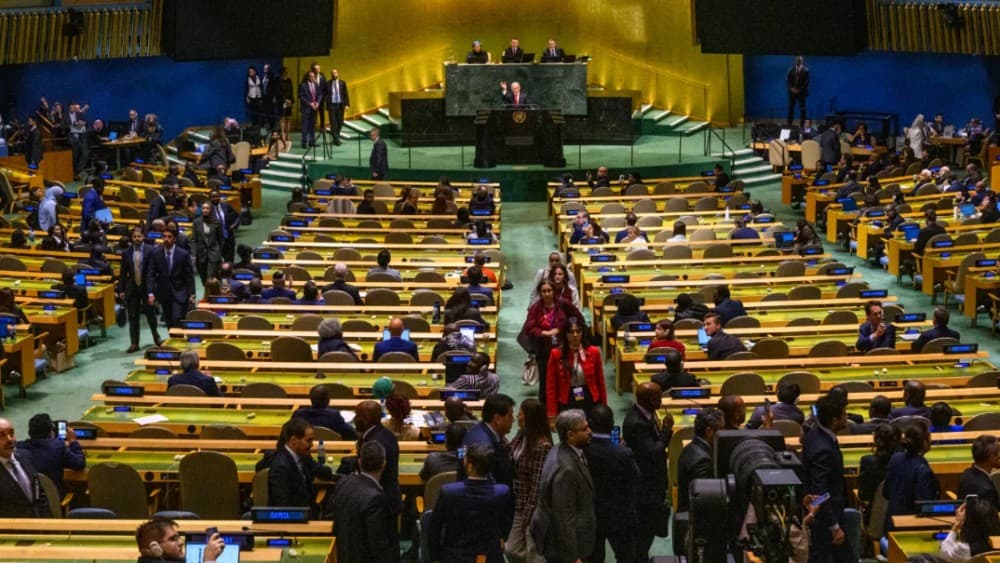
ISLAMABAD: Israeli Prime Minister Benjamin Netanyahu faced widespread protests at the United Nations on Thursday as dozens of delegates walked out of the General Assembly session during his address to protest Tel Aviv’s military operations in Gaza and its confrontation with Iran.
Netanyahu described those who left the hall as “moral cowards,” challenging them to leave if they were unwilling to hear his message, reported the American TV news channel CBS.
The half-empty UN hall during Netanyahu’s speech showed sharp divisions on Israel.
Former UN official, who served in Israel and Palestine, Andrew Whitley termed the walkout by delegates during Netanyahu's address reinforcement of the abhorrence people and states around the world feel for Israel's behavior towards Palestinians.
"Genocide and ethnic cleansing can never be tolerated and must be met with the most severe sanctions," explained Andrew Whitley, who also served as chairman of the Britain Palestine Project, while talking to Pakistan TV Digital.
He further said that such protests are necessary to stop these crimes from taking place in the first place and to warn others not to go down that path.
“What we've seen over recent years is the use of this symbolic peaceful protest, walking out of rooms, becoming more regular,” explained Professor Rosa Freedman, an expert in law, conflict and global development, about world leaders’ walkout during Netanyahu’s speech.
Talking to SBS Australia, Freedman said such walkouts have particularly been used against states perceived as either “pariah" or as powerful and therefore protected at the United Nations, citing Russia and Ukraine and now Israel.
Public reaction
The hatred was not confined to the UN hall, as several protests were held in New York before and during Netanyahu’s speech at the General Assembly.
Massive demonstrations were staged in New York City to protest Netanyahu’s presence there.


At least 100 people, including the Oscar-winning actress Susan Sarandon and Emmy-winning actress Hannah Einbinder, were detained for protesting against Netanyahu’s visit.
“What we made clear today is that New Yorkers, including Jewish New Yorkers, do not want war criminals and the architects of genocide coming to our city,” Beth Miller, political director of Jewish Voice for Peace Action, which coordinated the first protest outside the UN, told a British newspaper.
“We will not be silent as our government fully funds a genocide in Palestine,” said actor Hannah Einbinder.
Trip shortened
In view of the leaders’ and public protests, Netanyahu had to shorten his stay in New York and left soon after his address.
Israeli media reported that security officials had recommended against extending Netanyahu’s stay.
Unlike on his previous visits to the US, Netanyahu could not meet President Donald Trump this time and had to cancel his already scheduled meetings with at least nine world leaders and Elon Musk.
Former Israeli ambassador to Washington Michael Oren described the speech as a “campaign speech” and noted that Netanyahu’s unusually brief US visit, without a meeting with President Donald Trump, was significant.
“Not meeting the president was a big, big miss for him at a time when he can’t afford misses,” remarked Natan Sachs, a senior fellow of the Middle East Institute, while talking to a Norwegian TV channel.
Social media was also abuzz with hate for the Israeli PM, as subscribers on different platforms criticized him for the war in Gaza and other regional conflicts.
Leaders challenge Israel
Besides walkouts, several world leaders, during their speeches to the General Assembly, voiced severe criticism toward Israel and Prime Minister Netanyahu for their wars in Gaza and against Iran.
Netanyahu’s appearance came after several world leaders used their UN speeches to sharply criticize Israel’s conduct in Gaza.
Palestinian President Mahmoud Abbas told the international community: “How long will some countries continue to remain silent about Israel, or continue supplying it with weapons that it uses against our people?”
Abbas asked what the international community was waiting for before acting to protect Palestinians, according to reporting from the UN debate.
Other leaders also warned that the continuing Gaza war is damaging Israel’s international standing.
Greek Prime Minister Kyriakos Mitsotakis, speaking during the UN debate, said that continuation of the current course would ultimately harm Israel’s own interests by eroding international support.
Analysts say Netanyahu’s UN appearance was directed not only at the international audience but also at voters in Israel, where he faces an election later this year.
Ariel Cohen, a senior fellow at the Atlantic Council’s Eurasia Center, said that Netanyahu’s speech was more appropriate for an Israeli election campaign.
“That speech should be given at an election rally in Israel; this is who he’s communicating to,” Cohen told a Middle Eastern TV channel, arguing that Netanyahu was making points aimed at his domestic political survival.
A divided UN
The walkout at the UNGA, therefore, reflected more than a protest against a single speech. It highlighted the widening gap between Israel and a number of countries over Gaza, while Israel continues to enjoy strong US backing.
Netanyahu left the UN defending Israel’s military campaign and accusing critics of hypocrisy. His opponents, meanwhile, used the General Assembly to demand greater international action over Gaza.
The result was a UN appearance that exposed, rather than narrowed, the deep diplomatic divide over Israel, Gaza and the wider Middle East conflict.