


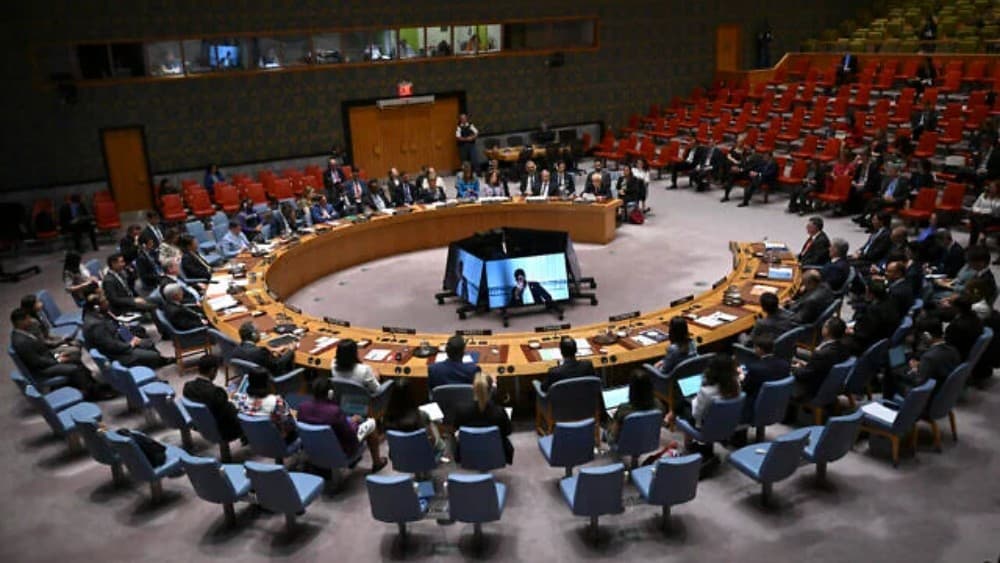
ISLAMABAD: Pakistan's Permanent Representative to the United Nations, Asim Iftikhar Ahmad, said its neighbour, a clear reference to India, has "no credentials whatsoever" to stake a claim for a permanent Security Council seat.
Speaking on Pakistan TV Digital's South Speaks with Saqib, the ambassador said countries seeking council seats face scrutiny of their voting records, their compliance with past Security Council resolutions, and their commitment to the UN Charter.
"There are several countries, including our neighbour obviously, which has no credentials whatsoever to even stake a claim for permanent membership of the Security Council," he said.
Ahmad added that the demand for new permanent seats, driven by the G4 grouping of India, Germany, Japan, and Brazil, is itself what has blocked reform for two decades.
"This is like seeking a certain privilege from this whole process. We believe that is an unjust demand, and not just unjust, it is unfeasible," he said.
He said the Council's repeated paralysis on crises such as Gaza and Ukraine comes from the positions of the five permanent members and their use of the veto.
"If the council is deadlocked often because of the positions of five permanent members, you can imagine that it will be even more deadlocked if you have eight, nine or 10 permanent members instead of the current five," he said.
Adding more veto holders, he said, means "more problems, not less problems."
‘Unilateral blocking power’
Ahmad described the veto as an "undemocratic... unilateral blocking power" that can only block decisions.
Even a permanent member needs nine affirmative votes to pass its own resolution, he said.
He outlined the alternative from the Uniting for Consensus group, which Pakistan leads alongside Italy, Canada, Turkey, South Korea, Mexico, and Argentina: ten new elected seats, creating a 25-member council where elected members outnumber permanent ones four to one.
Unwanted resolutions could still be blocked under that model, he said, by states denying the required votes together.
"It will be a majority blocking, with the majority of the members of the Security Council coming together," he said.
He said the group is open to longer elected terms of three to five years, with the possibility of re-election.
Ahmad also added that the co-facilitators of the current intergovernmental negotiations have concluded that the demand for new permanent seats "seems not realizable" and have proposed fixed longer-term regional seats instead.