


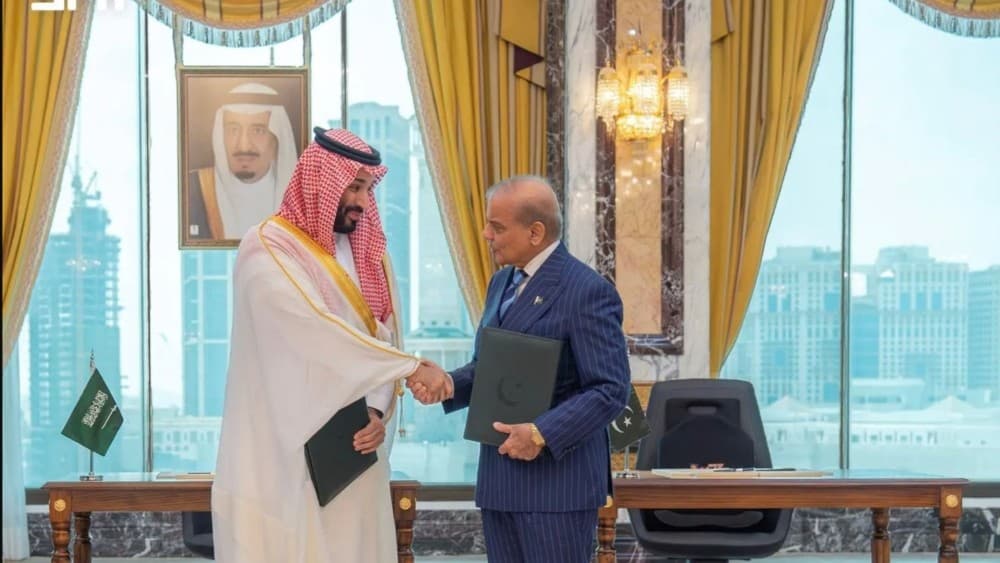
ISLAMABAD: Pakistan’s security commitments to Saudi Arabia are covered by both the Makkah Joint Defense Agreement and a separate Strategic Mutual Defense Agreement with the Kingdom, the military spokesperson said, as Islamabad maintains close coordination with Riyadh amid escalating Houthi attacks.
Lt Gen Ahmed Sharif Chaudhry, director general of Pakistan military’s media wing, Inter-Services Public Relations, told Arab News that Pakistan’s commitments to Saudi Arabia were not limited to the trilateral defense arrangement with Saudi Arabia and Türkiye.
“As for the commitments that Pakistan has made, it is part of not only the Makkah Defense Agreement, but also as part of the strategic mutual defense agreement between Pakistan and the Kingdom of Saudi Arabia,” Chaudhry said.
His remarks come amid a sharp escalation in Houthi attacks on Saudi Arabia, including an attempted drone attack near Makkah that Saudi authorities said was intercepted before entering the prohibited airspace around the holy city. Saudi authorities described the security of the Two Holy Mosques and pilgrims as a “red line.” The Houthis have denied targeting Makkah.
The latest escalation also resulted in a fatality in Taif after debris from an intercepted Houthi drone fell over the governorate. Saudi Civil Defense said the incident killed one person and injured two others, while damaging buildings and vehicles.
Long-standing Saudi partnership
Chaudhry said Pakistan’s political and military leadership remained in close contact with Riyadh as the regional crisis develops.
“The Pakistani political-military leadership remains in continuous contact and engagement with the esteemed leadership of the Kingdom of Saudi Arabia,” he told Arab News, underscoring the longstanding nature of security ties between the two countries.
Pakistan and Saudi Arabia signed their Strategic Mutual Defense Agreement in Sept 2025, formalizing a longstanding defense relationship between the two countries. Pakistan has maintained defense cooperation with Saudi Arabia for decades, including training, military exchanges and the presence of Pakistani personnel in the Kingdom.
The bilateral agreement now operates alongside the Makkah Joint Defense Agreement, signed by Pakistan, Saudi Arabia and Türkiye on Aug 7 this year. The trilateral agreement provides that an armed attack against any one of the three countries would be regarded as an attack against all, consistent with the right of individual and collective self-defense under Article 51 of the UN Charter.
Makkah framework
The three countries have since moved to institutionalize the trilateral arrangement. At the first meeting of its Strategic Political and Defense Committee in Istanbul last month, Pakistan, Saudi Arabia and Türkiye agreed to establish a Secretariat in Saudi Arabia to support work under the agreement.
The Secretariat will initially be headed by a Secretary-General from Pakistan for three years, while the three countries agreed to strengthen collective deterrence and defense, defense-industry cooperation, joint technology development and production.
The agreement has also been publicly referred to as the “Makkah Defense Alliance” by Turkish Foreign Minister Hakan Fidan following the Istanbul meeting.
Foreign Office spokesperson Ambassador Sajjad Haider Khan has described the agreement as “purely for defensive purposes,” saying it is not directed against any country and does not formally constitute a new bloc. He said its objectives include strengthening defense cooperation, training and capacity building, sharing best practices and collectively deterring acts aimed at destabilizing regional security.
Defense with diplomacy
While emphasizing its security commitments, Pakistan has continued to call for de-escalation and a diplomatic resolution to the wider regional crisis.
Chaudhry told Arab News that Pakistan was working with regional countries, partners and friends to seek a peaceful settlement.
“Pakistan, at the same time, very earnestly and sincerely keeps on working to help the other regional countries, partners, and friends to find a negotiated peaceful outcome of this complex situation,” he said.
The position has also been reiterated by Pakistan’s political leadership following the attempted attack near Makkah. Prime Minister Shehbaz Sharif condemned the incident in the strongest possible terms and said Pakistan stood “shoulder to shoulder” with Saudi Arabia in defending its sovereignty, territorial integrity and the security and sanctity of the Haramain Sharifain.
Deputy Prime Minister and Foreign Minister Ishaq Dar similarly condemned the attack as a violation of Saudi sovereignty and territorial integrity and reaffirmed Pakistan’s support for safeguarding the Two Holy Mosques and the safety of pilgrims, citizens and residents.
Islamabad has also stressed that the latest security crisis should not close the door to diplomacy.
The Foreign Office said Pakistan remained concerned about the escalation’s implications for regional peace, maritime navigation and global energy supplies, while continuing to advocate dialogue and diplomacy as the sustainable means of resolving differences.