

ISLAMABAD: Lasers sweep across a cathedral square in Kosice, Slovakia. A priest in a Roman collar drops a techno set. Thousands of young people raise their hands, not in prayer but to the rhythm. When the set ends, just before midnight, the crowd doesn't drift toward a bar. It climbs the cathedral steps, where the night began.
It would be easy to file this under novelty: a DJ-priest, a viral clip, a quirky footnote to World Youth Day. That would be a mistake. What's happening in Kosice, in temples in Fukui and in arenas in Delhi is not a marketing experiment. It's a deliberate bet, made independently by clergy across three major religions, that the fastest way back into a young man's life is through his headphones. And it's working precisely because organized religion has quietly become a gender story.
Gen Z: No religious affiliation?
Start with the numbers, because they explain why anyone is DJ-ing in a cathedral in the first place. Roughly a third of Gen Z claims no religious affiliation. But that number hides a reversal that would have been unthinkable a generation ago: young women are now more likely to be unaffiliated than young men, 36% to 32%, according to the Public Religion Research Institute. Gen Z men are also measurably more conservative than Gen Z women (31% to 23%) while young women trend liberal.
Research published by Cambridge University Press points to part of the mechanism: across the United States, Europe and Australia, young men are drifting back toward religion even as young women leave it, a shift the researchers tie to identity politics and to movements that package faith as a distinctly masculine pursuit.
Put plainly, religion is one of the few institutions where young men are currently gaining ground while young women retreat. That is not an accident that the clergy failed to notice. It's the opening they're building a soundtrack for.
Padre Guilherme Peixoto is the clearest case. A Portuguese priest and former military chaplain, he started streaming techno sets during COVID-19 lockdowns just to keep his congregation from scattering. It worked well enough that he later played to more than a million young people at World Youth Day in Lisbon, and in April, he closed a set in Buenos Aires, marking the first anniversary of Pope Francis's death. Peixoto isn't accompanying the liturgy with music. He's discovered that the rave is the recruitment funnel, and the church is the destination once the set ends.
Techno memorial services
Buddhism is running the same play with less subtlety. In South Korea, a comedian performs Electronic Dance Music (EDM) sets in monastic robes as "NewJeansNim." He isn't ordained, rather the country's largest Buddhist sect simply gave him a monastic name and its blessing, because only 8% of South Koreans in their twenties still identify as Buddhist and the math is not survivable without an intervention.
In Japan, a former DJ-turned-priest holds "techno memorial services" at a temple that predates the printing press, pairing sutra chants with beat drops for crowds that have since followed him on tour to the United States. When the export failed, Malaysia's government shut down a Kuala Lumpur show after Buddhist groups objected, and Singapore allowed the act only with the robes and chanting stripped out, it failed because the religious content survived the crossing intact enough to alarm people. That's not what a gimmick looks like. That's what a genuine evangelism strategy looks like when it meets resistance.
'Bhajan clubbing'
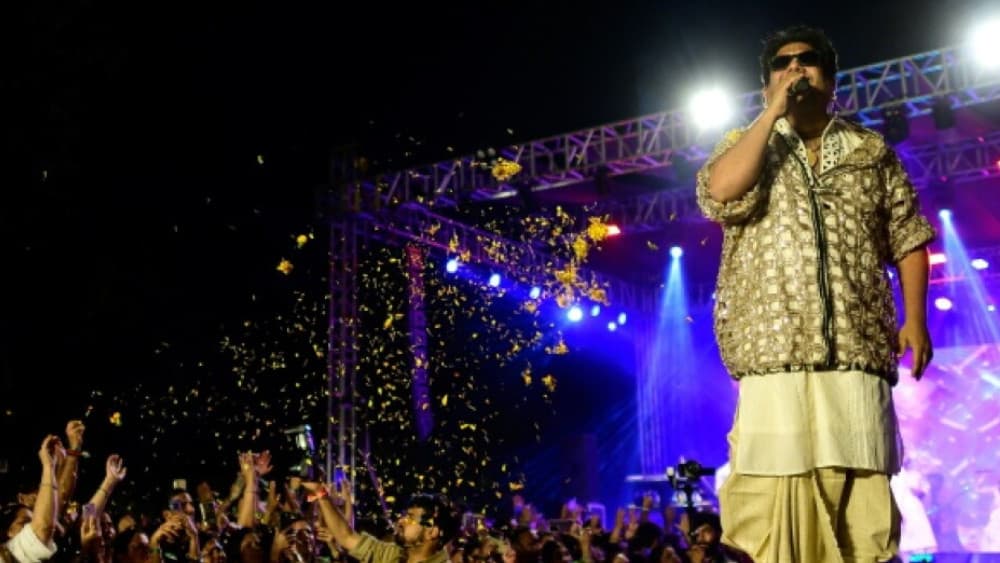
India's version, "bhajan clubbing," draws thousands into arenas to hear Sanskrit mantras over electric guitar and bass. 7,000 people at Delhi's Purana Qila fort in March and even sellout events in Nepal and Dublin. London has Ekklesia, splicing gospel lyrics into hip-hop and R&B for club crowds. Different scriptures, identical instinct: if a generation of men won't come to the sermon, bring something louder than the sermon to them, and let the sermon ride in on it.
Sense of belonging
None of this would matter much if it were only about taste in music. It matters because of who is showing up. The manosphere has spent a decade telling young men that mainstream institutions have nothing for them, no ritual, no hierarchy, no clear account of what a man is for. Religion, of all things, is answering that pitch faster than politics or culture has. A cathedral square full of hands in the air isn't just a concert. It's a group of young men being told, in a language they already speak, that structure and belonging still exist, and that this building has both.
That's worth some scrutiny, not celebration. A movement that grows by giving disaffected young men exactly what they're primed to want (belonging, hierarchy, a sense of being chosen) can just as easily curdle into the same grievance politics it claims to be an alternative to. The line between "welcoming young men back to faith" and "flattering young men's sense that the world has wronged them" is thinner than a laser show suggests, and it's a line worth watching rather than assuming away.
Back in Kosice, the crowd files up the cathedral steps in the dark, still sweating from the set. Nobody made them go to church that night. The church came to them first, wearing headphones.