

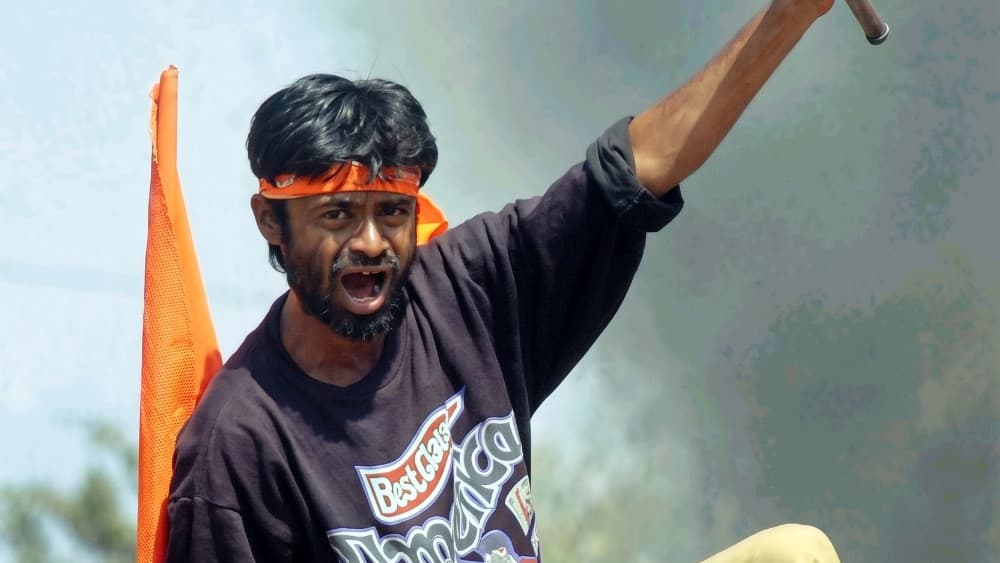
ISLAMABAD: Coordinated vigilante assaults on Muslim citizens have risen across India’s most populous state over the past 18 months, with perpetrators using similar tactics: forced religious recitation, public humiliation, and the deliberate dissemination of footage on social media to intimidate vulnerable populations.
A report compiled by Pakistan TV Digital documented six such incidents in Uttar Pradesh, a state of about 240 million people, involving at least 23 perpetrators and seven victims
In each case, victims were forced to recite “Jai Shri Ram,” a Hindu nationalist slogan. Four of the incidents were filmed and posted on social media, while five resulted in formal police complaints and three led to arrests.
The incidents unfolded in public places across the state, from markets and roads to a food-distribution site. Four were filmed and posted on social media. Five resulted in formal police complaints, known in India as First Information Reports (FIRs). Only three resulted in arrests.
Video evidence played a key role in the cases that led to arrests.
In Agra, a 57-year-old taxi driver, Raheesh Khan, was pulled from his vehicle in November 2025 and assaulted by Rohit Thakur, who slapped Khan and pulled his beard while telling him he would be forced to chant the slogan, The Times of India reported.

The attack was filmed and uploaded to social media. Agra police arrested Thakur in early December and charged him under multiple sections of the Bharatiya Nyaya Sanhita and the Information Technology Act.
Months later, in Bareilly, a migrant worker visiting from Dubai was intercepted by Hindu mobs led by Rishabh Thakur, according to the district’s police records online.
Times of India reported that the assailants accused the man of engaging in “Love Jihad,” a term used in Hindu nationalist discourse to describe an alleged campaign by Muslim men to convert Hindu women through romantic relationships.
They beat him, extorted approximately $108 and forced him to chant Hindutva slogans. Police arrested Rishabh Thakur the following day. Authorities also discovered that he was already subject to an active externment order under the Uttar Pradesh Goonda Act.
Assaults, but no cases registered
The pattern was not limited to cases that resulted in arrests.
In Mathura, five men assaulted a Muslim youth in a public market on May 14, 2025, according to The Print.
In Aligarh, a Hindu mob attacked Mohammed Mustakeem, a mosque imam, with wooden sticks on Sept 20, The Times of India reported. Mustakeem was hospitalized with severe injuries.
But the police treatment of the Aligarh case differed sharply from the circumstances surrounding the arrests in Agra and Bareilly.
According to documentation by Citizens for Justice and Peace, Aligarh police later reclassified the incident as a minor road-obstruction dispute. The case lacked video evidence, and police denied its communal dimension.
Another incident occurred in Sultanpur on June 4 this year, when a Hindu mob intercepted two cousins traveling by motorcycle, the Press Trust of India reported. Seven men beat the pair and forced them to chant the nationalist phrase. Police registered a formal complaint on June 11, charging three identified perpetrators with wrongful restraint and criminal intimidation.
In Siddharthnagar, a political official, Lavkush Ojha, withheld food from an elderly Muslim man during a public food distribution on June 17, conditioning the meal on religious chanting, according to Times Now. Video of the interaction circulated widely on social media, but it did not result in any conclusive action.
Crimes against humanity
Taken together, the six cases show a gap between the filing of police complaints and the actions that followed. Five of the cases generated FIRs, but only three resulted in arrests. Those arrests occurred in cases in which video evidence generated public pressure and media coverage.
Where there was no comparable video evidence or public attention, the response was different: charges were downgraded, or the incidents were treated as personal disputes rather than communal violence.
The cases have also attracted scrutiny beyond India. In March 2026, a panel of independent jurists supported by King’s College London concluded that patterns of vigilante harassment combined with administrative inaction may constitute crimes against humanity under international law.
That same month, UN Special Rapporteur Alice Jill Edwards documented what she described as “institutionalized extrajudicial practices” and “systematic police inaction” in Uttar Pradesh, speaking with the People’s Union for Civil Liberties.
The circulation of videos has created another problem: not every video attributed to such incidents has been correctly identified.
In May 2026, a video circulated widely as purported evidence of a forced-chanting incident in Uttar Pradesh. India Today fact-checking found that the footage originated in Hisar, Haryana.
Analysts point out that the feedback loop grows stronger with each incident, as it can generate more fear and anger, making the next incident easier to provoke.