


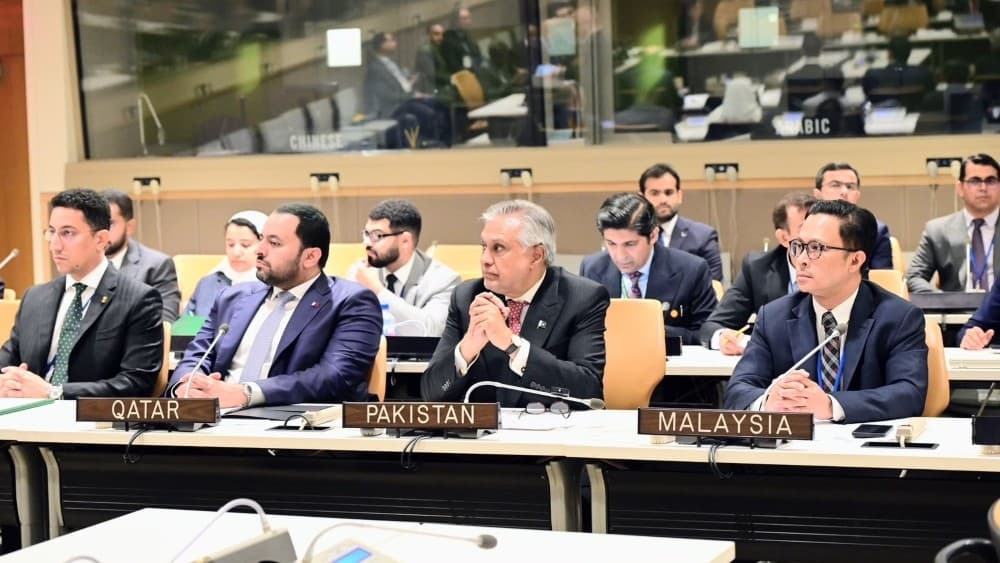
ISLAMABAD: Deputy Prime Minister and Foreign Minister Ishaq Dar on Tuesday called on the Organization of Islamic Cooperation (OIC) to press the Afghan Taliban to take concrete and verifiable steps to prevent Afghan soil from being used for terrorism against neighboring countries, particularly Pakistan.
Addressing the OIC Contact Group on Afghanistan on the sidelines of the 81st session of the United Nations General Assembly in New York, FM Dar said the OIC, as the collective voice of the Muslim world, “has a vital role in addressing the situation in Afghanistan.”
He expressed serious concern over the presence of terrorist groups in Afghanistan and recalled Pakistan's sacrifices in combating terrorism.
The foreign minister cited the recent terrorist attack in northwestern Pakistani city of Kohat as a reminder of the threat posed by terrorism emanating from the region.
Pakistan was the first country to open its doors to Afghanistan after the fall of Kabul in 2021, Dar said, recalling that Islamabad hosted the 17th Extraordinary Session of the OIC Council of Foreign Ministers on Dec 19 that year to mobilize Muslim countries' solidarity and international support for addressing the humanitarian situation in Afghanistan.
Dar said those efforts were undertaken in the expectation that the Taliban government would honor Afghanistan's international obligations and commitments, including eliminating terrorism, promoting inclusivity and protecting human rights.
“Regrettably, the expectations of the international community have remained unfulfilled,” he said.
“Resultantly, the Taliban have failed to seize the opportunity to integrate Afghanistan with the wider world and to improve the lives of the Afghan people due to their misplaced priorities and flawed ideologies,” Dar added.
Concrete action against terrorism
Dar said regional partners could help Afghanistan integrate with the international community, but the Taliban must first take steps to create a conducive environment.
“Foremost among these steps is concrete and verifiable actions to prevent Afghan soil from being used for terrorism against neighbouring countries,” he said.
The foreign minister also thanked Qatar, Türkiye and Saudi Arabia for their mediation and efforts to counsel the Taliban toward amicable solutions.
Dar called on the OIC to urge the Taliban to take action on seven key areas, including eliminating terrorism and ending patronage of terrorist groups; honoring Afghanistan's international obligations and commitments; and curbing trafficking through illegal networks involving narcotics, weapons and human trafficking.
He also called for restrictions on women and girls to be lifted where they are contrary to Islamic principles and norms of Muslim society, and urged the Taliban to reconsider policies that deny fundamental freedoms to Afghans.
Dar also referred to the 9th OIC Ministerial Conference on Women, held in Islamabad on July 12-13, which expressed concern over continued restrictions on girls' education and women's employment in Afghanistan.
He called for politically inclusive governance involving all ethnicities and minorities, as well as measures to facilitate the resettlement and integration of Afghan returnees.
“The international community also has a responsibility to share this burden,” FM Dar said, adding that no country desired normalcy and stability in Afghanistan more than Pakistan.
“No country has suffered from the consequences of instability and insecurity in Afghanistan, more than Pakistan,” he said.
Pakistan has reiterated its support for a stable and prosperous Afghanistan at peace with itself and its neighbors, while calling for adequate international funding for Afghanistan's humanitarian and socioeconomic needs.
PM Sharif holds UNGA meetings
Prime Minister Shehbaz Sharif also stepped up diplomatic engagements on the sidelines of the UNGA, meeting Kenyan President William Ruto and Kuwait's Crown Prince Sheikh Sabah Khaled Al-Hamad Al-Sabah, while holding informal meetings with Austrian Chancellor Christian Stocker and Somali President Hassan Sheikh Mohamud.
During his meeting with Ruto, PM Sharif emphasized the need to realize the potential for greater bilateral trade and investment and encouraged increased interaction between the business communities of Pakistan and Kenya.
He also highlighted Pakistan's interest in deeper engagement with the East African Community.
Ruto, according to Pakistan's official account, appreciated Pakistan's mediation role in the recent crisis involving the US and Iran.
During his meeting with the Kuwaiti crown prince, PM Sharif reviewed bilateral relations and discussed expanding cooperation in trade, investment, energy and human resource development. The two leaders also exchanged views on regional and international developments and reaffirmed their commitment to peace, stability and prosperity.
Islamabad pushes for regional diplomacy
Dar also held a series of bilateral meetings with foreign counterparts on the sidelines of the UNGA, including Japan's Foreign Minister Toshimitsu Motegi, Kuwait's Foreign Minister Sheikh Jarrah Jaber Al-Ahmad Al-Sabah, Saudi Foreign Minister Prince Faisal bin Farhan Al Saud and Libya's acting foreign minister, Al-Taher Al-Baour.
During his meeting with Motegi, the two sides discussed bilateral cooperation in trade and investment, education, health, automobiles and digital information technology, alongside regional developments and the situation in the Middle East.
Motegi appreciated Pakistan's diplomatic and mediation efforts in support of regional peace and stability, while both sides expressed hope that all parties would return to dialogue and pursue implementation of the Islamabad Memorandum of Understanding. They also discussed implications for energy supplies, supply chains and the global economy.
Dar also discussed regional developments with Kuwait's foreign minister and stressed the importance of continued dialogue and diplomacy in addressing regional issues.
In his meeting with Saudi Foreign Minister Faisal bin Farhan, FM Dar reiterated Pakistan's solidarity with Saudi Arabia and condemned recent attacks targeting the Kingdom. The two sides also discussed the Makkah Joint Defence Agreement and reaffirmed their commitment to strengthening cooperation and advancing regional peace, stability and security.
Pakistan reiterates support for Palestine
Dar also participated in the OIC Committee of Six on Palestine, where he called for “renewed and coordinated diplomatic action” to protect Palestinian rights and uphold international law.
He urged the committee to safeguard the historical and legal status quo at Al-Aqsa Mosque and other Islamic and Christian holy sites in Jerusalem, reject settlement expansion, annexationist measures, settler violence and forced displacement in the occupied Palestinian territory, including East Jerusalem.
Dar also called for the full implementation of the Gaza Peace Plan and UN Security Council Resolution 2803, saying reconstruction and governance arrangements in Gaza should remain Palestinian-led, with a central role for the Palestinian Authority.
He called for accountability for violations of international and humanitarian law and stronger coordination among OIC member states at the UN and other international forums.
“As members of the OIC Committee of Six, we have a particular responsibility to translate our collective solidarity into sustained and coordinated diplomatic action,” Dar said.
Dar reiterated Pakistan's support for an independent, sovereign and contiguous Palestinian state based on the pre-1967 borders, with Al-Quds Al-Sharif as its capital, as well as Palestine's full membership of the United Nations.
He also participated in a ministerial meeting of the Group of Eight Arab-Islamic countries, where he expressed concern over continued ceasefire violations and loss of life in Gaza and reiterated Pakistan's support for Palestinian statehood.