


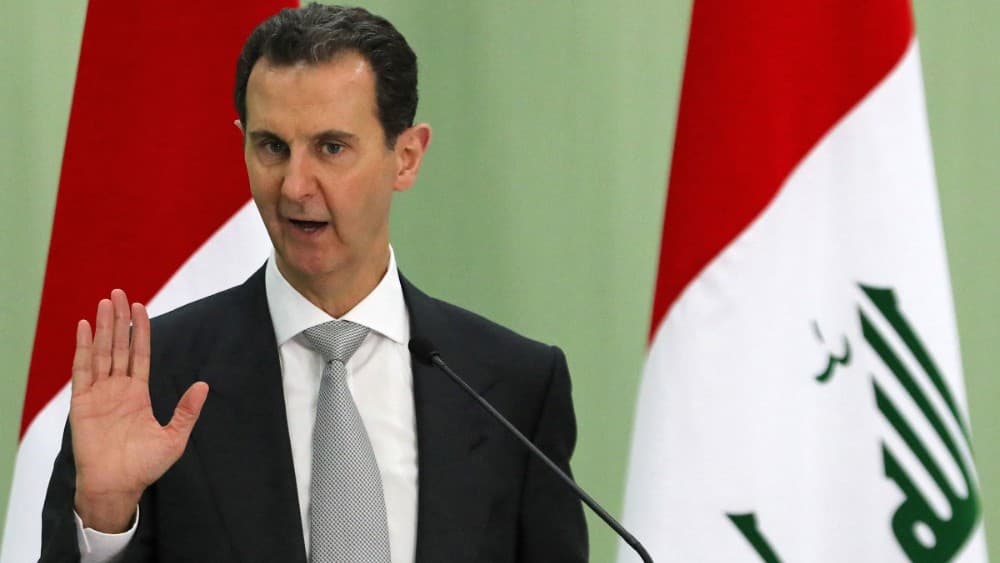
DAMASCUS: A Syrian court on Tuesday sentenced former ruler Bashar al-Assad to death after a trial in absentia, convicting him of atrocities committed during the country's nearly 14-year civil war.
It is the first such ruling under Syria's transitional leaders who ousted Assad in December 2024, vowing to provide justice and accountability for crimes committed under his rule.
Assad fled to Moscow as Islamist-led forces closed in on Damascus after a lightning offensive.
At a court in Damascus on Tuesday, Judge Fakhr al-Din al-Aryan convicted Assad of crimes including "premeditated murder, the intentional killing of more than one person, the intentional killing of children under 15 years... torture, torture leading to death, and deprivation of liberty on multiple occasions -- classified as crimes against humanity and war crimes".
"He is therefore sentenced to death," the judge said.
Syria in April began proceedings against Assad and other officials accused in person and in absentia of atrocities during the country's civil war, which erupted with brutal repression of pro-democracy protesters by the former authorities.
More than half a million people were subsequently killed and millions displaced, while tens of thousands disappeared, many into the country's prison system.
The court also sentenced six former military and security officials in absentia to death, including Assad's brother Maher, who ran the army's elite Fourth Division.
'Warmed our hearts'
Those convicted included former defense minister Fahd al-Freij and Louay al-Ali, who headed military intelligence in Daraa province in 2011.
The court convicted the officials of crimes including murder, incitement to murder, torture leading to death and repeated deprivation of liberty, also considered "crimes against humanity" and "war crimes".
Former security official Atif Najib -- the only one in the dock -- was sentenced to death for "crimes against humanity" committed when he was head of political security in Daraa province, the cradle of Syria's uprising.
A cousin of Assad who was arrested in January last year, Najib was convicted of crimes including "the intentional killing of children under 15", and "torture leading to death".
Aryan said Najib had denied the charges and showed "no remorse".
An AFP correspondent saw dozens of people gathered at the courthouse for the ruling, many from Daraa province and some holding pictures of loved ones they said had disappeared or were imprisoned under those on trial.
Ramzi Abu Naboud was carrying a picture of his brother Ahmed, who was killed when Assad's authorities broke up a sit-in at Daraa's Al-Omari mosque in 2011.
"Thank God and thanks to the judiciary, today we have obtained a judgement that has warmed our hearts," even if it will not bring back those who were killed, he said.
'A test'
Syrian Justice Minister Mazhar al-Wais told state television that the rulings would be referred to Syria's court of cassation for a final decision, adding that defendants had the right to appeal within 30 days.
In a series of trial sessions held since late April, the court heard from witnesses and was presented with documents, images and at times classified information, while the judge's statements were sometimes televised.
Human Rights Watch, which attended several of Najib's hearings, called his case and other proceedings "a test of Syrian authorities' efforts to pursue credible justice for Assad-era abuses".
"Criminal proceedings need to meet international fair trial standards. That also means abolishing the death penalty," HRW's Balkees Jarrah said in a statement, urging authorities to "adopt a transitional justice law that sets out a clear legal process for these cases."
Syria's national commission for transitional justice called the ruling against Najib "an important milestone in the process of accountability for grave crimes."
Syria's uprising against Assad began in Daraa in March 2011, after 15 students were arrested for allegedly writing anti-government slogans on the city's walls.
Residents said the students were tortured, leading to a protest demanding their release that ended in bloodshed.
Security personnel suppressed peaceful demonstrations with force and fired live ammunition to disperse sit-ins at several locations.
Najib was dismissed after the crackdown, as the protests spread to other provinces.
The Assad family ruled Syria for more than five decades, with Bashar taking the presidency in 2000 after the death of his father, Hafez al-Assad.