


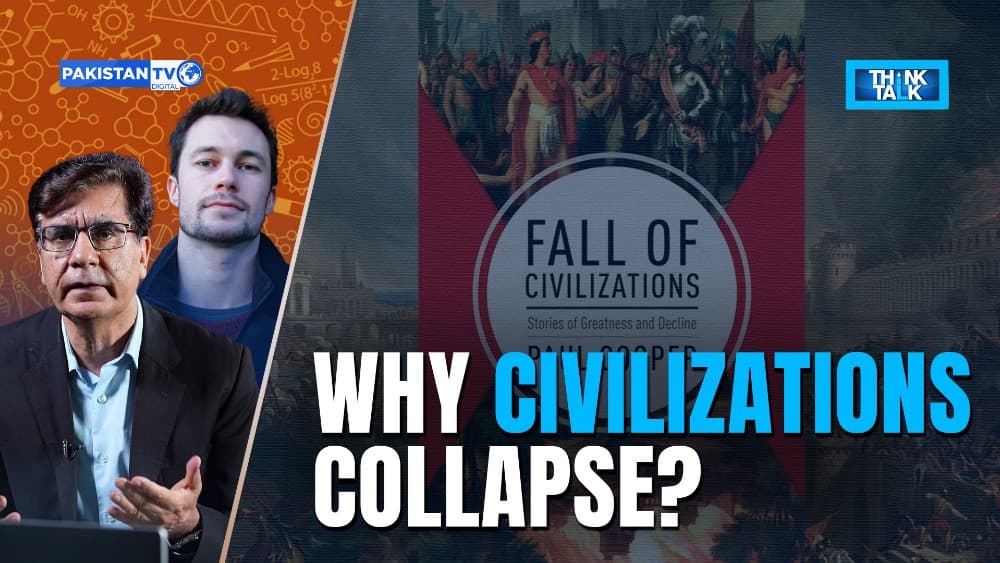
ISLAMABAD: Most of us assume the world we live in is permanent. The historian Paul Cooper has built a career on evidence that it is not.
For six years, the British historian and novelist has been telling the story of how civilizations end. His podcast and YouTube series "Fall of Civilizations" has drawn millions into the last days of the Sumerians, the Maya, the Khmer, and Byzantium. Elon Musk described it as his favorite podcast.
In an interview with Pakistan TV Digital's show "Think Talk with Zafar," Cooper explained why he is drawn to the fall rather than the rise, what the ruins can teach the present, and why the civilization that flourished on the Indus is the one story he cannot tell.
.jpg)

His interest is not morbid. "I try to look at the collapse of various societies throughout history as much a part of our human history as all of the great monuments and exalted epics that we prize," he said, "and there's a huge amount to learn from these stories too."
There is urgency in it too. In an age facing what he calls perhaps the greatest number of challenges humanity has ever faced, the question of what lets a society survive is no longer academic. But he admits to a certain poetics as well.
"These are stories of people's world coming apart," he said, "often worlds that they've completely taken for granted, just as we take our modern world for granted around us."
The one story he cannot tell
For Pakistani viewers, the most pointed moment came when Cooper was asked why the series has never devoted an episode to the Indus Valley, a civilization of monumental cities that flourished on this land and fell to ruin some 4,000 years ago.
He replied that the Indus Valley Civilization looks like "a classic story of environmental change," perhaps a series of droughts that emptied the cities.
The obstacle is evidence of a particular kind. Cooper builds his episodes on primary sources, using voice actors to read aloud what these societies wrote about themselves. For Sumer, that material is abundant: ration lists, poetry, the Epic of Gilgamesh. "We can hear the voices of Sumerians," he said.
The Indus script has never been deciphered. Without it, there are no voices, only sites and artifacts.
"I really want people to hear the voices of people, how they experienced life, what they imagined, their myths, the names of their kings," he said. "So the Indus Valley civilization, although it's a very fascinating story, I think it's not one that I could successfully tell."
The pattern, and the warning
Across dozens of collapses, Cooper sees no single cause, but rather recurring themes, the one above all being rapid environmental change. A society, he argues, sits somewhere between a machine and a biological organism, adapted to survive in one particular environment.
"If the environment changes too rapidly, then just like a biological organism, a society may fail to adapt and may face a period of extinction."
Drought runs through case after case. In the Yucatan, a 200-year drought emptied more than 40 Maya cities. Others were simply outmatched, like Carthage, or made so many enemies that their neighbors united against them, like Assyria. As the saying goes, he observed, history does not repeat itself, but it sometimes rhymes.
The lesson for our own century is uncomfortable. We like to pretend, he said, that societies no longer depend on their environments, even as biodiversity collapses and the climate warms. But he draws one sharp distinction between us and the Sumerians or the Maya: they never saw it coming.
"We have the immense privilege of being able to prepare and adapt," he said. "But the question is whether we have the will."
Saying no to Elon Musk
In 2023, Cooper turned down an offer from Elon Musk to host the series on X, and does not regret it.
He described Musk as "a ridiculous figure and a very troubled man" whose political involvement is "extremely harmful to the world," and far more likely to be "the kind of foolish figure who causes the collapse of a society than someone who prevents it."
That one man could amass such wealth, he added, is "an enormous flashing red warning sign that the economic system, as we've designed it, is not working."
Their hands reaching out to ours
Asked for the single lesson he would want a viewer to take with them, Cooper pointed first to leadership, the foolishness of rulers and "their inability to listen to their people."
But his real answer was gentler. The feeling that we live in uniquely chaotic times, he said, is not at all modern. It is ancient. People throughout history wrote down the same fear, the same sense that nothing was certain.
"When we read these things, we can feel their hands reaching out to ours," he said, "that we can feel like we're not alone in that feeling."
That connection, he believes, is something we can use "to energize and steel ourselves for the century to come."