


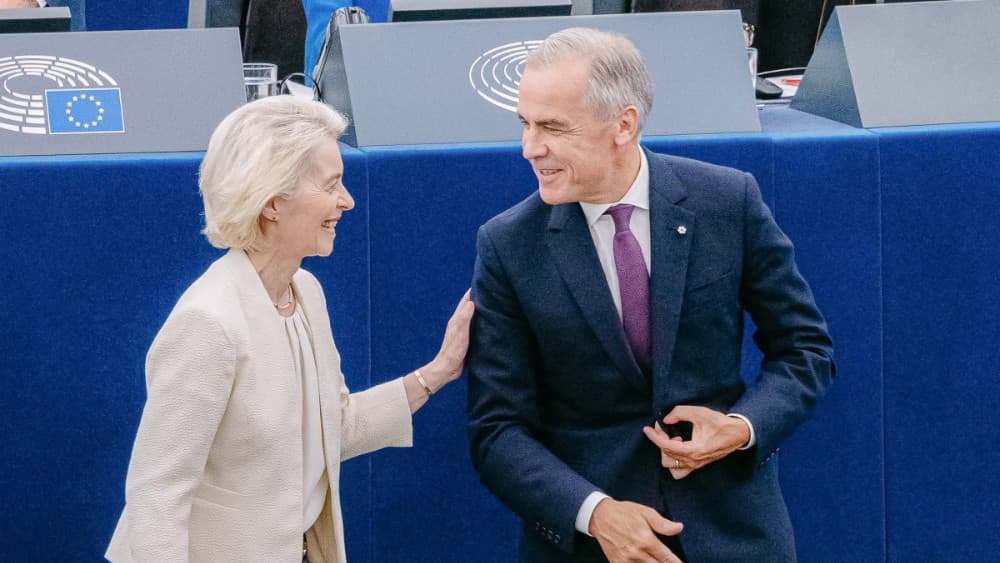
ISLAMABAD: The President of the European Commission Ursula von der Leyen proposed opening the door for Canada to become the first associate member of the European Union during her 2026 State of the European Union address on Wednesday, marking a significant expansion of ties between the bloc and its North American ally.
Von der Leyen made the announcement with Canadian Prime Minister Mark Carney present at the European Parliament. She said the partnership would elevate the relationship "to the highest level possible" and create "a common prosperity and economic security space."
Under the proposed alliance, the two would work on intelligent manufacturing, create a tech alliance, integrate defense industrial bases, and make the Arctic a flagship joint project. They would also collaborate on energy, critical minerals, batteries, artificial intelligence, quantum computing, cybersecurity and economic security.
"We share one ocean, one set of values, one way of seeing the world. And we will now build our shared future as well," von der Leyen said.
The move comes as trade between the EU and Canada has grown 75% in less than a decade under their existing CETA trade agreement, according to the commission president.

Von der Leyen stated that the partnership was not directed against any other nation but rather aimed at strengthening shared democratic values. "Europe and Canada believe in democracy," she said. "We believe that power does not belong to the strongest, the richest or the loudest — but to all of us."
The commission president also announced sweeping priorities for European independence and resilience. She called for completing the “Single Market,” reducing administrative burdens, securing affordable energy and limiting strategic dependencies on foreign powers.
On climate change, von der Leyen cited a devastating summer of wildfires and heatwaves across Europe and announced a new framework for climate resilience, a European Heatwave Plan and a new European Water initiative.
Regarding artificial intelligence, von der Leyen stated that responsible development and proposed partnering with like-minded countries including Canada and the United Kingdom was needed on model evaluation, verification and security.
Von der Leyen stated that the EU stood with Ukraine and announced a new European Instrument for Strategic Enablers to develop critical defense support assets aligned with NATO. She also proposed an “Emergency Security Protocol” to coordinate European responses to hybrid threats.
The EU president also announced the “EU Kids Act” to protect children online, banning social media access for those under 13 and restricting personal accounts for those aged 13 to 15.
She concluded her speech by announcing a new Congress of Europe to mark the upcoming 70th anniversary of the Treaty of Rome.