


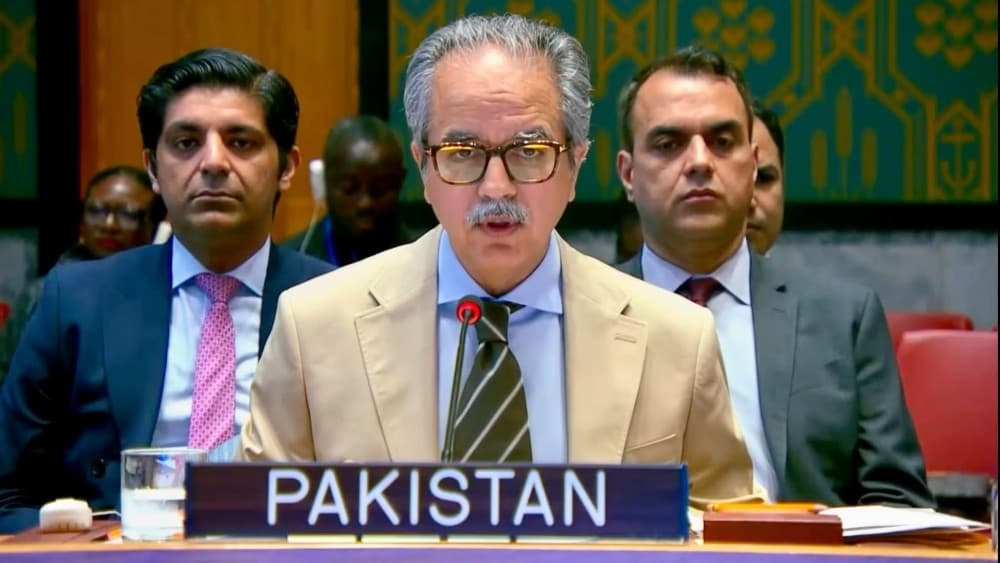
ISLAMABAD: Pakistan’s Permanent Representative to the UN, Ambassador Asim Iftikhar Ahmad, has said that Islamabad remained committed to working with all partners for durable peace and stability in Afghanistan and the welfare of its people.
While speaking at the meeting of the UN Security Council on the situation in Afghanistan, the ambassador said that Pakistan has made rigorous efforts to help ameliorate the suffering of Afghans despite reservations with regard to certain policies of the Taliban.
“Pakistan abided by its international commitments to allow unhindered humanitarian aid to Afghanistan,” he said.
“We agree with the assessment that the risks associated with human rights violations, lack of political inclusivity, acute economic pressure, and the increasing terrorist threat from Afghanistan are a cause of grave concern for the international community,” he added.
The ambassador said that most indicators in Afghanistan present a declining trend.
“Afghanistan has once again become a safe haven for numerous terrorist groups operating with impunity from its soil,” he said.
He said that terrorism was at the core of Afghanistan’s problems, finding its roots in the deep nexus between the Taliban and terrorist groups such as the Tehreek-e-Taliban Pakistan (TTP), the Baloch Liberation Army (BLA), etc.
“Over the last three years alone, more than 4,700 innocent Pakistanis have lost their lives to terrorism emanating from Afghanistan,” he said, adding that Islamabad expected that the Taliban would take concrete and verifiable actions against terrorist groups.
“Regrettably, they failed to act in complete disregard for the legitimate security concerns of Pakistan and other countries,” he said.
“Taliban's refusal to publicly denounce and condemn terrorist groups is evidence enough of their complicity and active support for these groups,” he added.
The ambassador said that Islamabad will not sit idle in the face of this terrorist onslaught.
“We will respond in self-defense, as and when needed and in accordance with international law,” he said.
He said that deteriorating humanitarian, human rights situation also demonstrated the Taliban’s continued backtracking on their international obligations.
“Women and girls are denied their fundamental freedoms and basic dignity, with discriminatory and abusive practices that contravene Islamic laws, traditions, and tenets of Muslim faith,” he said.
Reminding the council about Pakistan’s efforts to facilitate vulnerable Afghans, the ambassador said that the international community must step up and shoulder its responsibility.
“We look forward to the next steps of the UN-led Doha Process and action plan, the Mosaic approach, to address Afghanistan's multifaceted challenges comprehensively, with well-defined objectives and a realistic roadmap as the only viable pathway for normalization,” he said.