


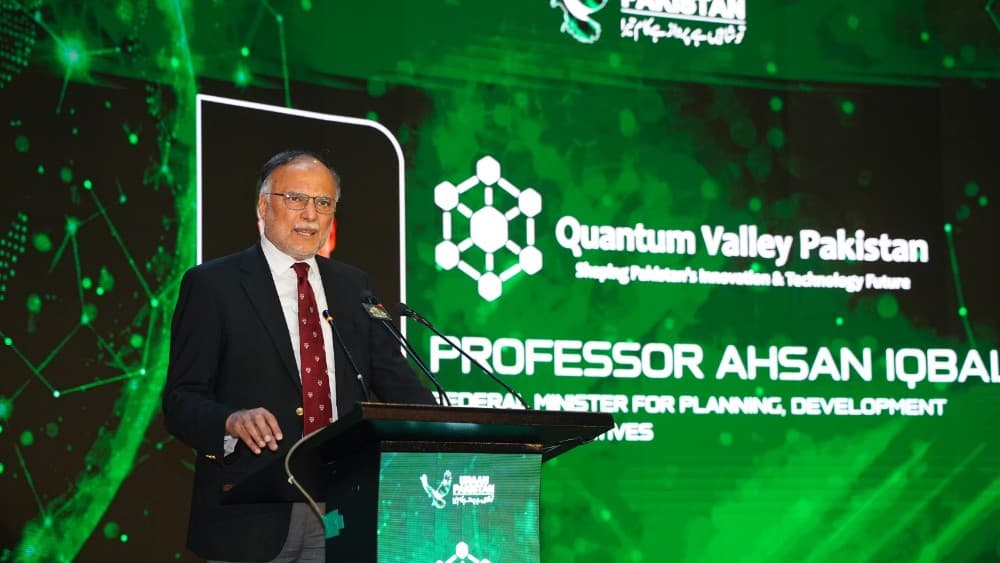
ISLAMABAD: Pakistan has launched a new technology and innovation center to link young people and startups with international technology hubs, the Ministry of Planning, Development and Special Initiatives said.
Speaking at the launch of Quantum Valley Pakistan in Islamabad on Wednesday, Planning Minister Ahsan Iqbal said the initiative would create opportunities for startups and high-tech businesses and connect Pakistani youth with global innovation networks.
“Today is not merely the inauguration of a project; it marks the beginning of a new direction for Pakistan’s future,” he said.
Two agreements were signed at the ceremony, one between Quantum Valley Pakistan and Cambridge Innovation Center (CIC), and another with Plug and Play, to support technological cooperation and Pakistan’s startup ecosystem.
CIC chief executive Tim Rowe, CIC partner Dougan Sherwood and Plug and Play managing partner Seena Amidi attended the event, according to the statement.
Iqbal said Pakistan’s large young population offered significant economic potential but needed to be better connected to technology and innovation.
“Pakistan’s youth can earn millions of dollars in foreign exchange for the country through knowledge and technology,” he said.
He said the government wanted to move young people beyond being “merely job seekers” and help them become entrepreneurs and contributors to the technology economy.
'Targeting trillions'
Iqbal said Pakistan was targeting a $1 trillion economy by 2035 and $3 trillion by 2047, while aiming to increase exports to $100 billion by 2035.
“Achieving a $1 trillion economy by 2035 is certainly difficult, but it is not impossible,” he said.
Pakistan, with a population of around 260 million, needed to develop the capacity to generate at least $400 billion a year in foreign exchange, the statement said.
“The center of power in the 21st century is no longer physical strength,” Iqbal said. “It is intellectual and creative capability.”
He pointed to technology centers established in 2017 in areas including artificial intelligence, big data, cybersecurity, robotics, space technology and genomics, saying they had helped build links between universities and the technology sector.
The government’s URAAN Pakistan program had further accelerated the country’s technology drive since 2024, he said.
Iqbal said Pakistan needed to increase exports and build economic strength to support its long-term development.
“Pakistan needs a strong economic future for its young generation, not turmoil on its streets.”
“Our objective is to enable Pakistan to achieve a leading position in technology and innovation globally,” he added.