


ISLAMABAD: Beoga, a traditional Irish folk band from County Antrim, Northern Ireland, withdrew from Ed Sheeran's US Loop Tour after the American rapper Macklemore was removed from the lineup for delivering an onstage speech supporting Palestinian liberation.
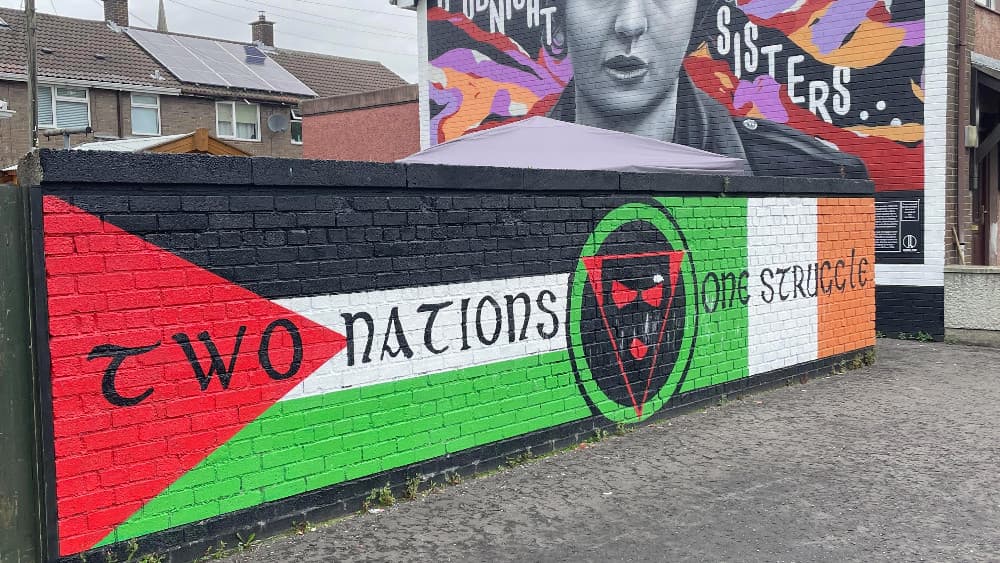
The band's departure marked the latest expression of a decades-long Irish commitment to Palestinian solidarity rooted in shared experiences of colonialism and displacement.
Macklemore gave remarks advocating "Free Palestine" and Gaza at MetLife Stadium before tour promoters and stadium owners dropped him from the remaining dates. Beoga, which served as Sheeran's official live backing band, announced they could not perform in venues that silence artists advocating for Palestinian rights.
In their Instagram statement, the band cited their membership in Irish Artists for Palestine and Ireland's historical experience under English colonial rule. "We are Irish people who understand colonialism," Beoga wrote, adding that playing in spaces that suppress Palestine advocacy was "simply not an option."
The band acknowledged their decade-long friendship with Sheeran and the magnitude of the stadium tour opportunity.
Support acts Aaron Rowe, Finneas and Lukas Graham also withdrew in solidarity.


That commitment to Palestine extends far beyond concert boycotts. According to Marie-Violaine Louvet's analysis in the Palestine Studies journal, the Republic of Ireland became one of the first Western European nations to recognize the Palestine Liberation Organization as the legitimate Palestinian representative by 1974. As early as 1937, Irish leader Éamon de Valera opposed the partition of Palestine at the League of Nations, arguing against displacing Palestinian.
The trajectory accelerated through subsequent decades. As per Louvet's research, on February 10, 1980, Ireland became the first European Economic Community country to officially recognize Palestinians' right to self-determination and statehood. The Bahrain Declaration, signed by Irish Minister for Foreign Affairs Brian Lenihan and Bahraini Minister Muhammad Bin Mubarak Al Khalifa, formalized this position. Louvet's work notes that in 1985, the PLO set up a Palestine Information Office in Dublin.
According to Stuart C Aveyard's article "Northern Ireland, Israel-Palestine and the use of other conflicts, 1970–86," published in Historical Research in 2023, Irish-Palestinian solidarity is structurally rooted in what scholars call "anti-colonial memory." Aveyard's research demonstrates that both populations endured shared experiences of forced displacement, land confiscation and cultural suppression. Both experienced violent dispossession by colonial powers and attempts to erase native languages and traditions.
Between the 1970s and 1980s, according to Aveyard's findings, Irish republicans and Palestinian fighters forged direct organizational ties, with some Irish volunteers training alongside Palestinian forces in Lebanon. British officials investigating claims of coordinated activity ultimately concluded the relationship was "more imagined than real" but "no less meaningful" to those involved.
Modern Irish activism intensified with Israel's military campaigns. During the 2008-09 Israel military campaign in Gaza, Irish activists participated in Freedom Flotillas in 2010 and 2011 attempting to break the blockade. In 2011, Ireland voted to make Palestine a full UNESCO member.
Under Ireland's 2013 European Union presidency, as reported by Louvet, the bloc excluded Israeli settlements from new trade treaties. In 2014, the Irish parliament voted to officially recognize Palestinian statehood. Two years later, lawmakers passed legislation prohibiting trade with illegal settlements.
According to Brendan Ciarán Browne's research on Irish solidarity activism, the Irish Congress of Trade Unions became the first European trade union federation to support Boycott, Divestment and Sanctions against Israel in 2007. Dozens of Irish civil society organizations, from sports associations to cultural groups, have rallied behind Palestinian causes since then.
On May 28, 2024, the Republic of Ireland granted official recognition to the Palestinian state. In December, it joined South Africa's genocide case at the International Court of Justice.
For Beoga and thousands of Irish activists, this trajectory represents consistency rather than novelty. It is a decades-long commitment to supporting colonized peoples that connects present actions to historical struggle.